• Fri frakt över 249 kr
  • •
  • Snabba leveranser
  • •
  • Billiga böcker
Kundservice

Du är på sajten för privatpersoner.

Företag, bibliotek eller offentlig verksamhet?

Du handlar på classic.bokus.com, där alla dina funktioner finns intakta.
Till classic.bokus.com
Bokus logotyp. Gå till startsidan.
  • Erbjudanden
  • Nyheter
  • Student
  • Topplistor
  • Barn & ungdom
  • Bokus Play
  • E-böcker
  • Pocketböcker
  • Spel & pussel

10% rabatt på allt med kod: NYSTART10 →

Sidfot

Mina sidor

    Hjälp

    • Kundservice
    • Vanliga frågor och svar
    • Frakt och leverans
    • Retur vid ångerrätt
    • Reklamera vara
    • Betalning
    • Köpvillkor
    • Allmänna villkor
    • Information om webbplatsens tillgänglighet

    Om Bokus

    • Om oss
    • Pressrum
    • För studenter
    • För företag
    • För bibliotek och offentlig verksamhet
    • För leverantörer
    • Hållbarhet

    Populärt

    • Aktuella erbjudanden
    • Presentkort
    • Studentlitteratur
    • Nya böcker
    • Topplistor
    • Signerade böcker
    • Engelska böcker

    Inspiration

    • Boktips
    • BookTok
    • Populära bokserier
    • Barnbokskaraktärer
    • Populära författare
    Logotyp för Bokus
    Följ oss på Facebook (extern länk)Följ oss på Instagram (extern länk)Följ oss på YouTube (extern länk)Följ oss på TikTok (extern länk)
    bokus @ CookiesAnpassa cookiesIntegritetspolicyKöpvillkor
    Till Citymail hemsida (extern länk)Till Budbee hemsida (extern länk)Till Postnord hemsida (extern länk)Till Schenker hemsida (extern länk)Till Early Bird hemsida (extern länk)Till Walleys hemsida (extern länk)
    1. Ekonomi och Ledarskap
    2. Företagsekonomi
    3. Entreprenörskap

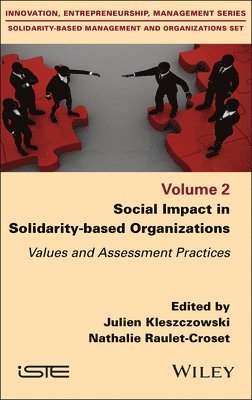
    Social Impact in Solidarity-based Organizations

    Values and Assessment Practices

    AvJulien Kleszczowski,Julien Kleszczowski

    Inbunden, Engelska, 2025

    Del i serien ISTE Invoiced

    1 772 kr

    Beställningsvara. Skickas inom 5-8 vardagar. Fri frakt över 249 kr.

    Beskrivning

    In recent years, social impact assessment (SIA) has become an important issue for organizations in the social and solidarity economy (SSE). SIA refers to the measurement of the effects of these organizations on society, and it is increasingly seen as a performance measurement for this type of organization.Social Impact in Solidarity-based Organizations is based on a series of original case studies of SIA approaches carried out in a variety of organizations. It takes a nuanced, reflective look at SIA, charting a path between unreserved promotion and wholesale rejection of the very principle of the approach. The book focuses on the debates, uses and limits of SIA practices, placing them in their own contexts, values, challenges and objectives.

    Produktinformation

    • Utgivningsdatum:2025-06-26
    • Mått:156 x 234 x 13 mm
    • Vikt:581 g
    • Format:Inbunden
    • Språk:Engelska
    • Serie:ISTE Invoiced
    • Antal sidor:208
    • Förlag:ISTE Ltd and John Wiley & Sons Inc
    • ISBN:9781786309754

    Utforska kategorier

    • Entreprenörskap inom Ekonomi och Ledarskap
    • Ledarskapsböcker inom Ekonomi och Ledarskap

    Mer om författaren

    Julien Kleszczowski is Senior Lecturer of Management Science at IAE Lille (LUMEN Laboratory), University of Lille, France, where he heads up the master's degree program in Management of SSE Organizations. His thesis focused on social impact assessment of non-profit organizations.Nathalie Raulet-Croset is Professor at the IAE Paris-Sorbonne (IAE Paris-Sorbonne Lab), Panthéon-Sorbonne University, France, where she heads up the mutations anticipations innovations chair and the executive master's degree program in Management of Non-profit Organizations.

    Innehållsförteckning

    • Introduction ixJulien KLESZCZOWSKI and Nathalie RAULET-CROSETChapter 1. Co-Construction of an Assessment Process by and for Organizations in the Social and Solidarity Economy 1Charlotte MOREAU, Helena SADZOT and Sybille MERTENS1.1. Introduction 11.2. Contextualization 21.3. The VISES project 31.3.1. Description of the VISES project 31.3.2. Choice of the action research approach 51.4. Action research project outcome: a social impact assessment process 81.4.1. A three-step process 91.4.2. Specific characteristics of the VISES social impact assessment process 141.5. Conclusion 221.6. References 24Chapter 2. Appropriate and Appropriated Social Impact Monitoring Tools for Social Enterprises 27Coralie HELLEPUTTE and Odile DAYEZ2.1. Introduction 272.2. Literature review 282.2.1. Management tools in the social impact assessment of social enterprises 282.2.2. The tensions around management tools in social enterprises 292.2.3. The opportunities of management tools in social enterprises 302.2.4. The appropriation of management tools in social enterprises 312.3. Methodology 332.3.1. The case study 332.3.2. Data collected 332.3.3. Analytical frameworks 342.4. Presentation and analysis of the tool 352.4.1. The context of the introduction of the social impact reporting tool 352.4.2. The (initial) process of co-constructing the tool 382.4.3. Content and actual use of the tool 392.5. Discussion: lessons learned about appropriation of the tool 422.6. Conclusion 452.7. References 46Chapter 3. Assessment as a Socio-Political Compromise: Case Study of a Crèche Chain 51Marion STUDER3.1. Introduction 513.2. Assessment conventions in the social and solidarity economy 523.2.1. The theoretical framework of the economics of conventions 523.2.2. The "managerial" and "deliberative" assessment conventions 543.3. Social impact assessment at Berceau 583.3.1. A chain of parental crèches "not like the rest" 583.3.2. Composite organization of Berceau’s assessment 613.4. Conclusion 693.5. References 70Chapter 4. Assessment Logics of Social Innovation Projects: Case Study of a Social Impact Bond 73Adrien BAUDET, Mathias GUÉRINEAU and Julien KLESZCZOWSKI4.1. Introduction 734.2. The issues at stake in assessing social innovation from a perspective of funding and upscaling 754.2.1. An innovative tool for funding social innovation: SIBs 754.2.2. Assessing the social impact of social innovation projects 774.3. Research methodology and empirical context 784.3.1. Research methodology 784.3.2. The SIB between Jobactive and the various stakeholders 794.3.3. The various steps in the construction of the SIB 824.4. The construction of a social impact assessment process in the context of an SIB 834.4.1. The functions of the mechanism: the objectives of the process 844.4.2. Criteria and indicators: how to measure the achievement of objectives 844.4.3. Contractual objectives of the SIB 854.4.4. Definition of the target audience 864.4.5. Methods of collecting the data required for the assessment 884.5. Case study analysis: an imbalanced assessment 894.5.1. An assessment that does not fully address the relevant issues 894.5.2. The reasons for the imbalance in the assessment process 904.5.3. Two different assessment logics 924.6. Conclusion 934.7. References 94Chapter 5. Social Impact Assessment in an Environment of Extreme Poverty: The Case of Access to Drinking Water 99Guillaume MARTIN and Thierry CÔME5.1. Introduction 995.2. The challenge of assessing the impact of a social enterprise in an environment of extreme poverty 1015.2.1. Multidimensional poverty: "Think about it three times" 1015.2.2. A complex impact assessment process 1045.3. The social enterprise 1001fontaines in rural Cambodia 1055.3.1. Presentation of the social enterprise 1001fontaines in Cambodia 1055.3.2. 1001fontaines’ environment in Cambodia 1085.3.3. Safe drinking water access in rural areas and systemic impact on poverty 1095.4. Assessing the social impact of 1001fontaines in Cambodia 1115.4.1. A diversity of partners and operational difficulties in conducting the assessment 1115.4.2. The economic impact assessment: socially effective and sustainable microenterprises in Cambodia's villages 1125.4.3. Impact assessments on health and absenteeism 1155.4.4. Occurrence of natural disasters and importance of assessing the model's resilience to climate change 1165.5. Discussion 1205.6. Conclusion 1215.7. References 122Chapter 6. Assessing SSE Organizations: A Relational Approach Constitutive of Value 127Elena LASIDA, Hélène DUCLOS, Augustin GILLE, Julien KLESZCZOWSKI, Juliana LIMA and Emmanuelle BRIAND6.1. Introduction 1276.2. The limits of existing approaches to assessing social impact 1296.2.1. An instrumental rationality conveyed by the existing approaches to social impact assessment 1296.2.2. The rationale underlying SSE organizations: a combination of instrumental action and constitutive action 1306.3. The assessment of SdC's social impact 1316.3.1. Case study: the social impact assessment process of the SdC association 1326.3.2. Phase one of the process: qualification of the social impact of SdC via the definition of a core value 1346.3.3. Phase two of the process: quantification of the social impact of SdC 1406.3.4. Phase three of the process: learning strategy -- appropriation of the outcomes by SdC 1426.4. Approaching assessment through relational value 1436.4.1. Social impact: a relational conception of value 1446.4.2. The assessment method implemented: ingredients of a socio-anthropological approach 1476.5. Conclusion 1516.6. References 153List of Authors 157Index 159