• Fri frakt över 249 kr
  • •
  • Snabba leveranser
  • •
  • Billiga böcker
Kundservice

Du är på sajten för privatpersoner.

Företag, bibliotek eller offentlig verksamhet?

Du handlar på classic.bokus.com, där alla dina funktioner finns intakta.
Till classic.bokus.com
Bokus logotyp. Gå till startsidan.
  • Erbjudanden
  • Nyheter
  • Student
  • Topplistor
  • Barn & ungdom
  • Bokus Play
  • E-böcker
  • Pocketböcker
  • Spel & pussel

10% rabatt på allt med kod: NYSTART10 →

Sidfot

Mina sidor

    Hjälp

    • Kundservice
    • Vanliga frågor och svar
    • Frakt och leverans
    • Retur vid ångerrätt
    • Reklamera vara
    • Betalning
    • Köpvillkor
    • Allmänna villkor
    • Information om webbplatsens tillgänglighet

    Om Bokus

    • Om oss
    • Pressrum
    • För studenter
    • För företag
    • För bibliotek och offentlig verksamhet
    • För leverantörer
    • Hållbarhet

    Populärt

    • Aktuella erbjudanden
    • Presentkort
    • Studentlitteratur
    • Nya böcker
    • Topplistor
    • Signerade böcker
    • Engelska böcker

    Inspiration

    • Boktips
    • BookTok
    • Populära bokserier
    • Barnbokskaraktärer
    • Populära författare
    Logotyp för Bokus
    Följ oss på Facebook (extern länk)Följ oss på Instagram (extern länk)Följ oss på YouTube (extern länk)Följ oss på TikTok (extern länk)
    bokus @ CookiesAnpassa cookiesIntegritetspolicyKöpvillkor
    Till Citymail hemsida (extern länk)Till Budbee hemsida (extern länk)Till Postnord hemsida (extern länk)Till Schenker hemsida (extern länk)Till Early Bird hemsida (extern länk)Till Walleys hemsida (extern länk)
    1. Naturvetenskap och teknik
    2. Matematik och naturvetenskap
    3. Kemi

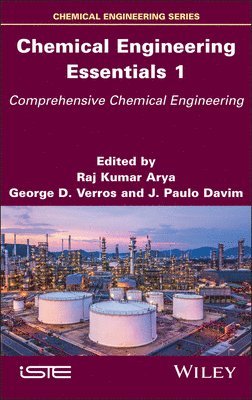
    Chemical Engineering Essentials, Volume 1

    Comprehensive Chemical Engineering

    AvRaj K. Arya,Raj K. Arya

    Inbunden, Engelska, 2025

    Del i serien ISTE Invoiced

    1 731 kr

    Beställningsvara. Skickas inom 5-8 vardagar. Fri frakt över 249 kr.

    Beskrivning

    In an era of rapid innovation and with a focus on sustainability, Chemical Engineering Essentials provides a definitive guide to mastering the discipline. Divided into two volumes, this series offers a seamless blend of foundational knowledge and advanced applications to address the evolving needs of academia and industry.This volume lays a strong foundation with topics such as material and energy balances, thermodynamics, phase equilibrium, fluid mechanics, transport phenomena, and essential separation processes such as distillation and membrane technologies.Volume 2 builds on these principles, delving into reaction engineering, reactor modeling with MATLAB and ASPEN PLUS, material properties, process intensification and nanotechnology. It also addresses critical global challenges, emphasizing green chemistry, waste minimization, resource recovery, and workplace safety.Together, these volumes provide a holistic understanding of chemical engineering, equipping readers with the tools to innovate and lead in a dynamic and sustainable future.

    Produktinformation

    • Utgivningsdatum:2025-07-03
    • Mått:156 x 234 x 25 mm
    • Vikt:851 g
    • Format:Inbunden
    • Språk:Engelska
    • Serie:ISTE Invoiced
    • Antal sidor:464
    • Förlag:ISTE Ltd and John Wiley & Sons Inc
    • ISBN:9781786309846

    Utforska kategorier

    • Kemi inom Naturvetenskap och teknik
    • Tillverkningsteknik inom Naturvetenskap och teknik

    Mer om författaren

    Raj Kumar Arya works at the Dr. B. R. Ambedkar National Institute of Technology in Jalandhar, India.George D. Verros works in the Public Sector in Thessaloniki, Greece.J. Paulo Davim works at the University of Aveiro in Aveiro, Portugal.

    Innehållsförteckning

    • Preface xvRaj Kumar ARYA, George D. VERROS and J. Paulo DAVIMPart 1. Fundamental Principles 1Chapter 1. Overview of Chemical Engineering 3Devyani THAPLIYAL, Kshitij TEWARI, Chitresh Kumar BHARGAVA, Avinash CHANDRA, Pramita SEN, Rahul KUMAR, Amit K. THAKUR, George D. VERROS and Raj Kumar ARYA1.1. Introduction 31.2. History of chemical engineering 41.3. Chemical engineering profession 51.4. Features and challenges in chemical engineering 61.5. Conclusions 141.6. References 15Chapter 2. Fundamentals of Material and Energy Balances 17Kshitij TEWARI, Devyani THAPLIYAL, Chitresh Kumar BHARGAVA, Avinash CHANDRA, Pramita SEN, Rahul KUMAR, Amit K. THAKUR, George D. VERROS and Raj Kumar ARYA2.1. Introduction 172.2. Process term definitions 182.3. Engineering calculations - introduction 212.4. International system of units (SI) 222.5. Analysis of processes and variables affecting density 252.6. Classification of material balances in process fundamentals 292.7. General balance equation 302.8. Flow charts and process balancing 332.9. Degree-of-freedom analysis. 332.10. Procedure for calculating material balances in single unit processes 352.11. Recycling and bypassing 352.12. Limiting reactant 362.13. Product separation and recycling 372.14. Combustion 372.15. Single-phase systems 382.16. Clausius-Clapeyron equation 392.17. Mass balance problem 422.18. Energy and the concept of energy balance 462.18.1. Energy balances for closed systems 462.19. Energy balances on open systems in the steady state 472.19.1. Steady-state energy balance of the open system 482.20. Estimation of heat capacity 512.21. Estimation and correlation of latent heat 522.22. Heats of solution and mixing 532.23. Heat of reaction measurement 552.24. Energy balance problem 602.25. References 63Chapter 3. Laws of Thermodynamics 65Girish GUPTA and Neha DHIMAN3.1. Introduction 653.2. Thermodynamical systems 663.3. Types of system 683.4. Macroscopic system and properties 693.5. State of system and state variables 703.6. Zeroth law of thermodynamics 713.7. Heat 723.8. Work 733.9. State functions and path functions 733.10. First law of thermodynamics 743.11. Internal energy is a state function 743.12. Work and heat are path functions 753.13. Second law of thermodynamics 763.14. Thermal energy reservoir 763.15. Heat engines 773.16. The second law: Kelvin-Plank statement 773.17. The second law: Clausius’ statement 783.18. Refrigerator and heat pumps 783.19. References 78Chapter 4. Thermodynamic Properties and Equations of States 79Dipaloy DATTA4.1. Thermodynamic property relations of pure substances 804.2. Equations of states 994.3. References 102Chapter 5. Thermodynamics and Phase Equilibrium 103Vyomesh M. PARSANA, Abhishek GUPTA, Dharmesh SUR and Kedar JOSHI5.1. Introduction 1035.2. Fundamentals of thermodynamics 1045.3. Vapor-liquid equilibrium 1115.4. Solid-liquid equilibrium 1285.5. Liquid-liquid equilibrium 1305.6. References 1325.7. Further reading 133Part 2. Fluid Mechanics and Transport Phenomena 135Chapter 6. Basics of Flow Through Equipment 137Devyani THAPLIYAL, Kshitij TEWARI, Chitresh Kumar BHARGAVA, Avinash CHANDRA, Pramita SEN, Rahul KUMAR, Amit K. THAKUR, George D. VERROS and Raj Kumar ARYA6.1. Fundamental laws of fluid mechanics 1376.2. Pumps, compressors and flowmeters 1536.3. Pressure drop in designing equipment 1646.4. Computational fluid dynamics 1756.5. Conclusions 1836.6. References 183Chapter 7. Conduction, Convection and Radiation 189Thangallapalli SRINIVAS, G. SRINIVAS, B.K. PUROHIT and A.V. RAGHAVENDRA RAO7.1. Fundamentals of heat transfer mechanisms 1897.2. Conduction 1937.3. Convection heat transfer 2077.4. Radiation heat transfer 2207.5. References 226Chapter 8. Diffusion and Mass Transfer Coefficients 229A.V. RAGHAVENDRA RAO, Rompicherla SRIVIDYA, V. Sravani SAMEERA, K.S.N.V. PRASAD and Thangallapalli SRINIVAS8.1. Introduction 2298.2. Diffusion mass transfer 2318.3. Mass transfer coefficients 2448.4. Nomenclature 2528.5. References 253Part 3. Separation Processes 263Chapter 9. Extraction 265Juli DAS, Diptanu DE, Aanchal MITTAL, G.C. JEEVITHA and Sangeeta GARG9.1. Introduction 2659.2. Conventional extraction methods 2669.3. Modern extraction methods 2869.4. Conclusion 2949.5. References 295Chapter 10. Distillation 303Neha DHIMAN and Girish GUPTA10.1. Introduction 30310.2. Applications of distillation process 30410.3. Relative volatility 30510.4. Classification of distillation 30710.5. References 330Chapter 11. Mathematical Modeling of Binary and Multicomponent Distillation 331Ananya MUNNANGI, MUTHAMIZHI K., KARTHIKEYAN C., K. TAMILSELVI and A.B. MOHAMMED BASITH11.1. Introduction 33111.2. Ideal simple distillation 33211.3. Nonideal multicomponent distillation 33711.4. Batch distillation 34011.5. Applications and advancements 34211.6. Conclusion 34311.7. References 343Chapter 12. Filtration and Membrane Processes 345Esmaeil ALLAHKARAMI and Ebrahim ALLAHKARAMI12.1. Introduction 34612.2. Types of membranes 34912.3. Membrane fabrication techniques 36312.4. Application of membrane processes 36712.5. Membrane fouling 37412.6. Conclusion 38012.7. References 381Chapter 13. Pervaporation 393Tapas PALAI, Abhishek KUMAR and Leela Manohar AESHALA13.1. Introduction 39313.2. Basics of membrane separation processes 39413.3. Pervaporation 40113.4. Selection of membrane 41313.5. Recent developments 41813.6. Future scope and emerging trends 42013.7. References 421List of Authors 427Index 431Summary of Volume 2 435