• Fri frakt över 249 kr
  • •
  • Snabba leveranser
  • •
  • Billiga böcker
Kundservice

Du är på sajten för privatpersoner.

Företag, bibliotek eller offentlig verksamhet?

Du handlar på classic.bokus.com, där alla dina funktioner finns intakta.
Till classic.bokus.com
Bokus logotyp. Gå till startsidan.
  • Erbjudanden
  • Nyheter
  • Student
  • Topplistor
  • Barn & ungdom
  • Bokus Play
  • E-böcker
  • Pocketböcker
  • Spel & pussel

10% rabatt på allt med kod NYSTART10 →

Sidfot

Mina sidor

    Hjälp

    • Kundservice
    • Vanliga frågor och svar
    • Frakt och leverans
    • Retur vid ångerrätt
    • Reklamera vara
    • Betalning
    • Köpvillkor
    • Allmänna villkor
    • Information om webbplatsens tillgänglighet

    Om Bokus

    • Om oss
    • Pressrum
    • För studenter
    • För företag
    • För bibliotek och offentlig verksamhet
    • För leverantörer
    • Hållbarhet

    Populärt

    • Aktuella erbjudanden
    • Presentkort
    • Studentlitteratur
    • Nya böcker
    • Topplistor
    • Signerade böcker
    • Engelska böcker

    Inspiration

    • Boktips
    • BookTok
    • Populära bokserier
    • Barnbokskaraktärer
    • Populära författare
    Logotyp för Bokus
    Följ oss på Facebook (extern länk)Följ oss på Instagram (extern länk)Följ oss på YouTube (extern länk)Följ oss på TikTok (extern länk)
    bokus @ CookiesAnpassa cookiesIntegritetspolicyKöpvillkor
    Till Citymail hemsida (extern länk)Till Budbee hemsida (extern länk)Till Postnord hemsida (extern länk)Till Schenker hemsida (extern länk)Till Early Bird hemsida (extern länk)Till Walleys hemsida (extern länk)
    1. Ekonomi och Ledarskap
    2. Nationalekonomi

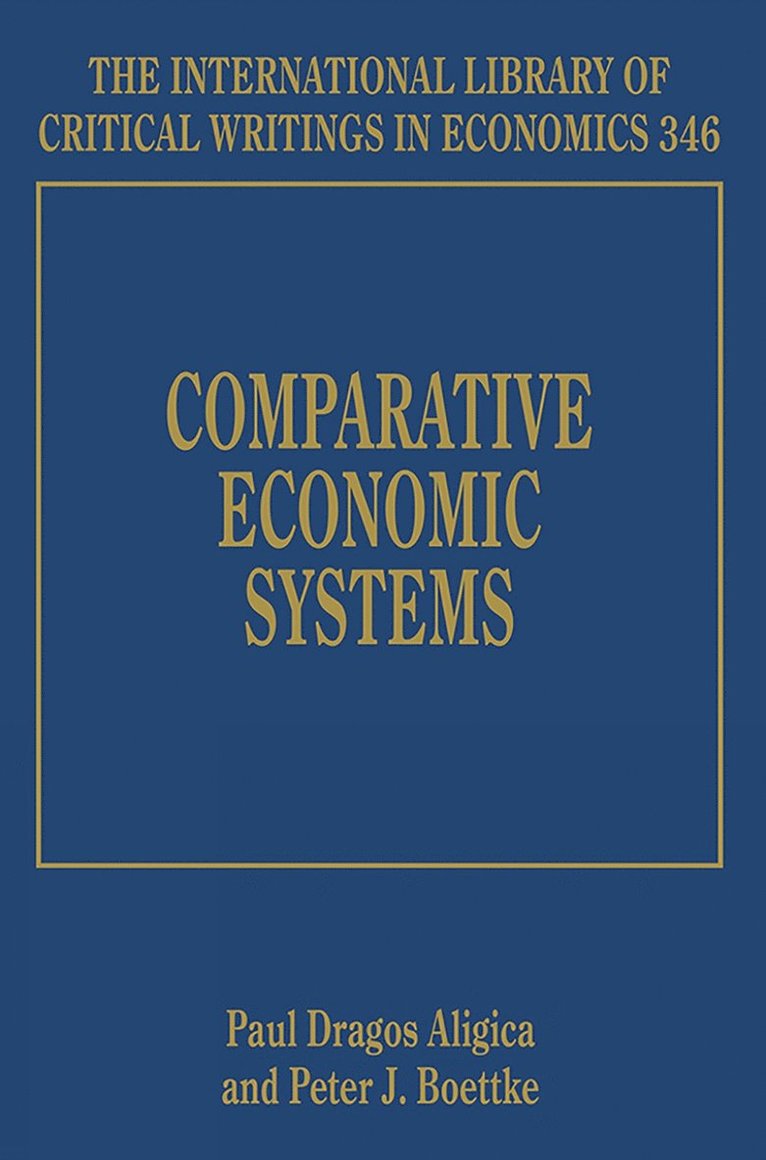
    Comparative Economic Systems

    AvPaul D. Aligica,Peter J. Boettke

    Inbunden, Engelska, 2018

    Del 346 i serien The International Library of Critical Writings in Economics series

    5 822 kr

    Beställningsvara. Skickas inom 5-8 vardagar. Fri frakt över 249 kr.

    Beskrivning

    The search for alternatives to capitalism and the problem of comparative assessment of the performance of socialist and capitalist systems have inspired one of the richest and most remarkable episodes in the history of economic thought. By the mid 20th century an entire field had emerged, conceptualizing, theorizing, monitoring, and analyzing the largest and most consequential social and economic natural experiment in human history: Real-life Socialism. This research review focuses on the fundamental literature associated with the comparative study of socialist and capitalist systems. It features both a well-rounded inquiry of the modern history of economic thought, as well as a vibrant and critical disentanglement of the role of the economic system from the role of environment and policy decisions, as determinants of economic performance. This review will be an interesting and invaluable research resource for academics and students alike.

    Produktinformation

    • Utgivningsdatum:2018-06-29
    • Mått:169 x 244 x undefined mm
    • Format:Inbunden
    • Språk:Engelska
    • Serie:The International Library of Critical Writings in Economics series
    • Förlag:Edward Elgar Publishing Ltd
    • ISBN:9781786431660

    Utforska kategorier

    • Nationalekonomi inom Ekonomi och Ledarskap
    • Ekonomiska system inom Ekonomi och Ledarskap

    Mer om författaren

    Edited by Paul Dragos Aligica, Professor, University of Bucharest and Senior Research Fellow, Mercatus Center at George Mason University and Peter J. Boettke, University Professor of Economics and Philosophy, George Mason University, US

    Recensioner i media

    ‘This exquisite anthology covers sixty years of conceptual and empirical scholarship on comparative economic systems, zeroing in on central plan economies. Paul Dragos Aligica and Peter J. Boettke have assembled both indispensable classic papers and innovative recent contributions. The volume encompasses several types of central plan economies, including the Soviet Union, Nazi Germany, Mao’s China, and Yugoslavia. Five distinct sections organize thirty-six articles into a logical sequence, enabling the volume to achieve simultaneously two objectives: provide a multifaceted, in-depth analysis of the subject and present a history of economic ideas and debates. An exhaustive introduction by the editors summarizes this history in a lively fashion.’

    Innehållsförteckning

    • Contents: AcknowledgementsIntroduction Paul Dragos Aligica and Peter J. BoettkePART ICOMPARATIVE FRAMEWORKS AND APPROACHES1. David Conn (1978), ‘Economic Theory and Comparative Economic Systems: A Partial Literature Survey’, Journal of Comparative Economics, 2 (4), December, 355–81 2. Avner Ben-Ner, John Michael Montias and Egon Neuberger (1993), ’Basic Issues in Organizations: A Comparative Perspective’, Journal of Comparative Economics, 17 (2), June, 207–423. William Duffy and Egon Neuberger (1972), ‘Toward a Decision-Theoretic Approach to the Study of Economic Systems’, Jahrbuch der Wirtschaft Osteuropas – Yearbook of East-European Economics, 3 (1), 67–854. Leonid Hurwicz (1979), ‘Socialism and Incentives: Developing a Framework’, Journal of Comparative Economics, 3 (3), September, 207–16 5. Raaj Kumar Sah and Joseph E. Stiglitz (1986), ‘The Architecture of Economic Systems: Hierarchies and Polyarchies’, American Economic Review, 76 (4), September, 716–276. Benjamin Ward (1988), ‘LEP: An Alternative Criterion for Socio-Economic Valuation’, Journal of Economic Issues, XXII (3), September, 763–80 PART II PROBLEMS OF MEASUREMENT AND ASSESSMENT 7. Robert W. Campbell (1959), ‘Problems of United States-Soviet Economic Comparisons’, in Comparisons of the United States and Soviet Economies: Papers Submitted by Panelists Appearing Before the Subcommittee on Economic Statistics: Part I, 86th Congress: 1st Session, Washington, DC, USA: United States Government Printing Office, 13–308. G. Warren Nutter (1958), ‘Industrial Growth in the Soviet Union’, American Economic Review: Papers and Proceedings, 48 (2), May, 398–4119. Evsey D. Domar (1967), ‘An Index-Number Tournament’, Quarterly Journal of Economics, LXXXI (2), May, 169–8810. Simon Kuznets (1962), ‘Inventive Activity: Problems of Definition and Measurement’, in Universities-National Bureau Committee for Economic Research and Committee on Economic Growth of the Social Science Research Council (eds), The Rate and Direction of Inventive Activity: Economic and Social Factors, Part I, Chapter 1, Princeton, NJ, USA: Princeton University Press, 19–5111. Abram Bergson (1987), ‘Comparative Productivity: The USSR, Eastern Europe, and the West’, American Economic Review, 77 (3), June, 342–57 12. Abram Bergson (1992), ‘Communist Economic Efficiency Revisited’, American Economic Review: Papers and Proceedings, 82 (2), May, 27–3013. Steven Rosefielde (2003), ‘The Riddle of Post-war Russian Economic Growth: Statistics Lied and Were Misconstrued’, Europe-Asia Studies, 55 (3), May, 469–81PART III CASES, SYSTEMS, AND INTERPRETATIONS 14. Gregory Grossman (1963), ‘Notes for a Theory of the Command Economy’, Soviet Studies, XV (2), October, 101–2315. Eugenia Belova and Paul Gregory (2002), ‘Dictator, Loyal, and Opportunistic Agents: The Soviet Archives on Creating the Soviet Economic System’, Public Choice, 113 (3–4), December, 265–8616. Walter Eucken (1948), ‘On the Theory of the Centrally Administered Economy: An Analysis of the German Experiment: Part I’, trans. by T. W. Hutchison, Economica, 15 (58), May, 79–10017. Walter Eucken (1948), ‘On the Theory of the Centrally Administered Economy: An Analysis of the German Experiment: Part II’, trans. by T. W. Hutchison, Economica, 15 (59), August, 173–9318. Frederic L. Pryor (1988), ‘Corporatism as an Economic System: A Review Essay’, Journal of Comparative Economics, 12 (3), September, 317–4419. Audrey Donnithorne (1972), ‘China’s Cellular Economy: Some Economic Trends Since the Cultural Revolution’, China Quarterly, 52, October, 605–1920. Steven Rosefielde and Henry Latané (1980), ‘Decentralized Economic Control in the Soviet Union and Maoist China: One-Man Rule versus Collective Self-Management’, in Steven Rosefielde (ed.), World Communism at the Crossroads: Military Ascendancy, Political Economy, and Human Welfare, Chapter 12, Boston, MA, USA: Martinus Nijhoff Publishing, 273–30421. Benjamin Ward (1958), ‘The Firm in Illyria: Market Syndicalism’, American Economic Review, 48 (4), September, 566–8922. Jaroslav Vanek (1969), ‘Decentralization Under Workers’ Management: A Theoretical Appraisal’, American Economic Review, 59 (5), December, 1006–14PART IV FACETS, DYNAMICS, AND STRUCTURAL CHANGE 23. János Kornai (1986), ‘The Soft Budget Constraint’, Kyklos, 39 (1), February, 3–3024. Gregory Grossman (1981), ‘The “Second Economy” of the USSR’, in Morris Bornstein (ed.), The Soviet Economy: Continuity and Change, Chapter 4, Boulder, CO, USA: Westview Press, 71–9325. Morris Bornstein (1978), ‘The Administration of the Soviet Price System’, Soviet Studies, XXX (4), October, 466–9026. Joseph S. Berliner (1978), ‘Innovation and Central Economic Planning’, Il Politico, 43 (1), March, 47–6127. Nicolas Spulber (1959), ‘The Soviet-Bloc Foreign Trade System’, Law and Contemporary Problems, State Trading: Part II, 24 (3), Summer, 420–3428. Jan Tinbergen (1961), ‘Do Communist and Free Economies Show a Converging Pattern?’, Soviet Studies, XII (4), April, 333–4129. Robert C. Stuart and Paul R. Gregory (1971), ‘The Convergence of Economic Systems: An Analysis of Structural and Institutional Characteristics’, Jahrbuch der Wirtschaft Osteuropas – Yearbook of East-European Economics, 2, 425–4130. Frederic L. Pryor (1970), ‘Barriers to Market Socialism in Eastern Europe in the Mid 1960s’, Studies in Comparative Communism, 3 (2), April, 31–6431. Peter Murrell and Mancur Olson (1991), ‘The Devolution of Centrally Planned Economies’, Journal of Comparative Economics, 15 (2), June, 239–65PART VCOMPARATIVE ECONOMIC SYSTEMS AND THE NEW COMPARATIVE ECONOMICS 32. Simeon Djankov, Edward Glaeser, Rafael La Porta, Florencio Lopez-de-Silanes and Andrei Shleifer (2003), ‘The New Comparative Economics’, Journal of Comparative Economics, 31 (4), December, 595–61933. Peter J. Boettke, Christopher J. Coyne, Peter T. Leeson and Frederic Sautet (2005), ‘The New Comparative Political Economy’, Review of Austrian Economics, 18 (3–4), December, 281–30434. Josef C. Brada (2009), ‘The New Comparative Economics versus the Old: Less Is More but Is It Enough?’, European Journal of Comparative Economics, 6 (1), 3–1535. Bruno Dallago (2004), ‘Comparative Economic Systems and the New Comparative Economics’, European Journal of Comparative Economics, 1 (1), 59–8636. J. Barkley Rosser Jr. and Marina V. Rosser (2008), ‘A Critique of the New Comparative Economics’, Review of Austrian Economics, 21 (1), March, 81–97Index