• Fri frakt över 249 kr
  • •
  • Snabba leveranser
  • •
  • Billiga böcker
Kundservice

Du är på sajten för privatpersoner.

Företag, bibliotek eller offentlig verksamhet?

Du handlar på classic.bokus.com, där alla dina funktioner finns intakta.
Till classic.bokus.com
Bokus logotyp. Gå till startsidan.
  • Erbjudanden
  • Student
  • Topplistor
  • Barn & ungdom
  • Bokus Play
  • E-böcker
  • Ljudböcker
  • Pocketböcker
  • Spel och pussel

Pocketfynda! Hundratals böcker för 49 kr/st →

Sidfot

Mina sidor

    Hjälp

    • Kundservice
    • Vanliga frågor och svar
    • Frakt och leverans
    • Retur vid ångerrätt
    • Reklamera vara
    • Betalning
    • Köpvillkor
    • Allmänna villkor
    • Information om webbplatsens tillgänglighet

    Om Bokus

    • Om oss
    • Pressrum
    • För studenter
    • För företag
    • För bibliotek och offentlig verksamhet
    • För leverantörer
    • Hållbarhet

    Populärt

    • Aktuella erbjudanden
    • Presentkort
    • Studentlitteratur
    • Nya böcker
    • Topplistor
    • Signerade böcker
    • Engelska böcker

    Inspiration

    • Boktips
    • BookTok
    • Barnbokskaraktärer
    • Populära författare
    Logotyp för Bokus
    Följ oss på Facebook (extern länk)Följ oss på Instagram (extern länk)Följ oss på YouTube (extern länk)Följ oss på TikTok (extern länk)
    bokus @ CookiesAnpassa cookiesIntegritetspolicyKöpvillkor
    Till Citymail hemsida (extern länk)Till Budbee hemsida (extern länk)Till Postnord hemsida (extern länk)Till Schenker hemsida (extern länk)Till Early Bird hemsida (extern länk)Till Walleys hemsida (extern länk)
    1. Skönlitteratur
    2. Litteraturvetenskap
    3. Litteraturvetenskap

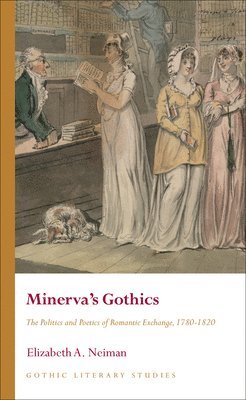
    Minerva’s Gothics

    The Politics and Poetics of Romantic Exchange, 1780-1820

    AvElizabeth Neiman

    Inbunden, Engelska, 2019

    Del i serien Gothic Literary Studies

    1 191 kr

    Beställningsvara. Skickas inom 5-8 vardagar. Fri frakt över 249 kr.

    Fler format och utgåvor

    E-bok

    1 191 kr

    E-bok

    426 kr

    Beskrivning

    Between 1790 and 1820, William Lane’s Minerva Press published an unprecedented number of circulating-library novels by obscure female authors. Because these novels catered to the day’s fashion for sentimental themes and Gothic romance, they were and continue to be generally dismissed as ephemera. Recently, however, scholars interested in historicizing Romantic conceptions of genius and authorship have begun to write Minerva back into literary history. By making Minerva novels themselves the centre of the analysis, Minerva’s Gothics illustrates how Romantic ‘anxiety’ is better conceptualized as a mutual though not entirely equitable ‘exchange’, a dynamic interrelationship between Minerva novels and Romantic-era politics and poetics that started in 1780, when Lane began publishing novels with some regularity. Reading Minerva novels for their shared popular conventions demonstrates that circulating-library novelists collectively recirculate, engage and modify commonplaces about women’s nature, the social order and, most importantly, the very Romantic redefinitions of authorship and literature that render their novels not worth reading. By recognizing Minerva’s collaborative rather than merely derivative authorial model, a forgotten pathway is restored between first-generation Romantic reactions to popular print culture and Percy Shelley’s influential conceptualization of the poet in A Defence of Poetry.

    Produktinformation

    • Utgivningsdatum:2019-02-15
    • Mått:138 x 216 x 22 mm
    • Vikt:510 g
    • Format:Inbunden
    • Språk:Engelska
    • Serie:Gothic Literary Studies
    • Antal sidor:304
    • Förlag:University of Wales Press
    • ISBN:9781786833679

    Utforska kategorier

    • Litteraturvetenskap inom Skönlitteratur

    Mer om författaren

    Elizabeth A. Neiman is Assistant Professor at the University of Maine, with a joint appointment in English and Women's, Gender, and Sexuality Studies. Her research interests include the British Romantic era, women's writing, the long-nineteenth century, and book history.

    Recensioner i media

    `Insightfully tracing the commercial commodification of both reading material and the reading activity itself among Romantic-era women readers and writers, Minerva’s Gothics will make an immediate difference to the ways in which we think about Romantic-era fiction, and indeed about Romantic-era reading practices generally.’ ; - Professor Stephen C. Behrendt, University of Nebraska ; `Minerva’s Gothics offers a meticulously detailed and methodologically ambitious reassessment of the Minerva imprint, its authors and its impact. Combining close readings and distant reading strategies, Neiman’s eminently readable and important book exposes the spurious Romantic prejudices that have unfairly pushed Minerva to the margins of literary history.’ ; - Professor Jennie Batchelor, University of Kent ; `Minerva’s Gothics offers a much-needed and utterly compelling reappraisal of the oft-derided publications of the Minerva Press. Through its combination of exemplary statistical analysis and more traditional qualitative methods, the study presents a persuasive counter-narrative to conventional accounts of Minerva works as sordidly unoriginal, detailing as it does so a new and richly rewarding interpretive lens through which to view Romantic-era popular fiction.’ ; - Dr Christina Morin, University of Limerick ; `In Minerva’s Gothics, Elizabeth Neiman offers a revisionary account of Romantic circulating-library fiction, exposing its savvy, self-aware use of narrative formulas and tracing its contribution to the major intellectual debates of the day. Expansive, spirited and lucid, this book is a vital resource for anyone interested in the history of popular fiction.’ ; -Dr Yael Shapira, Bar-Ilan University ; `Minerva’s Gothics combines deeply-researched publication data and other modes of distant reading with elegant close reading both of some fifty largely forgotten novels (most by women) published by the Minerva Press and of some of the most canonical works of British Romanticism. By doing so, Neiman makes clear that the Romantic period was centred in an exchange and dynamic interrelationship between the popular collective (or “generic”) model of authorship fostered by the Minerva Press and canonical Romantic writing and theories of individual genius. Minerva’s Gothics is a major advancement both in substance and methodology, and it will henceforth be a de rigueur point of departure for the study of British Romanticism as a period.’ ; - Professor Edward Jacobs, Old Dominion University ; `Minerva’s Gothics is the first monograph study in eighty years of one of the most influential yet nearly forgotten publishers of fiction during the Romantic period. In an engaging and timely intervention, Elizabeth Neiman establishes that the true of the Minerva Press during its fifty-year history lay in its unique employment of numerous women authors of purposefully formulaic works, creating a rich and enduring literary network. Nuanced close readings of under-examined Minerva novels against the works of canonical writers (Wordsworth, Wollstonecraft, Shelley) anchor the wider analysis of the Georgian literary marketplace in a compelling and original way. This book will introduce readers who know little about the Minerva Press to vital information regarding its role and significance within Romantic literary culture, while serving those already familiar with the Press with original arguments and fresh analysis that break important new ground.’ ; - Professor Anthony Mandal, Cardiff University

    Innehållsförteckning

    • Table of ContentsPreface: Chapter 1: Remapping Minerva’s influence on the novel marketSection One: Feminist Discernment and Minerva’sProduction of Romantic FantasySection OverviewChapter 2: Julies and St. Preuxes: Networking ‘lady’ authors, 1785-9Chapter 3: Wollstonecraft and the revolutionary feminist novel: At a crossroads with Wordsworth Section Two: The Revolution Debate in Britain: Minerva and the Politics of FeelingSection OverviewChapter 4: Providential adaptations to the romantic fantasy, 1790-4Chapter 5: Godwin and Providential feeling in Things As They Are: Meeting readers where they areChapter 6: Providential feeling at Minerva’s zenith: what the commoner teaches the noblemanSection Three: The Forgotten Poetics of Romantic Exchange: Gothic Habits of MindSection OverviewChapter 7: Minerva’s continued influence: the Poet as Nightingale in Shelley’s 1810 GothicsChapter 8: Reinstating romantic fantasy in Minerva’s ‘late’ novels: Romanticism and ‘Gothic’ habits of mindAfterwordBibliographyList of Tables:List of Figures: