Häftad, Engelska, 2017
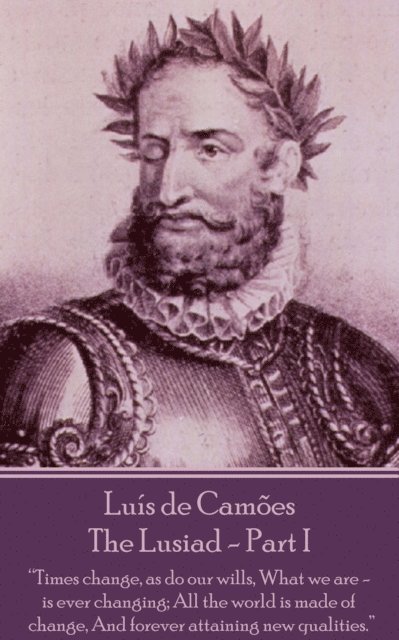
Luis de Camoes - The Lusiad - Part I
274 kr
Beställningsvara. Skickas inom 3-6 vardagar. Fri frakt över 249 kr.
Beskrivning
Luís Vaz de Camões, without doubt, remains to this day the Portuguese language’s foremost poet and has mentored many with his work through the centuries and wherever the Portuguese Empire or its Sailors reached, or its language spoken – from Brazil and Africa, through Portugal itself to India and the Far East. During his lifetime the Portuguese Empire, grew rapidly and this was, perhaps, a Golden Age for Portugal in many areas. His lyrical poetry showed such mastery that, for many, his talents are the equal of Shakespeare, Homer or Dante. With lines as encompassing and truthful as “em várias flamas variamente ardia” (“I burnt myself at many flames”) it is hard to argue against. Probably born in 1524 it is unknown as to where. There is a statue dedicated to him in Constanzia which together with Lisbon, Coimbra or Alenquer also rival as his birthplace. What is known is that he was an only child from a fading family of the old Aristocracy. His father went to India to pursue his fortune and died in Goa. His mother later remarried and for Camões early life was financially comfortable. He was educated within the Catholic church and then attended the University of Coimbra giving him access to a wide range of classical and contemporary literature. Aside from his native Portuguese he read in Latin and Italian and wrote poetry in Spanish. What can be acknowledged from his work was that Camões was a man of great learning and widely read. He was able to use that knowledge and influence to write beautiful and lasting poetry. Camões was a romantic, and it was rumoured, fell in love with a lady in waiting to the Queen and also Princess Maria. Possibly due to indiscretions surrounding these love affairs, he was exiled from Lisbon and enlisted in the overseas militia where he lost the sight in his right eye and eventually returned to Lisbon. He now led a bohemian lifestyle and a fracas resulted in him injuring a member of the royal stables. He was imprisoned but his mother successfully pleaded for his release which involved paying a large fine and serving three years in militia in the Orient after which he took up a post in Macau. During this time he was shipwrecked and some romantics claim that he swam ashore whilst holding aloft the manuscript of his unfinished epic; Os Lusíadas , the poetical tale of how Vasco da Gama discovered India. When finally back in Lisbon, in 1570, he finished and then published two years later, ‘Os Lusiadas’, the masterpiece for which his poetic talent has deservedly been recognised. In July of that year he was granted a royal pension, probably in recompense for both his service in India and his having written Os Lusíadas. Luis Vaz de Camões died in 1580 on 10th June, coincidentally Portugal’s national day, and is buried in the Jeronimos Monastery in Lisbon.
Produktinformation
- Utgivningsdatum: 2017-01-24
- Format: Häftad
- Språk: Engelska
- Antal sidor: 192
- Förlag: Portable Poetry
- ISBN: 9781787370128
Utforska kategorier
Betyg & recensioner
0 recensioner
Inga recensioner tillgängliga.