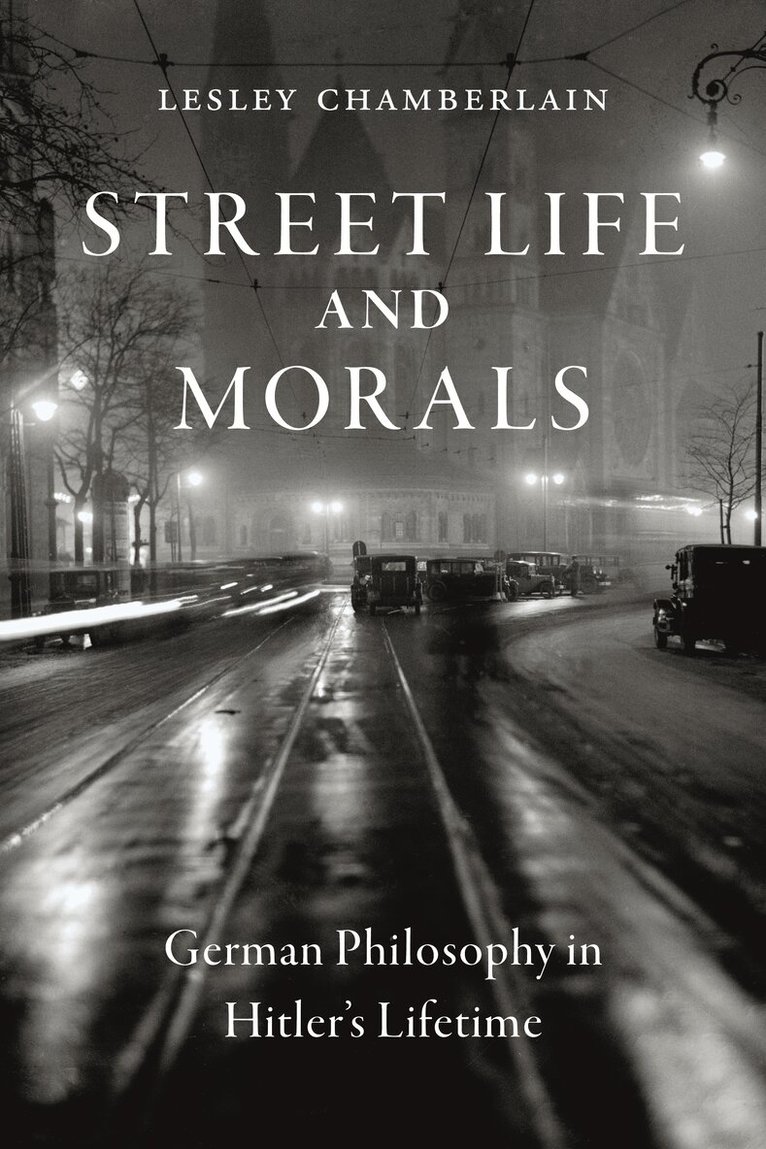
Street Life and Morals
German Philosophy in Hitler’s Lifetime
364 kr
Beställningsvara. Skickas inom 5-8 vardagar. Fri frakt över 249 kr.
Du är på sajten för privatpersoner.
364 kr
Beställningsvara. Skickas inom 5-8 vardagar. Fri frakt över 249 kr.
Lesley Chamberlain, a novelist and historian of ideas, was educated in England in German literature and philosophy. Her books include the acclaimed Nietzsche in Turin (1996), The Secret Artist: A Close Reading of Sigmund Freud (2000) and Arc of Utopia: The Beautiful Story of the Russian Revolution (Reaktion, 2017). She lives in London.
This important, lively work tracks the failure of two generations of post-idealist philosophers to reconceive – in light of the social and economic upheaval that emerged during the lifetime of Adolf Hitler – Immanuel Kant’s conception of autonomy and moral personhood. An initial chapter provides a richly detailed discussion of the technological and social transformation that characterized the late decades of the nineteenth century and first decades of the twentieth. Subsequent chapters provide provocative readings of how German philosophy attempted to recast the idealist tradition of vernunft to meet the reality of a fragmented, atomized, and technologically shaped street life of the newly emerging metropolis. This work is a must read for anyone concerned, as were the philosophers Chamberlain discusses, about the place of meaning, value, and autonomy in a disenchanted world that tends toward biologism and both technological and scientific reductionism. Chamberlain writes from a seat of deep learning, but she has the ability to make the most abstruse ideas clear and relevant to the narrative of her intellectual history of this period. Highly recommended. - ChoiceLesley Chamberlain’s study is a masterly analysis and interpretation of the fate of mainstream Kantian philosophy in Mr. A.H.’s lifetime, as the tradition of individual autonomy and high moral earnest failed to come to terms with the modern challenges of mass culture and technologisation. But Chamberlain shows too how, from the rubble, just these elements – from Benjamin and Cassirer, Adorno and Arendt and, yes, even Heidegger – were used to rebuild the house of German philosophy in today’s form. Her study combines vast scholarship and formal ease with crystal lucidity and a beguiling confessional dimension. - Nicholas Saul, Director (Arts and Humanities), Institute of Advanced Study, Durham University, and author of 'Interrogations of Evolutionism in German Literature 1859–2011' (2021)
Filippo Tommaso Marinetti, Lesley Chamberlain
Häftad, 2014
134 kr
Lesley Chamberlain
Häftad, 2008
338 kr
Filippo Tommaso Marinetti, Lesley Chamberlain
Häftad, 2014
134 kr
Lesley Chamberlain
Häftad, 2008
338 kr
Du är på sajten för privatpersoner.
364 kr
Beställningsvara. Skickas inom 5-8 vardagar. Fri frakt över 249 kr.
Lesley Chamberlain, a novelist and historian of ideas, was educated in England in German literature and philosophy. Her books include the acclaimed Nietzsche in Turin (1996), The Secret Artist: A Close Reading of Sigmund Freud (2000) and Arc of Utopia: The Beautiful Story of the Russian Revolution (Reaktion, 2017). She lives in London.
This important, lively work tracks the failure of two generations of post-idealist philosophers to reconceive – in light of the social and economic upheaval that emerged during the lifetime of Adolf Hitler – Immanuel Kant’s conception of autonomy and moral personhood. An initial chapter provides a richly detailed discussion of the technological and social transformation that characterized the late decades of the nineteenth century and first decades of the twentieth. Subsequent chapters provide provocative readings of how German philosophy attempted to recast the idealist tradition of vernunft to meet the reality of a fragmented, atomized, and technologically shaped street life of the newly emerging metropolis. This work is a must read for anyone concerned, as were the philosophers Chamberlain discusses, about the place of meaning, value, and autonomy in a disenchanted world that tends toward biologism and both technological and scientific reductionism. Chamberlain writes from a seat of deep learning, but she has the ability to make the most abstruse ideas clear and relevant to the narrative of her intellectual history of this period. Highly recommended. - ChoiceLesley Chamberlain’s study is a masterly analysis and interpretation of the fate of mainstream Kantian philosophy in Mr. A.H.’s lifetime, as the tradition of individual autonomy and high moral earnest failed to come to terms with the modern challenges of mass culture and technologisation. But Chamberlain shows too how, from the rubble, just these elements – from Benjamin and Cassirer, Adorno and Arendt and, yes, even Heidegger – were used to rebuild the house of German philosophy in today’s form. Her study combines vast scholarship and formal ease with crystal lucidity and a beguiling confessional dimension. - Nicholas Saul, Director (Arts and Humanities), Institute of Advanced Study, Durham University, and author of 'Interrogations of Evolutionism in German Literature 1859–2011' (2021)
Filippo Tommaso Marinetti, Lesley Chamberlain
Häftad, 2014
134 kr
Lesley Chamberlain
Häftad, 2008
338 kr
Filippo Tommaso Marinetti, Lesley Chamberlain
Häftad, 2014
134 kr
Lesley Chamberlain
Häftad, 2008
338 kr