• Fri frakt över 249 kr
  • •
  • Snabba leveranser
  • •
  • Billiga böcker
Kundservice

Du är på sajten för privatpersoner.

Företag, bibliotek eller offentlig verksamhet?

Du handlar på classic.bokus.com, där alla dina funktioner finns intakta.
Till classic.bokus.com
Bokus logotyp. Gå till startsidan.
  • Erbjudanden
  • Nyheter
  • Student
  • Topplistor
  • Barn & ungdom
  • Bokus Play
  • E-böcker
  • Pocketböcker
  • Spel & pussel

10% rabatt på allt med kod NYSTART10 →

Sidfot

Mina sidor

    Hjälp

    • Kundservice
    • Vanliga frågor och svar
    • Frakt och leverans
    • Retur vid ångerrätt
    • Reklamera vara
    • Betalning
    • Köpvillkor
    • Allmänna villkor
    • Information om webbplatsens tillgänglighet

    Om Bokus

    • Om oss
    • Pressrum
    • För studenter
    • För företag
    • För bibliotek och offentlig verksamhet
    • För leverantörer
    • Hållbarhet

    Populärt

    • Aktuella erbjudanden
    • Presentkort
    • Studentlitteratur
    • Nya böcker
    • Topplistor
    • Signerade böcker
    • Engelska böcker

    Inspiration

    • Boktips
    • BookTok
    • Populära bokserier
    • Barnbokskaraktärer
    • Populära författare
    Logotyp för Bokus
    Följ oss på Facebook (extern länk)Följ oss på Instagram (extern länk)Följ oss på YouTube (extern länk)Följ oss på TikTok (extern länk)
    bokus @ CookiesAnpassa cookiesIntegritetspolicyKöpvillkor
    Till Citymail hemsida (extern länk)Till Budbee hemsida (extern länk)Till Postnord hemsida (extern länk)Till Schenker hemsida (extern länk)Till Early Bird hemsida (extern länk)Till Walleys hemsida (extern länk)
    1. Ekonomi och Ledarskap
    2. Industrier och branscher
    3. Servicesektorn

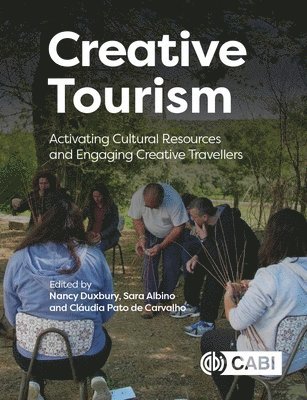
    Creative Tourism

    Activating Cultural Resources and Engaging Creative Travellers

    AvNancy Duxbury,Sara Albino

    Häftad, Engelska, 2021

    757 kr

    Beställningsvara. Skickas inom 5-8 vardagar. Fri frakt över 249 kr.

    Beskrivning

    This book provides a synthesis of current research and international best practice in the emerging field of creative tourism. Including knowledge, insights, and reflections from both practitioners and researchers, it covers types of creative tourist, trends, designing and implementing creative tourism products, embedding activities in a community and place, and addressing sustainability challenges. Applying lessons learned from the CREATOUR project and other initiatives, the editors present key information in an actionable manner best suited to people working on the ground. The book: - Addresses important issues such as local economic benefit, social and collaborative economy, community engagement, social inclusion, youth empowerment, cross-cultural exchange, and responsible travel. - Provides a core, introductory text plus a wide range of cases examining creative tourism development in practice in the following 15 countries: Austria, Brazil, Canada, Colombia, Denmark, Finland, Kenya, Namibia, Portugal, the Netherlands, New Zealand, Slovenia, Spain, Thailand, and the USA. - Includes colour photos, diagrams, text boxes, and call-out quotations throughout to help guide and engage readers. A vital resource for tourism agencies, practitioners, planners and policymakers interested in developing creative tourism programmes and activities, this book will also be of interest to cultural and creative tourism researchers, students, and teachers of tourism and culture-based development.

    Produktinformation

    • Utgivningsdatum:2021-10-12
    • Mått:189 x 246 x 15 mm
    • Vikt:851 g
    • Format:Häftad
    • Språk:Engelska
    • Antal sidor:304
    • Förlag:CABI Publishing
    • ISBN:9781789243543

    Utforska kategorier

    • Servicesektorn inom Ekonomi och Ledarskap

    Mer om författaren

    Nancy Duxbury (Edited By) Nancy Duxbury, PhD, is a Senior Researcher at the Centre for Social Studies, University of Coimbra, Portugal, and Co-coordinator of its Cities, Cultures and Architecture Research Group. She is also an Adjunct Professor of the School of Communication, Simon Fraser University and of the School of Urban and Regional Planning, University of Waterloo, Canada. She is a member of the European Expert Network on Culture, and was Chair of the Policies group of the European research network "Investigating Cultural Sustainability" (2011-2015). Previously, she was co-founder and Director of Research of the Creative City Network of Canada. Her research has examined the integration of culture in local sustainable development, with an emphasis on the policy and planning frameworks that enable this; culture-based development models in smaller communities; and the emerging interdisciplinary field of cultural mapping, which bridges insights from academic inquiry, community practice, and artistic approaches to understanding and articulating place. Building on these foundations, she is now the Principal Investigator for a major three-year research and application project on creative tourism in Portugal, entitled "CREATOUR: Creative Tourism Destination Development in Small Cities and Rural Areas." The project involves five Portuguese research centres and 40 pilots, and aims to link the cultural and tourism sectors within a context of inclusive and sustainable local and regional development. She was born in Canada, and lived on both the Atlantic and Pacific Coasts of the country before moving to Portugal in 2009. She currently splits her time between Coimbra and São Miguel Island, Azores.Sara Albino (Edited By) Sara Albino, PhD is a Research Fellow of the Interdisciplinary Centre of History, Culture and Societies of the University of Évora and also a Member of the UNESCO Chair in "Intangible Heritage and Traditional Know-How: Linking Heritage" (University of Évora - Portugal). She is also an associate researcher at the Research Centre in Fine Arts of the University of Lisbon. Her research has addressed the issue of immaterial heritage in tourism planning and territorial branding using mixed methods in qualitative research. Presently is involved as a researcher in the action-research project CREATOUR- "Creative Tourism Destination Development in Small Cities and Rural Areas". As a community outreach practical project, she is the co-founder of Buinho Creative Hub, the Rural Fablab of Baixo Alentejo with its children's makerspace in the Primary School of Messejana. Based on her experience of creating one of the first artistic residencies program in fablab environment of Europe, she has been currently examining the profile and impacts of creative travellers and creative hubs development in rural areas.Claudia Pato Carvalho (Edited By) Claudia Pato Carvalho is a permanent researcher at the Centre for Social Studies of the University of Coimbra under the ARTERIA project (operation no. CENTRO-07-2114-FEDER-000022, Portugal 2020). Arteria is an action-research project, coordinated by O Teatrão (a professional theatre company from Coimbra) that aims at the development of a cultural programming network in the Centro Region (Portugal) and the creation of artistic intervention projects in eight cities of this Region. She completed her PhD in Sociology, with a specialization in Sociology of Culture, Knowledge and Communication, at the Faculty of Economics of the University of Coimbra, in collaboration with the Center for Reflective Community Practice (DUSP, MIT). Between 2010 and 2018, has established an European network in the field of arts education and disadvantaged communities, with several projects approved under the Youth in Action Program and ERASMUS+. She is member of the coordinating CES research team of the project CREATOUR: Creative Tourism Destination Development in Small Cities and Rural Areas. CREATOUR is an incubator/demonstration and multidisciplinary research initiative, supporting collaborative research processes involving five research centres working with a range of cultural/creative organizations and other stakeholders located in small cities in the Norte, Centro, Alentejo and Algarve regions.

    Innehållsförteckning

    • 1: An introduction to creative tourism development: Articulating local culture and travel Part I: Types of creative travellers 2: A typology of creative travellers in Bogota, Colombia: The experience of 5Bogota 3: Creative travellers in Austria 4: Domestic and international creative tourists in Portugal: Insights for practitioners 5: Collective invention: A travelling artist’s perspective 6: Interview with Mélanie Wolfram, Vagar Walkingtours: Connecting to family travel with creative tourism Part II: Trends in creative tourism 7: Trajectories and trends in creative tourism: Where are we headed? 8: Interview with Caroline Couret about the Creative Tourism Network® 9: Gastronomic creative tourism: Experiences in the Algarve region of Portugal 10: Interview with Geetika Agrawal about Vacation With An Artist 11: I need you, but I don’t want you: The ambiguity of artistic residencies and tourism Part III: Designing and managing creative tourism products 12: From theory to practice: The three principles of community-based design 13: User-centred design for creative tourism prototyping: The Maribor experience 14: Bogota through the 5 Senses: Building a creative tourism start-up 15: Deep mapping as a cultural mapping process and a creative tourism driver: Two examples 16: The creative tourist and the creating artist: The base for rural development 17: COOLWOOL – Creative weekend at Covilhã, a co-designed programme 18: Co-creating subtle attractions 19: Linking creative tourism products to markets: Target marketing, promotion, commercialization, and market readiness 20: Creative tourism marketing and social media management 21: Loulé Criativo: Our creative tourism development story 22: Santa Fe, New Mexico’s Creative Tourism Initiative 23: Creative tourism development and innovation in Kenya: An entrepreneurship perspective Part IV: Embedding creative tourism activities within a community 24: Creative tourism as a local development strategy 25: Why creative tourism won’t work if residents are not involved: A tale of two cities 26: Youth, ways of production, and community 27: Creative tourism as a strategic approach for decolonial thinking and doing in Namibian tourism 28: Connecting local artisans to tourism in extra-metropolitan areas: The importance of social embeddedness Part V: Addressing challenges of impact and sustainability 29: An impact self-assessment tool for creative tourism with insights from its application to the CREATOUR® project 30: A sustainable future for creative tourism in Lapland 31: Policy recommendations on creative tourism development in small cities and rural areas: Insights from the CREATOUR® project in Portugal Part VI: Concluding remarks 32: Pursuing creative tourism for positive transformation and sustainable development