• Fri frakt över 249 kr
  • •
  • Snabba leveranser
  • •
  • Billiga böcker
Kundservice

Du är på sajten för privatpersoner.

Företag, bibliotek eller offentlig verksamhet?

Du handlar på classic.bokus.com, där alla dina funktioner finns intakta.
Till classic.bokus.com
Bokus logotyp. Gå till startsidan.
  • Erbjudanden
  • Nyheter
  • Student
  • Topplistor
  • Barn & ungdom
  • Bokus Play
  • E-böcker
  • Pocketböcker
  • Spel & pussel

10% studentrabatt med kod TERM26

Sidfot

Mina sidor

    Hjälp

    • Kundservice
    • Vanliga frågor och svar
    • Frakt och leverans
    • Retur vid ångerrätt
    • Reklamera vara
    • Betalning
    • Köpvillkor
    • Allmänna villkor
    • Information om webbplatsens tillgänglighet

    Om Bokus

    • Om oss
    • Pressrum
    • För studenter
    • För företag
    • För bibliotek och offentlig verksamhet
    • För leverantörer
    • Hållbarhet

    Populärt

    • Aktuella erbjudanden
    • Presentkort
    • Studentlitteratur
    • Nya böcker
    • Topplistor
    • Signerade böcker
    • Engelska böcker

    Inspiration

    • Boktips
    • BookTok
    • Populära bokserier
    • Barnbokskaraktärer
    • Populära författare
    Logotyp för Bokus
    Följ oss på Facebook (extern länk)Följ oss på Instagram (extern länk)Följ oss på YouTube (extern länk)Följ oss på TikTok (extern länk)
    bokus @ CookiesAnpassa cookiesIntegritetspolicyKöpvillkor
    Till Citymail hemsida (extern länk)Till Budbee hemsida (extern länk)Till Postnord hemsida (extern länk)Till Schenker hemsida (extern länk)Till Early Bird hemsida (extern länk)Till Walleys hemsida (extern länk)
    1. Kultur
    2. Scenkonst och film
    3. Film

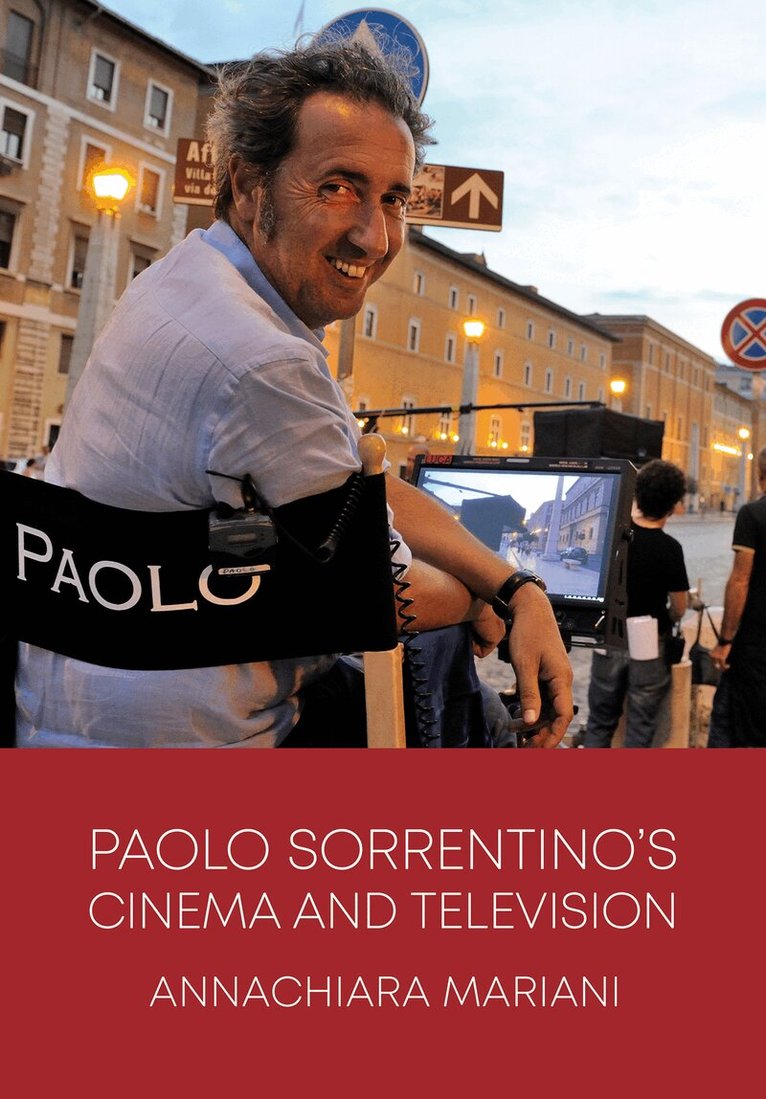
    Paolo Sorrentino’s Cinema and Television

    AvAnnachiara Mariani

    Inbunden, Engelska, 2021

    Del i serien Trajectories of Italian Cinema and Media

    1 222 kr

    Beställningsvara. Skickas inom 5-8 vardagar. Fri frakt över 249 kr.

    Beskrivning

    The Naples-born director and screenwriter Paolo Sorrentino has, to date, written and directed nine films, winning an Oscar, a Bafta and a Golden Globe for The Great Beauty in 2013.  In 2016, he created and directed his first TV series, The Young Pope, which starred Jude Law. John Malkovich joined the cast in 2020 for the follow-up series. He has established himself as a world-leading auteur with a list of critically acclaimed and award-winning films.This is an invaluable contribution to the existing literature on Sorrentino and is the first English language collection dedicated to this prolific director, who has emerged as one of the most compelling figures in twenty-first-century European film.International contributors from the UK, Italy, France, The Netherlands, Australia, Israel, Canada and the United States, Italy, Israel, France, UK, Australia, Canada, offer original interpretations of Sorrentino’s work.   They examine his recurrent grand themes of memory, nostalgia, ageing, love, thirst for fulfilment, search for the self, identity crisis, human estrangement, marginality, irony and power. In so doing, they offer new perspectives and unique cues for discussion, challenging established assumptions and interpretations.  Important and current themes such as eco-cinema and post-secularism are addressed as well as the links between Sorrentino’s highly visual cinema and artistic practice such as painting and architecture. While there are several books on Sorrentino available in Italian, noneof these provide an authoritative account of his work; and language has restricted the readership.  This is the first English-language collection focussed on Sorrentino, arguably the most successful and significant contemporary Italian filmmaker.The majority of the chapters included in this new book are original and it also includes a Foreword by Giancarlo Lombardi, Professor of Italian and Comparative Literature at CUNY, and an interview with renowned costume designer Carlo Poggioli, who has worked with Sorrentino on many productions.Some of the chapters were previously published in a special issue of the journal JICMS – The Journal of Italian Cinema and Media Studies in 2019.  The new collection makes a significant coherent contribution to the field.   Primary readership will be academics, researchers and scholars of Italian film and media studies.  Also post-graduate students and upper level under-graduates.Potential to be used as textbook or as supplementary reading for undergraduate and graduate coursesGiven the subject, there is a possibility for some crossover appeal to a broader readership, but this is primarily a scholarly text.
    Produktinformation

    • Utgivningsdatum:2021-06-14
    • Mått:170 x 244 x 21 mm
    • Vikt:707 g
    • Format:Inbunden
    • Språk:Engelska
    • Serie:Trajectories of Italian Cinema and Media
    • Antal sidor:240
    • Förlag:Intellect
    • ISBN:9781789383966

    Utforska kategorier

    • Film inom Kultur

    Mer om författaren

    Annachiara Mariani is an assistant professor of Italian. She received her Laurea (BA-MA) in foreign languages and literatures from the Università di Bologna and her Ph.D in Italian from Rutgers University. Her research interests are in Italian cinema, National and Trans-National media studies, and Italian theatre. She has authored a book on the Grotesque Theatre and Pirandello (2013). She has also published numerous articles, essays, film reviews, book reviews on Italian Theatre, Cinema, and the interrelation between cinema and literature. She has recently published a special edition of the journal of Italian cinema and media studies on Sorrentino’s films and TV series. She is currently working on a book-length project on today’s portrayal of the Italian Renaissance through popular culture and television seriesFlavia Laviosa is senior lecturer in the Department of French, Francophone and Italian Studies at Wellesley College. Her research interests are in Italian women filmmakers. She is the founder and Editor-in-Chief of the Journal of Italian Cinema & Media Studies and the book series Trajectories. She has authored chapters in the volumes He Was My Father (Peter Lang, 2018) (edited by S. Gastaldi and D. Ward), The Italian Cinema Book (BFI, 2014) (edited by P. Bondanella), A New Italian Political Cinema? Emerging Themes (Troubadour, 2013) (edited by W. Hope) and Popular Italian Cinema and Politics in a Postwar Society (Bloomsbury, 2011) (edited by F. Brizio-Skov). She has published in the Journal of Mediterranean Studies, Journal of Journalism, Media and Cultural Studies, Rivista di Studi Italiani, Italica, Incontri: Rivista Europea di Studi Italiani, among others. She has also guest-edited the Special Issue of Studies in European Cinema, ‘Cinematic Journeys of Italian Women Directors’ (8:2, 2011) and edited Visions of Struggle in Women’s Filmmaking in the Mediterranean (Palgrave Macmillan, 2010).Contact: Italian Studies, Wellesley College, 106 Central Street, Wellesley, MA 02481, USA.

    Recensioner i media

    'This is an extremely valuable contribution to Sorrentino scholarship that, especially when read in conjunction with Kilbourn’s monograph, provides a provocative, wide-ranging and thought-provoking overview of Sorrentino’s originality and significance. Moreover, it does not fail to engage with the more controversial and divisive aspects of his work, such as his treatment of gender (addressed in essays by Russell Kilbourn and Nicoletta Marini-Maio) and alleged privileging of style over content (addressed in essays by Lydia Tuan and Michela Barisonzi). The book should be of great interest to anyone concerned with Italian cinema, contemporary Italian culture, or the state of global film and television today. Sorrentino has finally achieved the recognition he deserves within academia and I am sure this exciting new collection will only serve as a spur to further scholarship.'

    Innehållsförteckning

    • Acknowledgments  List of Illustrations ForwardGiancarlo Lombardi Introduction: The Creative and Artistic Trajectory of Paolo SorrentinoAnnachiara Mariani  Part one: Examining and Deconstructing Sorrentino’s EthosChapter 1: Private Pain/Public Places: Sights, Sightings, and Sounds of Nostalgia in Youth and The Young Pope Ellen Nerenberg Chapter 2: Against Postmodernism. Paolo Sorrentino and the Search for AuthenticityMimmo Cangiano Chapter 3: A Journey from Death to Life: Spectacular Realism and the ‘Unamendability’ of Reality in Paolo Sorrentino’s The Great BeautyMonica Facchini Chapter 4: Paolo Sorrentino’s Cinematic ExcessLydia Tuan Part two: Sorrentino’s Real and Symbolic SpacesChapter 5: Posthuman Sorrentino. Youth and The Great Beauty as EcocinemaMatteo Gilebbi  Chapter 6: Interpolating the ‘blah, blah, blah’: Rome’s Vocalization Through Architecture in The Great BeautyAlex Gammon  Chapter 7: The Great Beauty: A Journey Through Art and Relations in Search for BeautyMichela Barisonzi  Chapter 8: The Urban Dimension as Film Character: Rome in The Great BeautyCarla Molinari Part three: A Journey into Sorrentino’s Psyche Chapter 9: The ‘Primal Scene’: Memory, Redemption and (The Image of) ‘Woman’ in the Films of Paolo SorrentinoRussell Kilbourn Chapter 10: Anxiety (of Influence) and (Absent) Fathers in Paolo SorrentinoSandra Waters  Chapter 11: ‘È solo l’alito di un vecchio’. Obscenity, Exchange Regimes, and the Catastrophe of Aging in Loro.Nicoletta Marini-Maio Part four: Sorrentino’s Postsecular Pope Chapter 12: The Young Pope’s Credit Sequence: A Postsecular Allegory in Ten Paintings.Russell Kilbourn Chapter 13: The ‘Fabrication’ of Religion in The Young Pope: the Double Irony of Post-Secular IconicityMonica Jansen and Maria Bonaria Urban  Chapter 14: The Young Pope Between Television and Celebrity StudiesAnna Manzato and Antonella Mascio Interview with Carlo Poggioli (costume designer of Paolo Sorrentino)Annachiara Mariani Bibliography