• Fri frakt över 249 kr
  • •
  • Snabba leveranser
  • •
  • Billiga böcker
Kundservice

Du är på sajten för privatpersoner.

Företag, bibliotek eller offentlig verksamhet?

Du handlar på classic.bokus.com, där alla dina funktioner finns intakta.
Till classic.bokus.com
Bokus logotyp. Gå till startsidan.
  • Erbjudanden
  • Nyheter
  • Student
  • Topplistor
  • Barn & ungdom
  • Bokus Play
  • E-böcker
  • Pocketböcker
  • Spel & pussel

10% rabatt på allt med kod NYSTART10 →

Sidfot

Mina sidor

    Hjälp

    • Kundservice
    • Vanliga frågor och svar
    • Frakt och leverans
    • Retur vid ångerrätt
    • Reklamera vara
    • Betalning
    • Köpvillkor
    • Allmänna villkor
    • Information om webbplatsens tillgänglighet

    Om Bokus

    • Om oss
    • Pressrum
    • För studenter
    • För företag
    • För bibliotek och offentlig verksamhet
    • För leverantörer
    • Hållbarhet

    Populärt

    • Aktuella erbjudanden
    • Presentkort
    • Studentlitteratur
    • Nya böcker
    • Topplistor
    • Signerade böcker
    • Engelska böcker

    Inspiration

    • Boktips
    • BookTok
    • Populära bokserier
    • Barnbokskaraktärer
    • Populära författare
    Logotyp för Bokus
    Följ oss på Facebook (extern länk)Följ oss på Instagram (extern länk)Följ oss på YouTube (extern länk)Följ oss på TikTok (extern länk)
    bokus @ CookiesAnpassa cookiesIntegritetspolicyKöpvillkor
    Till Citymail hemsida (extern länk)Till Budbee hemsida (extern länk)Till Postnord hemsida (extern länk)Till Schenker hemsida (extern länk)Till Early Bird hemsida (extern länk)Till Walleys hemsida (extern länk)
    1. Data och IT
    2. Systemvetenskap och AI
    3. Artificiell intelligens

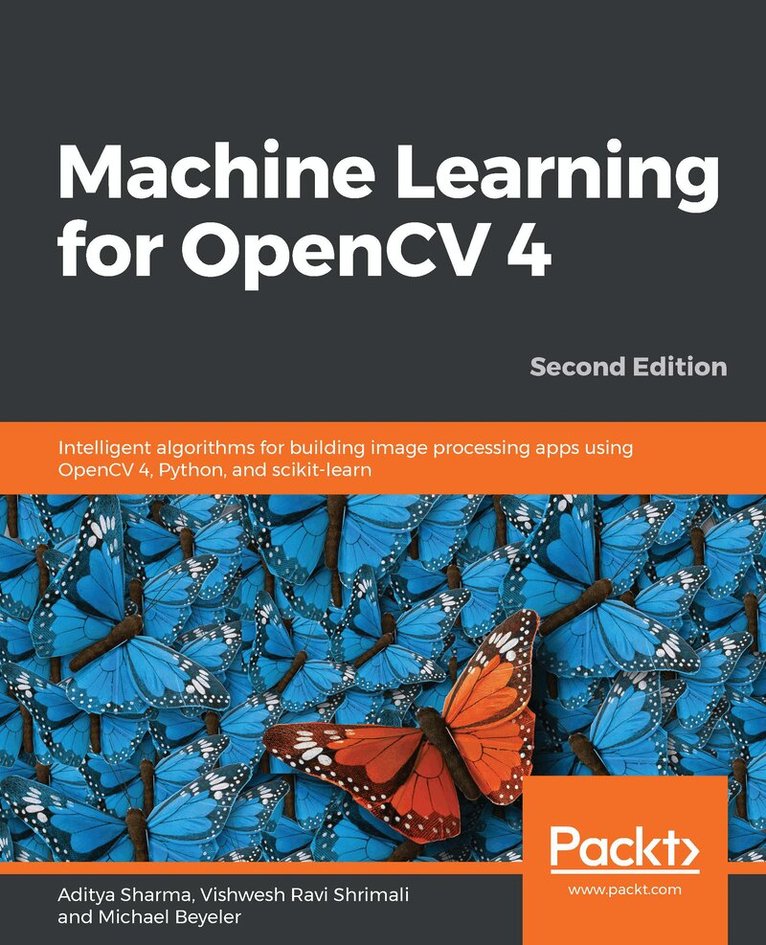
    Machine Learning for OpenCV 4

    Intelligent algorithms for building image processing apps using OpenCV 4, Python, and scikit-learn

    AvAditya Sharma,Michael Beyeler (USD)

    Häftad, Engelska, 2019

    651 kr

    Beställningsvara. Skickas inom 5-8 vardagar. Fri frakt över 249 kr.

    Beskrivning

    A practical guide to understanding the core machine learning and deep learning algorithms, and implementing them to create intelligent image processing systems using OpenCV 4Key FeaturesGain insights into machine learning algorithms, and implement them using OpenCV 4 and scikit-learnGet up to speed with Intel OpenVINO and its integration with OpenCV 4Implement high-performance machine learning models with helpful tips and best practicesBook DescriptionOpenCV is an opensource library for building computer vision apps. The latest release, OpenCV 4, offers a plethora of features and platform improvements that are covered comprehensively in this up-to-date second edition.You'll start by understanding the new features and setting up OpenCV 4 to build your computer vision applications. You will explore the fundamentals of machine learning and even learn to design different algorithms that can be used for image processing. Gradually, the book will take you through supervised and unsupervised machine learning. You will gain hands-on experience using scikit-learn in Python for a variety of machine learning applications. Later chapters will focus on different machine learning algorithms, such as a decision tree, support vector machines (SVM), and Bayesian learning, and how they can be used for object detection computer vision operations. You will then delve into deep learning and ensemble learning, and discover their real-world applications, such as handwritten digit classification and gesture recognition. Finally, you’ll get to grips with the latest Intel OpenVINO for building an image processing system.By the end of this book, you will have developed the skills you need to use machine learning for building intelligent computer vision applications with OpenCV 4.What you will learnUnderstand the core machine learning concepts for image processingExplore the theory behind machine learning and deep learning algorithm designDiscover effective techniques to train your deep learning modelsEvaluate machine learning models to improve the performance of your modelsIntegrate algorithms such as support vector machines and Bayes classifier in your computer vision applicationsUse OpenVINO with OpenCV 4 to speed up model inferenceWho this book is forThis book is for Computer Vision professionals, machine learning developers, or anyone who wants to learn machine learning algorithms and implement them using OpenCV 4. If you want to build real-world Computer Vision and image processing applications powered by machine learning, then this book is for you. Working knowledge of Python programming is required to get the most out of this book.

    Produktinformation

    • Utgivningsdatum:2019-09-06
    • Mått:191 x 235 x 23 mm
    • Vikt:780 g
    • Format:Häftad
    • Språk:Engelska
    • Antal sidor:420
    • Upplaga:2
    • Förlag:Packt Publishing Limited
    • ISBN:9781789536300

    Utforska kategorier

    • Artificiell intelligens inom Data och IT

    Mer om författaren

    Aditya Sharma is a senior engineer at Robert Bosch working on solving real-world autonomous computer vision problems. At Robert Bosch, he also secured first place at an AI hackathon 2019. He has been associated with some of the premier institutes of India, including IIT Mandi and IIIT Hyderabad. At IIT, he published papers on medical imaging using deep learning at ICIP 2019 and MICCAI 2019. At IIIT, his work revolved around document image super-resolution.He is a motivated writer and has written many articles on machine learning and deep learning for DataCamp and LearnOpenCV. Aditya runs his own YouTube channel and has contributed as a speaker at the NCVPRIPG conference (2017) and Aligarh Muslim University for a workshop on deep learning. Michael Beyeler is a postdoctoral fellow in neuroengineering and data science at the University of Washington, where he is working on computational models of bionic vision in order to improve the perceptual experience of blind patients implanted with a retinal prosthesis (bionic eye).His work lies at the intersection of neuroscience, computer engineering, computer vision, and machine learning. He is also an active contributor to several open source software projects, and has professional programming experience in Python, C/C++, CUDA, MATLAB, and Android. Michael received a PhD in computer science from the University of California, Irvine, and an MSc in biomedical engineering and a BSc in electrical engineering from ETH Zurich, Switzerland. Vishwesh Ravi Shrimali graduated from BITS Pilani, where he studied mechanical engineering, in 2018. He also completed his Masters in Machine Learning and AI from LJMU in 2021. He has authored - Machine learning for OpenCV (2nd edition), Computer Vision Workshop and Data Science for Marketing Analytics (2nd edition) by Packt. When he is not writing blogs or working on projects, he likes to go on long walks or play his acoustic guitar. Michael Beyeler is a postdoctoral fellow in neuroengineering and data science at the University of Washington, where he is working on computational models of bionic vision in order to improve the perceptual experience of blind patients implanted with a retinal prosthesis (bionic eye).His work lies at the intersection of neuroscience, computer engineering, computer vision, and machine learning. He is also an active contributor to several open source software projects, and has professional programming experience in Python, C/C++, CUDA, MATLAB, and Android. Michael received a PhD in computer science from the University of California, Irvine, and an MSc in biomedical engineering and a BSc in electrical engineering from ETH Zurich, Switzerland.

    Innehållsförteckning

    • Table of ContentsA Taste of Machine LearningWorking with Data in OpenCVFirst Steps in Supervised LearningRepresenting Data and Engineering FeaturesUsing Decision Trees to Make a Medical DiagnosisDetecting Pedestrians with Support Vector MachinesImplementing a Spam Filter with Bayesian LearningDiscovering Hidden Structures with Unsupervised LearningUsing Deep Learning to Classify Handwritten DigitsEnsemble Methods for ClassificationSelecting the Right Model with Hyperparameter TuningUsing OpenVINO with OpenCVConclusion