• Fri frakt över 249 kr
  • •
  • Snabba leveranser
  • •
  • Billiga böcker
Kundservice

Du är på sajten för privatpersoner.

Företag, bibliotek eller offentlig verksamhet?

Du handlar på classic.bokus.com, där alla dina funktioner finns intakta.
Till classic.bokus.com
Bokus logotyp. Gå till startsidan.
  • Erbjudanden
  • Student
  • Topplistor
  • Barn & ungdom
  • Bokus Play
  • E-böcker
  • Ljudböcker
  • Pocketböcker
  • Spel och pussel

Pocketfynda! Hundratals böcker för 49 kr/st →

Sidfot

Mina sidor

    Hjälp

    • Kundservice
    • Vanliga frågor och svar
    • Frakt och leverans
    • Retur vid ångerrätt
    • Reklamera vara
    • Betalning
    • Köpvillkor
    • Allmänna villkor
    • Information om webbplatsens tillgänglighet

    Om Bokus

    • Om oss
    • Pressrum
    • För studenter
    • För företag
    • För bibliotek och offentlig verksamhet
    • För leverantörer
    • Hållbarhet

    Populärt

    • Aktuella erbjudanden
    • Presentkort
    • Studentlitteratur
    • Nya böcker
    • Topplistor
    • Signerade böcker
    • Engelska böcker

    Inspiration

    • Boktips
    • BookTok
    • Barnbokskaraktärer
    • Populära författare
    Logotyp för Bokus
    Följ oss på Facebook (extern länk)Följ oss på Instagram (extern länk)Följ oss på YouTube (extern länk)Följ oss på TikTok (extern länk)
    bokus @ CookiesAnpassa cookiesIntegritetspolicyKöpvillkor
    Till Citymail hemsida (extern länk)Till Budbee hemsida (extern länk)Till Postnord hemsida (extern länk)Till Schenker hemsida (extern länk)Till Early Bird hemsida (extern länk)Till Walleys hemsida (extern länk)
    1. Historia och arkeologi
    2. Arkeologi
    3. Arkeologiska perioder och områden

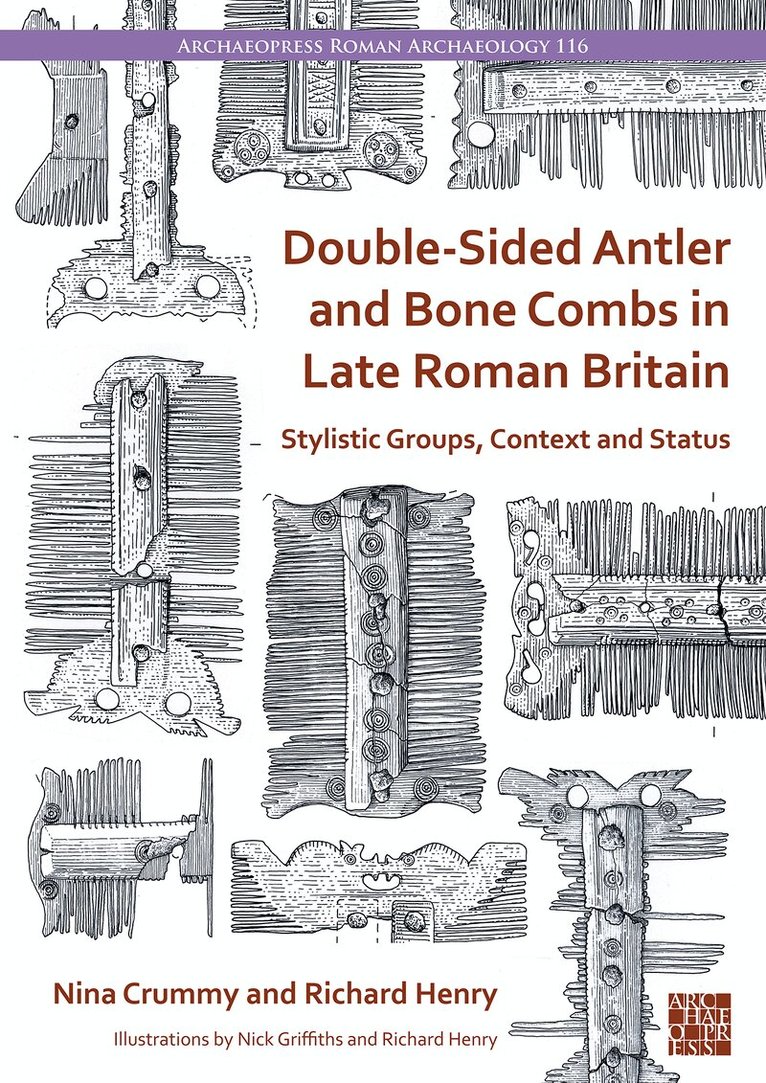
    Double-Sided Antler and Bone Combs in Late Roman Britain

    Stylistic Groups, Context and Status

    AvNina Crummy,Richard Henry

    Häftad, Engelska, 2024

    Del 116 i serien Archaeopress Roman Archaeology

    464 kr

    Skickas . Fri frakt över 249 kr.

    Beskrivning

    Double-Sided Antler and Bone Combs in Late Roman Britain offers the first detailed study and catalogue of a comb type that represents a new technology introduced into Britain towards the end of the 4th century AD and a major signifier of the late fourth- to fifth-century transition. Their end-plates were worked into a variety of decorative profiles, some clearly zoomorphic. Over time this decorative styling passed from elaborate to rudimentary, adding to the dating evidence for individual combs. As many combs survive only as small fragments, data collection has not been absolute but has concentrated on combs from burials, or with stylistically relevant end-plates, or those providing good dating or contextual evidence, the main aim of the study being to answer questions of typology, chronology and social distribution. A particularly distinctive feature within the assemblage from funerary contexts is the substantial number of these combs from Winchester, which together make up nearly a quarter of the wider British assemblage. It is proposed that a comb workshop was established in the town, and there is some evidence based on style and distribution that points to other workshops in the north and east, but these were not necessarily large and in some cases they appeared to serve only a local community, while Winchester and its hinterland appear to lie at the heart of the comb data.

    Produktinformation

    • Utgivningsdatum:2024-05-16
    • Mått:205 x 289 x 11 mm
    • Vikt:726 g
    • Format:Häftad
    • Språk:Engelska
    • Serie:Archaeopress Roman Archaeology
    • Antal sidor:148
    • Förlag:Archaeopress
    • Illustratör:Nick Griffiths
    • ISBN:9781803276441

    Utforska kategorier

    • Arkeologiska perioder och områden inom Historia och arkeologi

    Mer om författaren

    Nina Crummy is an independent researcher working mainly on Roman small finds from eastern and southern England. Chiefly known for her work on small finds from Colchester, Winchester and Silchester. her research interests include zoomorphic objects and items made from skeletal materials. Graduating from Keele University in 1971, she has an MA from the University of Wales Trinity St David (2014) and is a Senior Visiting Research Fellow of the University of Reading.Richard Henry is a Doctoral Research Student at the University of Reading and Curator of Archaeology for Southampton City Council. A find specialist and numismatist, he has a particular interest in late Roman Britain and the 5th century transition. A graduate of the University of Wales, Lampeter, he gained an MSc from Bournemouth University (2016), where he is a Visiting Research Fellow. While the Finds Liaison Officer for Wiltshire, he curated the award-winning exhibition ‘Terry Pratchett: HisWorld’.

    Innehållsförteckning

    • Preface and Acknowledgements Chapter 1: Introducing the combsThe datasetTerminologyThe combs in a wider contextCombs and Winchester: a preliminary note Chapter 2: Their date of arrival in BritainThe evidenceAnomalies explainedContemporary material and events Chapter 3: Manufacture and marketingManufactureMarketing Chapter 4: Aspects of the assemblageLate Roman or Anglo-Saxon?Other forms of composite comb used in late Roman BritainAn unusual variant Chapter 5: Stylistic groupsCustomised combs or devolved designs?Horse combsDolphin and Devolved Dolphin combsOwl combsStraight-centred combs with long connecting-plates: very Devolved Dolphins/OwlsConcave-ended combsEnd-plate groups and connecting-plate design Chapter 6: Distribution and contextDistribution and possible production centresDistribution by end-plate groupArchaeological contexts: baths, votives and burialsSite type Chapter 7: Combs from funerary contextsGenderThe importance of ageFemale status and identityComb positionBody positionEthnicity Chapter 8: ConclusionConcentrations and gapsBurial data and typologyValued objects, further research CatalogueCombs from inhumation burialsOther combs from cemeteries (disturbed grave goods?)Combs from non-funerary contextsSites with double-sided composite combs not in the catalogue but used in Figure 6.1 Appendix 1: Combs by the sex and age of the human remainsAppendix 2: Concordance by end-plate groupAppendix 3: Concordance by site typeBibliography