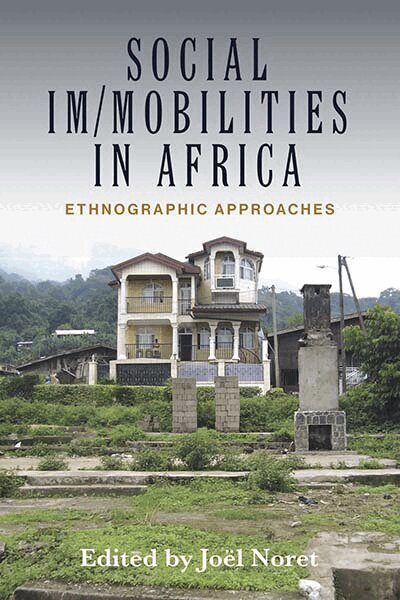
Social Im/mobilities in Africa
Ethnographic Approaches
511 kr
Beställningsvara. Skickas inom 5-8 vardagar. Fri frakt över 249 kr.
Du är på sajten för privatpersoner.
511 kr
Beställningsvara. Skickas inom 5-8 vardagar. Fri frakt över 249 kr.
Joël Noret is Professor of Anthropology at the Université libre de Bruxelles. He has conducted most of his fieldwork in Southern Benin, where he works on urban transformation and the production of social inequality.
“Readers will be impressed by the diverse range of case studies and detailed evidence from people’s personal lives. Overall, the chapters emphasize the importance of taking a multidimensional and interdisciplinary approach to understanding social mobility. Although this is a highly specialized field of study, the topics and chapters are well written and accessible enough to be of value to a wide range of readers…Recommended” • Choice“Whereas many edited books appear fragmented, this book comes across as consistent and well edited…This book fills empirical gaps and provides theoretical nuances, not only to simplistic notions of the current African narratives, but also to our conceptual understanding of social mobility.” • African Studies Review“This is a very important and timely contribution to the study of mobilities and immobilities in Africa. The volume advances our understanding of social positionalities as these intertwine and mediate with wider political and moral economies in contemporary Africa.” • Mattia Fumanti, University of St Andrews“Addresses thorny, contemporary realities and draws on a really thought-provoking theoretical palette in opening up debate. Moving beyond social inequality and linear ideas of social mobility is a sort of manifesto that others will take up.” • David Pratten, University of Oxford
Du är på sajten för privatpersoner.
511 kr
Beställningsvara. Skickas inom 5-8 vardagar. Fri frakt över 249 kr.
Joël Noret is Professor of Anthropology at the Université libre de Bruxelles. He has conducted most of his fieldwork in Southern Benin, where he works on urban transformation and the production of social inequality.
“Readers will be impressed by the diverse range of case studies and detailed evidence from people’s personal lives. Overall, the chapters emphasize the importance of taking a multidimensional and interdisciplinary approach to understanding social mobility. Although this is a highly specialized field of study, the topics and chapters are well written and accessible enough to be of value to a wide range of readers…Recommended” • Choice“Whereas many edited books appear fragmented, this book comes across as consistent and well edited…This book fills empirical gaps and provides theoretical nuances, not only to simplistic notions of the current African narratives, but also to our conceptual understanding of social mobility.” • African Studies Review“This is a very important and timely contribution to the study of mobilities and immobilities in Africa. The volume advances our understanding of social positionalities as these intertwine and mediate with wider political and moral economies in contemporary Africa.” • Mattia Fumanti, University of St Andrews“Addresses thorny, contemporary realities and draws on a really thought-provoking theoretical palette in opening up debate. Moving beyond social inequality and linear ideas of social mobility is a sort of manifesto that others will take up.” • David Pratten, University of Oxford