• Fri frakt över 249 kr
  • •
  • Snabba leveranser
  • •
  • Billiga böcker
Kundservice

Du är på sajten för privatpersoner.

Företag, bibliotek eller offentlig verksamhet?

Du handlar på classic.bokus.com, där alla dina funktioner finns intakta.
Till classic.bokus.com
Bokus logotyp. Gå till startsidan.
  • Erbjudanden
  • Nyheter
  • Student
  • Topplistor
  • Barn & ungdom
  • Bokus Play
  • E-böcker
  • Pocketböcker
  • Spel & pussel

10% rabatt på allt med kod: NYSTART10 →

Sidfot

Mina sidor

    Hjälp

    • Kundservice
    • Vanliga frågor och svar
    • Frakt och leverans
    • Retur vid ångerrätt
    • Reklamera vara
    • Betalning
    • Köpvillkor
    • Allmänna villkor
    • Information om webbplatsens tillgänglighet

    Om Bokus

    • Om oss
    • Pressrum
    • För studenter
    • För företag
    • För bibliotek och offentlig verksamhet
    • För leverantörer
    • Hållbarhet

    Populärt

    • Aktuella erbjudanden
    • Presentkort
    • Studentlitteratur
    • Nya böcker
    • Topplistor
    • Signerade böcker
    • Engelska böcker

    Inspiration

    • Boktips
    • BookTok
    • Populära bokserier
    • Barnbokskaraktärer
    • Populära författare
    Logotyp för Bokus
    Följ oss på Facebook (extern länk)Följ oss på Instagram (extern länk)Följ oss på YouTube (extern länk)Följ oss på TikTok (extern länk)
    bokus @ CookiesAnpassa cookiesIntegritetspolicyKöpvillkor
    Till Citymail hemsida (extern länk)Till Budbee hemsida (extern länk)Till Postnord hemsida (extern länk)Till Schenker hemsida (extern länk)Till Early Bird hemsida (extern länk)Till Walleys hemsida (extern länk)
    1. Samhälle och politik
    2. Samhälle och kultur
    3. Sociala grupper och identitet

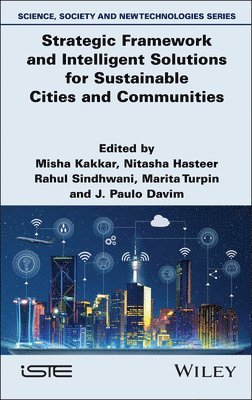
    Strategic Framework and Intelligent Solutions for Sustainable Cities and Communities

    AvMisha Kakkar,Misha Kakkar

    Inbunden, Engelska, 2025

    Del i serien ISTE Invoiced

    1 731 kr

    Beställningsvara. Skickas inom 5-8 vardagar. Fri frakt över 249 kr.

    Beskrivning

    In developing economies, due to rising population and increasing migration, cities are rapidly growing. By 2050, two-thirds of all humanity (6.5 billion people) will be living in cities. Sustainable development cannot be achieved without significantly transforming how we build and manage our cities and develop communities. There is an urgent need to make our cities sustainable (i.e. creating more jobs, safe and affordable housing, and building resilient societies and economies). Technology has always been a crucial driver for economic development, and AI, IoT and Data Science should be leveraged to manage public transport, clean water and eco-friendly ways to manage waste, improve urban planning and create a sustainable environment for growth. Strategic Framework and Intelligent Solutions for Sustainable Cities and Communities is a compilation of recent advancements in disruptive technologies such as AI, IoT, and Data Science, and ways to combat the challenges that are necessary for making our cities and communities sustainable.

    Produktinformation

    • Utgivningsdatum:2025-09-10
    • Mått:156 x 234 x 13 mm
    • Vikt:585 g
    • Format:Inbunden
    • Språk:Engelska
    • Serie:ISTE Invoiced
    • Antal sidor:224
    • Förlag:ISTE Ltd
    • ISBN:9781836690641

    Utforska kategorier

    • Sociala grupper och identitet inom Samhälle och politik

    Mer om författaren

    Misha Kakkar is Associate Professor and Head of Accreditation, Ranking and Quality Assurance at the Amity School of Engineering and Technology, Amity University Uttar Pradesh, India.Nitasha Hasteer is Professor, Head of the Information Technology Department and Deputy Director (Academics) at the Amity School of Engineering and Technology, Amity University Uttar Pradesh, India.Rahul Sindhwani is Assistant Professor at IIM Sambalpur, India.Marita Turpin is Full Professor in Informatics at the University of Pretoria, South Africa.J. Paulo Davim is Full Professor at the University of Aveiro, Portugal, and a Fellow (FIET) of the Institution of Engineering and Technology (UK).

    Innehållsförteckning

    • Preface xiChapter 1 Artificial Intelligence and Sustainable Development Goals: An Overview 1Misha KAKKAR1.1 Introduction 11.1.1 SDG 1 – no poverty 31.1.2 SDG 2 – zero hunger 51.1.3 SDG 3 – good health and well-being 71.1.4 SDG 4 – quality education 101.1.5 SDG 6 – clean water and sanitation 111.1.6 SDG 7 – affordable and clean energy 121.1.7 SDG 8 – decent work and economic growth 141.1.8 SDG 11 – sustainable cities and communities 151.1.9 SDG 13 – climate change 191.1.10 SDG 14 – life below water 211.1.11 SDG 15 – life on land 211.2 Conclusion 221.3 References 23Chapter 2 Technologies and Frameworks for Sustainable Smart Cities 25Depalle Sandhya RANI, Jagu Yeswanth Sai MAHESH, Swati SUCHARITA and Meerja Akhil JABBAR2.1 Introduction: embracing smart cities 262.1.1 Technological infrastructure: a backbone of smart cities 272.1.2 The role of AI in smart cities 282.1.3 IoT and data connectivity 292.1.4 Case study: Singapore’s smart nation 292.1.5 Environmental sustainability in smart cities 312.1.6 Challenges and opportunities 312.1.7 Future research and innovations 332.2 Technologies used in smart cities 332.2.1 AI in smart cities 332.2.2 AI-driven traffic management systems 342.2.3 AI in predictive infrastructure maintenance 342.2.4 Internet of Things: enabling connectivity 342.2.5 IoT in waste management 352.2.6 IoT in public utilities 352.2.7 Internet of Medical Things: enhancing public health 362.2.8 IoMT in disease monitoring and outbreak prediction 362.2.9 Cloud computing in smart cities 362.2.10 Edge computing: processing data locally 372.2.11 The role of 5G in enabling smart city technologies 372.2.12 Industrial Internet of Things in smart cities 372.2.13 IIoT in smart grids 382.2.14 Smart lighting systems 382.2.15 Smart water management systems: enhancing urban water efficiency and safety 382.2.16 Autonomous vehicles in smart cities: transforming urban travel 392.2.17 Smart parking solutions: reducing city congestion and simplifying parking 392.3 Smart buildings: making cities greener and more comfortable for everyday life 402.3.1 Urban air quality monitoring: safeguarding health through real-time data 402.3.2 AI in urban planning: shaping the future of livable cities 412.3.3 Cybersecurity in smart cities 412.3.4 Public safety and emergency response 422.3.5 Smart energy systems 422.3.6 Future of technology in smart cities 422.4 Case study: smart city implementation 432.4.1 Singapore: a model of smart city innovation 432.4.2 The role of AI in traffic management 432.4.3 Real-time traffic monitoring 432.4.4 Predictive analytics for traffic flow 442.4.5 Public transportation and AI integration 442.4.6 Autonomous vehicles: the future of Singapore’s transport 442.4.7 IoT and environmental monitoring 452.4.8 AI in healthcare: revolutionizing public health 452.4.9 IoMT in patient monitoring 462.4.10 AI and predictive healthcare 462.4.11 Telemedicine and AI-driven diagnosis 462.4.12 AI in public health surveillance 472.4.13 Digital twins for city planning 472.4.14 Waste management through smart technology 472.4.15 Smart energy management in Singapore 482.4.16 Water management and AI-driven solutions 482.4.17 Public safety and AI surveillance systems 482.4.18 Smart buildings for energy efficiency 492.5 Challenges in adopting smart cities 512.5.1 High initial costs and investment hurdles 512.5.2 Data privacy and security concerns 512.5.3 Technological infrastructure gaps 512.5.4 Fragmented governance and policy issues 522.5.5 Integration with legacy systems 522.5.6 Lack of technical expertise 532.5.7 Social and cultural barriers 532.5.8 Environmental and sustainability concerns 542.5.9 Political and legal challenges 542.5.10 Ethical considerations in AI and surveillance 552.6 Research directions 562.6.1 AI for predictive urban analytics 562.6.2 Sustainability and smart energy grids 572.6.3 Public–private partnerships in smart city development 572.6.4 Ethical AI in smart cities 572.6.5 AI and public transportation optimization 582.6.6 Data-driven decision-making in urban governance 592.6.7 AI in emergency services and disaster response 592.6.8 Urban air quality management with IoT and AI 592.7 Conclusion 612.8 References 63Chapter 3 IoT-Based Simulation for Emergency Vehicle Corridor for Smart Cities 65Himanshu DIDEN, Hriday CHAWLA, Yashvi SIKKA, Misha KAKKAR and Deepti MEHROTRA3.1 Introduction 653.2 Literature review 663.3 Methodology 703.3.1 Dataset used 703.3.2 Proposed solution 703.3.3 Detection phase 723.3.4 Regulation phase 753.4 Results and discussion 763.4.1 Phase 1: detection of ambulances 763.4.2 Phase 2: representation of traffic signals at a crossing 773.4.3 Regular traffic cycle 783.4.4 Traffic light during ambulance detection 783.5 Conclusion 793.6 References 79Chapter 4 Smart Waste Collection System 83Sumathi PAWAR, Ankitha KESHAV, Vandana BELENJI SANJEEVA and Rajermani THINAKARAN4.1 Introduction 844.1.1 Key components 854.1.2 Advantages of smart garbage systems 874.1.3 Bottlenecks to adoption 884.1.4 Case studies 884.1.5 Applications 894.1.6 Challenges 894.2 Related work 894.3 Methodology 934.3.1 Architecture of the system 944.3.2 Components required 954.4 Results 964.5 Analysis 974.6 Conclusions and future work 994.7 References 99Chapter 5 A Survey on AI Algorithms and Techniques for Developing Intelligent and Sustainable Cities 103Elumalai RAJALAKSHMI and M. SHOBANA5.1 Introduction 1045.1.1 Understanding the need for sustainable and intelligent cities 1045.1.2 Key AI techniques and algorithms 1055.2 Artificial intelligence uses for sustainable urban development 1075.2.1 Intelligent traffic management 1075.2.2 Energy efficiency 1085.2.3 Waste management 1085.2.4 Public safety 1085.2.5 Urban mobility and dynamics 1095.3 Advanced analytical techniques 1095.3.1 Leveraging AI for sustainable urban development: key research insights 1105.3.2 Anomaly detection in energy consumption 1125.3.3 Urban sustainability through air quality prediction 1125.3.4 Crowdsourcing logistics optimization 1125.3.5 Advanced anomaly detection for urban safety 1135.3.6 Innovative techniques in image classification 1135.3.7 Healthcare predictive modeling 1135.3.8 Cybersecurity in urban environments 1135.4 Advancements in intelligent solutions for sustainable urban development 1145.4.1 Taxi passenger hot spot identification 1145.4.2 Object contour recognition 1155.4.3 Freshwater ecosystem optimization 1155.4.4 Freeway incident duration prediction 1155.5 Conclusion 1195.6 Future directions 1195.7 References 120Chapter 6 Machine Learning-based Approaches for Energy Management and Optimization for Smart Cities 123Anil SHARMA, Tushar PANT, Suresh KUMAR and Pawan KUMAR6.1 Introduction 1246.1.1 Smart energy management systems 1256.1.2 Artificial intelligence and ML applications in SGs 1276.1.3 Cloud computing and IoT integration for energy management 1286.2 Literature review 1306.2.1 Smart meters in energy management 1316.2.2 Cloud computing 1316.2.3 Artificial intelligence and machine learning 1326.2.4 Internet of Things 1346.2.5 Communication technologies (ZigBee, Wi-Fi, WiMAX) 1356.2.6 Renewable energy integration 1356.2.7 Smart homes and buildings 1366.3 Discussion 1376.4 Conclusion 1396.5 Future work 1406.5.1 Enhanced AI and machine learning models 1406.5.2 Integration with renewable energy sources 1416.5.3 Cybersecurity and privacy 1416.5.4 Scalability and interoperability of IoT systems 1426.5.5 Smart grids and decentralized energy management 1426.5.6 Human-centric energy management 1426.6 References 143Chapter 7 Analyzing Accessible Learning Using Summarization for Communities 147Misha KAKKAR, Anuranjana SHARMA and Jeteish Pratap SINGH7.1 Introduction 1477.2 Literature review 1487.3 Proposed solution 1517.4 Results and discussion 1527.5 Conclusion 1537.6 Future scope 1537.7 References 154Chapter 8 Ranking of Smart Cities in India: IF-MOORA Approach 157Renuka NAGPAL, Deepti MEHROTRA and Rajni SEHGAL8.1 Introduction 1588.2 Literature review 1608.3 IF-MOORA method 1648.4 Results and discussion 1688.4.1 Process of selecting smart cities 1688.4.2 Process of selecting the criteria 1708.4.3 Selection of DM 1728.4.4 Perform process of application of IF-MOORA 1728.5 Conclusion 1788.6 References 179List of Authors 183Index 187