• Fri frakt över 249 kr
  • •
  • Snabba leveranser
  • •
  • Billiga böcker
Kundservice

Du är på sajten för privatpersoner.

Företag, bibliotek eller offentlig verksamhet?

Du handlar på classic.bokus.com, där alla dina funktioner finns intakta.
Till classic.bokus.com
Bokus logotyp. Gå till startsidan.
  • Erbjudanden
  • Nyheter
  • Student
  • Topplistor
  • Barn & ungdom
  • Bokus Play
  • E-böcker
  • Pocketböcker
  • Spel & pussel

10% rabatt på allt med kod NYSTART10 →

Sidfot

Mina sidor

    Hjälp

    • Kundservice
    • Vanliga frågor och svar
    • Frakt och leverans
    • Retur vid ångerrätt
    • Reklamera vara
    • Betalning
    • Köpvillkor
    • Allmänna villkor
    • Information om webbplatsens tillgänglighet

    Om Bokus

    • Om oss
    • Pressrum
    • För studenter
    • För företag
    • För bibliotek och offentlig verksamhet
    • För leverantörer
    • Hållbarhet

    Populärt

    • Aktuella erbjudanden
    • Presentkort
    • Studentlitteratur
    • Nya böcker
    • Topplistor
    • Signerade böcker
    • Engelska böcker

    Inspiration

    • Boktips
    • BookTok
    • Populära bokserier
    • Barnbokskaraktärer
    • Populära författare
    Logotyp för Bokus
    Följ oss på Facebook (extern länk)Följ oss på Instagram (extern länk)Följ oss på YouTube (extern länk)Följ oss på TikTok (extern länk)
    bokus @ CookiesAnpassa cookiesIntegritetspolicyKöpvillkor
    Till Citymail hemsida (extern länk)Till Budbee hemsida (extern länk)Till Postnord hemsida (extern länk)Till Schenker hemsida (extern länk)Till Early Bird hemsida (extern länk)Till Walleys hemsida (extern länk)
    1. Naturvetenskap och teknik
    2. Teknik och industri
    3. Elektronik och kommunikationer

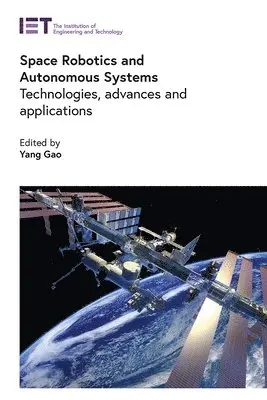
    Space Robotics and Autonomous Systems

    Technologies, advances and applications

    AvYang Gao

    Inbunden, Engelska, 2021

    Del i serien Control, Robotics and Sensors

    1 778 kr

    Beställningsvara. Skickas inom 3-6 vardagar. Fri frakt över 249 kr.

    Beskrivning

    Space robotics and autonomous systems (Space RAS) play a critical role in the current and future development of mission-defined machines that can survive in space while performing exploration, assembly, construction, maintenance and servicing tasks. They represent a multi-disciplinary emerging field at the intersection of space engineering, terrestrial robotics, computer science and materials. The field is essential to humankind's ability to explore or operate in space; providing greater access beyond human spaceflight limitations in the harsh environment of space, and offering greater operational handling that extends astronauts' capabilities. Space RAS covers all types of robotics for the exploration of planet surfaces as well as robotics used in orbit around the Earth and the sensors needed by the platform for navigation or control.Written by a team of International experts on space RAS, this book covers advanced research, technologies and applications including: sensing and perception to provide situational awareness for space robotic agents, explorers and assistants; mobility to reach and operate at sites of scientific interest on extra-terrestrial surfaces or free space environments using locomotion; manipulations to make intentional changes in the environment or objects using locomotion such as placing, assembling, digging, trenching, drilling, sampling, grappling and berthing; high-level autonomy for system and sub-systems to provide robust and safe autonomous navigation, rendezvous and docking capabilities and to enable extended-duration operations without human interventions to improve overall performance of human and robotic missions; human-robot interaction and multi-modal interaction; system engineering to provide a framework for understanding and coordinating the complex interactions of robots and achieving the desired system requirements; verification and validation of complex adaptive systems; modelling and simulation; and safety and trust.

    Produktinformation

    • Utgivningsdatum:2021-10-19
    • Mått:156 x 234 x 28 mm
    • Vikt:953 g
    • Format:Inbunden
    • Språk:Engelska
    • Serie:Control, Robotics and Sensors
    • Antal sidor:486
    • Förlag:Institution of Engineering and Technology
    • ISBN:9781839532252

    Utforska kategorier

    • Elektronik och kommunikationer inom Naturvetenskap och teknik
    • Flyg- och rymdteknik inom Naturvetenskap och teknik

    Mer om författaren

    Yang Gao is the Professor of Space Autonomous Systems at Surrey Space Centre of the University of Surrey, UK. Prof. Gao founded and heads the multi-awards winning Space Technology for Autonomous and Robotic systems Laboratory (STAR LAB), which specializes in robotic sensing, perception, visual GNC and biomimetic mechanisms for industrial applications in extreme environments. She has been the Principal Investigator of internationally teamed projects funded by UK Research Councils, InnovateUK, Royal Academy of Engineering, European Commission, European Space Agency (ESA), UK Space Agency, as well as industrial companies. She has also been actively involved in real-world space missions such as ESA's ExoMars, Proba3 and VMMO, UK's MoonLITE/Moonraker, and CNSA Chang'E3.Prof. Gao is an elected Fellow of the Institute of Engineering and Technology (IET) and the Royal Aeronautical Society (RAeS). She was named by the Times Higher Education in 2008 as one of ten UK's young leading academics who are making a very significant contribution to their disciplines, and was also awarded the Mulan Award in 2019 for Contributions to Science, Technology and Engineering. Research work under her leadership and supervision has also received many international recognitions such as the IAF's 3AF Edmond Brun Silver Medal, COSPAR's Outstanding Paper Award, Top places in ESA Grand Challenges, etc.Prof. Gao holds a B. Eng (1st Hons) and Ph.D. on electrical and control engineering from the Nanyang Technological University, Singapore.

    Innehållsförteckning

    • Chapter 1: IntroductionPart I: Mobility and mechanismsChapter 2: Wheeled planetary rover locomotion design, scaling, and analysisChapter 3: Compliant pneumatic muscle structures and systems for extra-vehicular and intra-vehicular activities in space environmentsChapter 4: Biologically-inspired mechanisms for space applications Part II: Sensing, perception and GNCChapter 5: Autonomous visual navigation for spacecraft on-orbit operationsChapter 6: Inertial parameter identification, reactionless path planning and control for orbital robotic capturing of unknown objectsChapter 7: Autonomous robotic grasping in orbital environment Part III: Astronaut-robot interactionChapter 8: BCI for mental workload assessment and performance evaluation in space teleoperationsChapter 9: Physiological adaptations in space and wearable technology for biosignal monitoringChapter 10: Future of human-robot interaction in space Part: IV System engineeringChapter 11: Verification for space roboticsChapter 12: Cyber security of new space systems