• Fri frakt över 249 kr
  • •
  • Snabba leveranser
  • •
  • Billiga böcker
Kundservice

Du är på sajten för privatpersoner.

Företag, bibliotek eller offentlig verksamhet?

Du handlar på classic.bokus.com, där alla dina funktioner finns intakta.
Till classic.bokus.com
Bokus logotyp. Gå till startsidan.
  • Erbjudanden
  • Nyheter
  • Student
  • Topplistor
  • Barn & ungdom
  • Bokus Play
  • E-böcker
  • Pocketböcker
  • Spel & pussel

Må bättre, för mindre! Upp till 50% rabatt på hälsoböcker

Sidfot

Mina sidor

    Hjälp

    • Kundservice
    • Vanliga frågor och svar
    • Frakt och leverans
    • Retur vid ångerrätt
    • Reklamera vara
    • Betalning
    • Köpvillkor
    • Allmänna villkor
    • Information om webbplatsens tillgänglighet

    Om Bokus

    • Om oss
    • Pressrum
    • För studenter
    • För företag
    • För bibliotek och offentlig verksamhet
    • För leverantörer
    • Hållbarhet

    Populärt

    • Aktuella erbjudanden
    • Presentkort
    • Studentlitteratur
    • Nya böcker
    • Topplistor
    • Signerade böcker
    • Engelska böcker

    Inspiration

    • Boktips
    • BookTok
    • Populära bokserier
    • Barnbokskaraktärer
    • Populära författare
    Logotyp för Bokus
    Följ oss på Facebook (extern länk)Följ oss på Instagram (extern länk)Följ oss på YouTube (extern länk)Följ oss på TikTok (extern länk)
    bokus @ CookiesAnpassa cookiesIntegritetspolicyKöpvillkor
    Till Citymail hemsida (extern länk)Till Budbee hemsida (extern länk)Till Postnord hemsida (extern länk)Till Schenker hemsida (extern länk)Till Early Bird hemsida (extern länk)Till Walleys hemsida (extern länk)
    1. Ekonomi och Ledarskap
    2. Nationalekonomi
    3. Internationell ekonomi

    From Reversal of Fortune to Economic Resurgence

    Industrialization and Leadership in Asia’s Prosperity and Nigeria’s Regress

    AvBanji Oyelaran-Oyeyinka,Oyebanke Abejirin

    Inbunden, Engelska, 2024

    1 064 kr

    Skickas . Fri frakt över 249 kr.

    Fler format och utgåvor

    Häftad

    422 kr

    Beskrivning

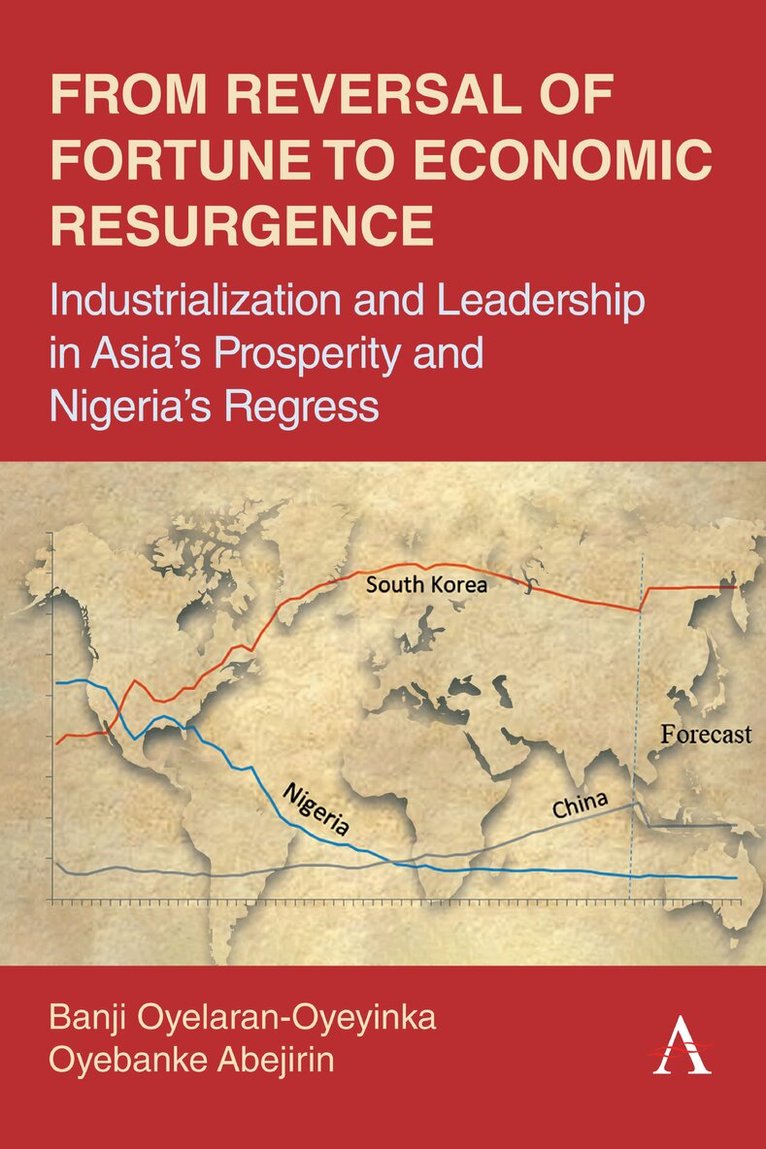
    This book examines Nigeria, Africa’s largest economy and most populous country, and Asia in comparative development and sectoral perspectives. We traced the divergent growth in wealth between the two regions. It takes a novel approach of matching key growth sectors across five selected Asian countries and Nigeria in a cross-regional context. We found that state and institutional capabilities underlying the generation and diffusion of industrial and technological knowledge in Asia distinguished it from Africa. We employ quantitative and qualitative methods, including case studies and statistical/econometric methods, to analyze factors that separate the sample countries that made rapid economic progress in “catching up” and those that tend to be stagnating and “falling behind.”Progress made by Asian countries over the last five decades was due in large part to their pursuit of industrialization, technological acquisition underpinned by leadership, good governance, and policies in the right institutional contexts. The four Asian countries compared with Nigeria are Indonesia, Malaysia, South Korea, Vietnam, and Bangladesh. There was not one grand development formula; however, the strategy broadly consisted of industrial (vertical) diversification as well as (horizontal) diversification in agriculture. Building industrial capabilities that enable export competitiveness was critical. Again, while leadership is not usually included in factors of growth, the book devotes a chapter to Leadership and Industrialization and another to State Capacity Industrialization and Economic Growth.African countries on the contrary took the low road in exporting minerals and raw agricultural commodities with little value addition; in the process, Africa experienced a reversal of fortune. The African condition is manifestly a Reversal of Fortune because in the 1950s, they were ahead of, or equal to, Asia in per capita income as well as in other development metrics.We carried out empirical measurement of Reversal of Fortune manifested in economic, social, technological, and industrial conditions by analyzing the disparities in development metrics, particularly the levels and rates of growth of national incomes, industrialization rates, and Human Development Index (HDI). The differences are stark.

    Produktinformation

    • Utgivningsdatum:2024-11-05
    • Mått:153 x 229 x 26 mm
    • Vikt:454 g
    • Format:Inbunden
    • Språk:Engelska
    • Antal sidor:292
    • Förlag:Anthem Press
    • ISBN:9781839991974

    Utforska kategorier

    • Internationell ekonomi inom Ekonomi och Ledarskap

    Mer om författaren

    Professor Banji Oyelaran-Oyeyinka is a renowned global thought leader and the first Nigerian professor in the field of development economics and industrial policy. He is the Senior Special Adviser on Industrialization to the President of the African Development Bank (AfDB) and was recently awarded the National Productivity Order of Merit Award (2021) by the Federal Republic of Nigeria.Dr. Banke Abejirin is a development economist who combines over 15 years of experience in international development, urban planning, research, and strategy consulting. She is currently an Economic Affairs Officer in the Macroeconomic and Governance Division at the United Nations Economic Commission for Africa.

    Recensioner i media

    Book Launch

    Innehållsförteckning

    • Preface; Foreword; Introduction: Nigeria’s Reversal of Fortune: Industrialization Sector Growth and Leadership Failure; Part I - 1. Understanding Development Reversal; 2. Measuring Nigeria’s Reversal of Fortune; 3. Evolution and Structure of the Nigerian Economy; Part II - 4. Vietnam and Nigeria: Divergent Paths to Economic Diversification; 5. An Asian Giant Outpaces the Giant of Africa: Economic Diversification: Nigeria and Indonesia in a Comparative Context; 6. Diversification Success and Failure: Malaysia and Nigeria; 7. Textiles and Garments: The Case of Bangladesh and Nigeria; Part - III 8. Leadership and Economic Development; 9. State Capacity and Development Reversal in Nigeria; Part - IV 10. Conclusions and Proposals for Reversing Development Reversal; Bibliography; Appendix; Index