• Fri frakt över 249 kr
  • •
  • Snabba leveranser
  • •
  • Billiga böcker
Kundservice

Du är på sajten för privatpersoner.

Företag, bibliotek eller offentlig verksamhet?

Du handlar på classic.bokus.com, där alla dina funktioner finns intakta.
Till classic.bokus.com
Bokus logotyp. Gå till startsidan.
  • Erbjudanden
  • Nyheter
  • Student
  • Topplistor
  • Barn & ungdom
  • Bokus Play
  • E-böcker
  • Pocketböcker
  • Spel & pussel

10% rabatt på allt med kod: NYSTART10 →

Sidfot

Mina sidor

    Hjälp

    • Kundservice
    • Vanliga frågor och svar
    • Frakt och leverans
    • Retur vid ångerrätt
    • Reklamera vara
    • Betalning
    • Köpvillkor
    • Allmänna villkor
    • Information om webbplatsens tillgänglighet

    Om Bokus

    • Om oss
    • Pressrum
    • För studenter
    • För företag
    • För bibliotek och offentlig verksamhet
    • För leverantörer
    • Hållbarhet

    Populärt

    • Aktuella erbjudanden
    • Presentkort
    • Studentlitteratur
    • Nya böcker
    • Topplistor
    • Signerade böcker
    • Engelska böcker

    Inspiration

    • Boktips
    • BookTok
    • Populära bokserier
    • Barnbokskaraktärer
    • Populära författare
    Logotyp för Bokus
    Följ oss på Facebook (extern länk)Följ oss på Instagram (extern länk)Följ oss på YouTube (extern länk)Följ oss på TikTok (extern länk)
    bokus @ CookiesAnpassa cookiesIntegritetspolicyKöpvillkor
    Till Citymail hemsida (extern länk)Till Budbee hemsida (extern länk)Till Postnord hemsida (extern länk)Till Schenker hemsida (extern länk)Till Early Bird hemsida (extern länk)Till Walleys hemsida (extern länk)
    1. Ekonomi och Ledarskap
    2. Nationalekonomi

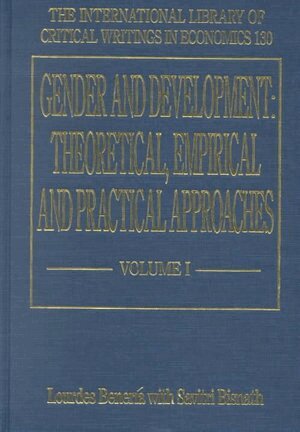
    Gender and Development: Theoretical, Empirical and Practical Approaches

    AvLourdes Benería,Savitri Bisnath

    Inbunden, Engelska, 2001

    Del 130 i serien The International Library of Critical Writings in Economics series

    9 951 kr

    Beställningsvara. Skickas inom 5-8 vardagar. Fri frakt över 249 kr.

    Beskrivning

    This two-volume set brings together a selection of the most significant contributions to the field of gender and development. The key emphasis is on economic analysis, with some articles informed by an interdisciplinary approach. The volumes cover a variety of topics, including conceptual and methodological questions, statistical accounting of women's work, issues related to the family, households and caring labour, poverty, employment and labour markets, structural adjustment policies and social change. The collection will be useful for economists as well as for other social scientists interested in the field of development, women's work, labor markets, and feminist economics.Although the volumes are addressed to an academic audience interested in development issues in general and gender and development in particular, they will also be of interest to government agencies, international organizations, NGOs and other institutions and individuals working on development, policy-making and action from a gender perspective.

    Produktinformation

    • Utgivningsdatum:2001-05-25
    • Mått:169 x 244 x undefined mm
    • Format:Inbunden
    • Språk:Engelska
    • Serie:The International Library of Critical Writings in Economics series
    • Förlag:Edward Elgar Publishing Ltd
    • ISBN:9781840641943

    Utforska kategorier

    • Nationalekonomi inom Ekonomi och Ledarskap
    • Internationell ekonomi inom Ekonomi och Ledarskap
    • Genusvetenskap inom Samhälle och politik

    Mer om författaren

    Edited by Lourdes Benería, Emerita Professor of Post-Graduate Studies, Cornell University, US and Senior Associate, IIEDG (Inter-University Institute on Women and Gender Studies), Spain with Savitri Bisnath, formerly Doctoral Candidate, Cornell University, US

    Recensioner i media

    '. . . a tremendously thorough, carefully considered and organized work, with 54 articles published between 1977 and 2000 presented chronologically by field. . . BenerIa's introductory overview immeasurably helps what may at first seem like the daunting task of taking all this work. In it, we are given a succinct narrative of conceptual developments in the field, as well as a brief summary of each of the volumes' ten parts. . . It is an invaluable and impressive resource for anyone working in or thinking about gender and development; I recommend it highly.'

    Innehållsförteckning

    • Contents:Volume IAcknowledgements • Introduction Lourdes BeneríaPART IECONOMIC DEVELOPMENT AND GENDER 1. Ingrid Palmer (1977), ‘Rural Women and the Basic-Needs Approach to Development’2. Lourdes Benería and Gita Sen (1982), ‘Class and Gender Inequalities and Women’s Role in Economic Development – Theoretical and Practical Implications’3. Nancy Folbre (1986), ‘Cleaning House: New Perspectives on Households and Economic Development’4. Irene Tinker (1990), ‘The Making of a Field: Advocates, Practitioners and Scholars’5. Lourdes Benería (1995), ‘Toward a Greater Integration of Gender in Economics’6. Diane Elson (1999), ‘Theories of Development’PART IIMETHODOLOGICAL APPROACHES 7. Caroline O.N. Moser (1989), ‘Gender Planning in the Third World: Meeting Practical and Strategic Gender Needs’8. Naila Kabeer (1992), ‘Evaluating Cost–Benefit Analysis as a Tool for Gender Planning’9. Diane Elson (1993), ‘Gender-Aware Analysis and Development Economics’10. Kalpana Bardhan and Stephan Klasen (1999), ‘UNDP’s Gender-Related Indices: A Critical Review’PART IIIACCOUNTING FOR WOMEN’S WORK 11. Ruth B. Dixon (1982), ‘Women in Agriculture: Counting the Labour Force in Developing Countries’12. Lourdes Benería (1999), ‘The Enduring Debate over Unpaid Labour’13. Maria Sagrario Floro (1995), ‘Women’s Well-Being, Poverty and Work Intensity’14. Duncan Ironmonger (1996), ‘Counting Outputs, Capital Inputs and Caring Labour: Estimating Gross Household Product’PART IVFAMILIES AND HOUSEHOLDS 15. Amartya Sen (1983), ‘Economics and the Family’16. Nancy Folbre (1988), ‘The Black Four of Hearts: Toward a New Paradigm of Household Economics’17. Nahid Aslanbeigui and Gale Summerfield (1989), ‘Impact of the Responsibility System on Women in Rural China: An Application of Sen’s Theory of Entitlements’18. Diane Wolf (1990), ‘Daughters, Decisions and Domination: An Empirical and Conceptual Critique of Household Strategies’19. Elizabeth Katz (1991), ‘Breaking the Myth of Harmony: Theoretical and Methodological Guidelines to the Study of Rural Third World Households’20. Jeanne Koopman (1991), ‘Neoclassical Household Models and Modes of Household Production: Problems in the Analysis of African Agricultural Households’21. Bina Agarwal (1997), ‘"Bargaining" and Gender Relations: Within and Beyond the Household’PART V PROJECT IMPLEMENTATION AND EMPOWERMENT STRATEGIES 22. Mayra Buvinic (1986), ‘Projects for Women in the Third World: Explaining Their Misbehaviour’23. Ela Bhatt (1989), ‘Toward Empowerment’24. Sally Baden and Anne Marie Goetz (1998), ‘Who Needs [Sex] When You Can Have [Gender]?: Conflicting Discourses on Gender at Beijing’25. Naila Kabeer (1999), ‘Resources, Agency, Achievements: Reflections on the Measurement of Women’s Empowerment’Name IndexVolume IIAcknowledgementsAn introduction by the editor to both volumes appears in Volume IPART IWOMEN’S ACCESS TO RESOURCES, GENDER AND POVERTY 1. Bina Agarwal (1986), ‘Women, Poverty and Agricultural Growth in India’2. Gillian Hart (1992), ‘Household Production Reconsidered: Gender, Labor Conflict, and Technological Change in Malaysia’s Muda Region’3. Carmen Diana Deere (1995), ‘What Difference Does Gender Make?: Rethinking Peasant Studies’4. Anne Marie Goetz and Rina Sen Gupta (1996), ‘Who Takes the Credit? Gender, Power, and Control over Loan Use in Rural Credit Programs in Bangladesh’5. Cecile Jackson (1998), ‘Rescuing Gender from the Poverty Trap’PART IIGENDER, EMPLOYMENT AND LABOUR MARKETS 6. Aline K. Wong (1981), ‘Planned Development, Social Stratification, and the Sexual Division of Labor in Singapore’7. Linda Y.C. Lim (1983), ‘Capitalism, Imperialism, and Patriarchy: The Dilemma of Third-World Women Workers in Multinational Factories’8. Catherine Hein (1986), ‘The Feminisation of Industrial Employment in Mauritius: A Case of Sex Segregation’9. Nilüfer Çagatay and Günseli Berik (1990), ‘Transition to Export-Led Growth in Turkey: Is There a Feminization of Employment?’10. Jean Larson Pyle and Leslie Dawson (1990), ‘The Impact of Multinational Technological Transfer on Female Workforces in Asia’11. Ruth Pearson (1991), ‘Male Bias and Women’s Work in Mexico’s Border Industries’12. Adrian Wood (1991), ‘North–South Trade and Female Labour in Manufacturing: An Asymmetry’13. Irma Arriagada (1994), ‘Changes in the Urban Female Labour Market’14. Guy Standing (1999), ‘Global Feminization Through Flexible Labor: A Theme Revisited,’PART IIISTRUCTURAL ADJUSTMENT AND ECONOMIC RESTRUCTURING 15. Lawrence Haddad, Lynn R. Brown, Andrea Richter and Lisa Smith (1995), ‘The Gender Dimensions of Economic Adjustment Policies: Potential Interactions and Evidence to Date’16. Diane Elson (1995), ‘Gender Awareness in Modeling Structural Adjustment’17. Nilüfer Çagatay and Sule Ozler (1995), ‘Feminization of the Labor Force: The Effects of Long-Term Development and Structural Adjustment’18. William Darity, Jr. (1995), ‘The Formal Structure of a Gender-Segregated Low-Income Economy’19. Maria Sagrario Floro and Kendall Schaefer (1998), ‘Restructuring of Labor Markets in the Philippines and Zambia: The Gender Dimension’20. Lourdes Benería (1999), ‘Structural Adjustment Policies’PART IVGENDER AND MARKETS21. Gita Sen (1996), ‘Gender, Markets and States: A Selective Review and Research Agenda’22. Nilüfer Çagatay (1996), ‘Gender and International Labor Standards in the World Economy’23. Barbara Harriss-White (1998), ‘Female and Male Grain Marketing Systems: Analytical and Policy Issues for West Africa and India’PART VINSTITUTIONAL AND SOCIAL CHANGE 24. Carmen Diana Deere (1985), ‘Rural Women and State Policy: The Latin American Agrarian Reform Experience’25. Nan Wiegersma (1991), ‘Peasant Patriarchy and the Subversion of the Collective in Vietnam’26. Bina Agarwal (1994), ‘Gender and Command Over Property: A Critical Gap in Economic Analysis and Policy in South Asia’27. Amy Lind (1997), ‘Gender, Development and Urban Social Change: Women’s Community Action in Global Cities’28. Mieke Meurs (1998), ‘Imagined and Imagining Equality in East Central Europe: Gender and Ethnic Differences in the Economic Transformation of Bulgaria’29. Valentine M. Moghadam (2000), ‘Gender and Economic Reforms: A Framework for Analysis and Evidence from Central Asia, the Caucasus, and Turkey’Name Index