• Fri frakt över 249 kr
  • •
  • Snabba leveranser
  • •
  • Billiga böcker
Kundservice

Du är på sajten för privatpersoner.

Företag, bibliotek eller offentlig verksamhet?

Du handlar på classic.bokus.com, där alla dina funktioner finns intakta.
Till classic.bokus.com
Bokus logotyp. Gå till startsidan.
  • Erbjudanden
  • Nyheter
  • Student
  • Topplistor
  • Barn & ungdom
  • Bokus Play
  • E-böcker
  • Pocketböcker
  • Spel & pussel

10% rabatt på allt med kod: NYSTART10 →

Sidfot

Mina sidor

    Hjälp

    • Kundservice
    • Vanliga frågor och svar
    • Frakt och leverans
    • Retur vid ångerrätt
    • Reklamera vara
    • Betalning
    • Köpvillkor
    • Allmänna villkor
    • Information om webbplatsens tillgänglighet

    Om Bokus

    • Om oss
    • Pressrum
    • För studenter
    • För företag
    • För bibliotek och offentlig verksamhet
    • För leverantörer
    • Hållbarhet

    Populärt

    • Aktuella erbjudanden
    • Presentkort
    • Studentlitteratur
    • Nya böcker
    • Topplistor
    • Signerade böcker
    • Engelska böcker

    Inspiration

    • Boktips
    • BookTok
    • Populära bokserier
    • Barnbokskaraktärer
    • Populära författare
    Logotyp för Bokus
    Följ oss på Facebook (extern länk)Följ oss på Instagram (extern länk)Följ oss på YouTube (extern länk)Följ oss på TikTok (extern länk)
    bokus @ CookiesAnpassa cookiesIntegritetspolicyKöpvillkor
    Till Citymail hemsida (extern länk)Till Budbee hemsida (extern länk)Till Postnord hemsida (extern länk)Till Schenker hemsida (extern länk)Till Early Bird hemsida (extern länk)Till Walleys hemsida (extern länk)
    1. Ekonomi och Ledarskap
    2. Nationalekonomi

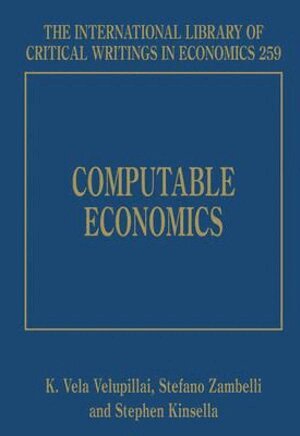
    Computable Economics

    AvK. Vela Velupillai,Stefano Zambelli

    Inbunden, Engelska, 2011

    Del 259 i serien The International Library of Critical Writings in Economics series

    6 717 kr

    Beställningsvara. Skickas inom 5-8 vardagar. Fri frakt över 249 kr.

    Beskrivning

    Computable economics is a growing field of research which has been given much attention by scholars in recent decades. In this authoritative collection, the editors successfully bring together the seminal papers of computable economics from the last sixty years and encompass the works of some of the most influential researchers in this area. Topics covered in this timely volume include the foundations of computable economics, classics of computable choice theory, computable macroeconomics and computable and social choice theory. The book is enhanced with a comprehensive introduction by the editors and will serve as an essential source of reference for students and researchers in the field.

    Produktinformation

    • Utgivningsdatum:2011-12-29
    • Mått:169 x 244 x undefined mm
    • Format:Inbunden
    • Språk:Engelska
    • Serie:The International Library of Critical Writings in Economics series
    • Antal sidor:816
    • Förlag:Edward Elgar Publishing Ltd
    • ISBN:9781843762393

    Utforska kategorier

    • Nationalekonomi inom Ekonomi och Ledarskap
    • Affärsförhandlingar inom Ekonomi och Ledarskap

    Mer om författaren

    Edited by K. Vela Velupillai, Professor of Economics, University of Trento, Italy, Stefano Zambelli, Professor of Economics, University of Trento, Italy and Stephen Kinsella, Lecturer in Economics, University of Limerick, Ireland

    Innehållsförteckning

    • Contents:Acknowledgements Introduction K. Vela Velupillai, Stephen Kinsella and Stefano Zambelli PART I FOUNDATIONS OF COMPUTABLE ECONOMICS 1. Stephen C. Kleene (1981), ‘Origins of Recursive Function Theory’2. A.M. Turing (1954), ‘Solvable and Unsolvable Problems’ PART II MATHEMATICAL AND METHODOLOGICAL FOUNDATIONS OF COMPUTABLE ECONOMICS 3. L.E.J. Brouwer (1952), ‘An Intuitionist Correction of the Fixed-Point Theorem on the Sphere’4. Allen Newell, J.C. Shaw and Herbert A. Simon (1958), ‘Elements of a Theory of Human Problem Solving’5. Ronald Harrop (1961), ‘On The Recursivity of Finite Sets’ 6. H. Steinhaus (1965), ‘Games, An Informal Talk’7. Hilary Putnam ([1967] 1975), ‘The Mental Life of Some Machines’8. Douglas S. Bridges (1999), ‘Constructive Methods in Mathematical Economics’PART III CLASSICS OF COMPUTABLE CHOICE THEORY 9. Douglas S. Bridges (1982), ‘Preference and Utility: A Constructive Development’10. Alain A. Lewis (1985), ‘On Effectively Computable Realizations of Choice Functions’11. Alain A. Lewis (1985), ‘The Minimum Degree of Recursively Representable Choice Functions’12. Berc Rustem and Kumaraswamy Velupillai (1990), ‘Rationality, Computability, and Complexity’13. Gregory Lilly (1993), ‘Recursiveness and Preference Orderings’ PART IV COMPUTABLE GAME THEORY 14. Michael O. Rabin (1957), ‘Effective Computability of Winning Strategies’15. Luca Anderlini (1990), ‘Some Notes on Church’s Thesis and the Theory of Games’16. Kislaya Prasad (1991), ‘Computability and Randomness of Nash Equilibrium in Infinite Games’17. David Canning (1992), ‘Rationality, Computability, and Nash Equilibrium’18. Kislaya Prasad (1997), ‘On the Computability of Nash Equilibria’19. K. (Vela) Velupillai (1997), ‘Expository Notes on Computability and Complexity in (Arithmetical) Games’20. Marcelo Tsuji, Newton C.A. Da Costa and Francisco A. Doria (1998), ‘The Incompleteness of Theories of Games’ PART V COMPUTABLE GENERAL EQUILIBRIUM THEORY 21. Rolf Ricardo Mantel (1968), ‘Toward a Constructive Proof of the Existence of Equilibrium in a Competitive Economy’22. Hirofumi Uzawa (1962), ‘Walras’ Existence Theorem and Brouwer’s Fixed-Point Theorem’23. Herbert E. Scarf (1984), ‘The Computation of Equilibrium Prices’24. K. Vela Velupillai (2006), ‘Algorithmic Foundations of Computable General Equilibrium Theory’25. Yasuhito Tanaka (2008), ‘Undecidability of Uzawa Equivalence Theorem and LLPO (Lesser Limited Principle of Omniscience)’ PART VI COMPUTABLE MACROECONOMICS 26. Stephen E. Spear (1989), ‘Learning Rational Expectations Under Computability Constraints’27. Francesco Luna (1997), ‘Learning in a Computable Setting. Applications of Gold’s Inductive Inference Model’28. Stefano Zambelli (2004), ‘Production of Ideas by Means of Ideas: A Turing Machine Metaphor’29. K. Vela Velupillai (2007), ‘The Impossibility of an Effective Theory of Policy in a Complex Economy’PART VII COMPUTABLE MICROECONOMICS 30. Alain A. Lewis (1991), ‘On the Effective Content of Asymptotic Verifications of Edgeworth’s Conjecture’31. Marcel K. Richter and Kam-Chau Wong (1999), ‘Non-Computability of Competitive Equilibrium’32. K. Vela Velupillai (2009), ‘Uncomputability and Undecidability in Economic Theory’ PART VIII COMPUTABLE AND SOCIAL CHOICE THEORY 33. Alain A. Lewis (1988), ‘An Infinite Version of Arrow’s Theorem in the Effective Setting’34. Jerry S. Kelly (1988), ‘Social Choice and Computational Complexity’35. H. Reiju Mihara (1997), ‘Arrow’s Theorem and Turing Computability’ PART IX EXOTICA 36. A.R.D. Mathias (1992), ‘The Ignorance of Bourbaki’37. Luca Anderlini and Leonardo Felli (1994), ‘Incomplete Written Contracts: Undescribable States of Nature’38. K. Vela Velupillai (2005), ‘The Unreasonable Ineffectiveness of Mathematics in Economics’