• Fri frakt över 249 kr
  • •
  • Snabba leveranser
  • •
  • Billiga böcker
Kundservice

Du är på sajten för privatpersoner.

Företag, bibliotek eller offentlig verksamhet?

Du handlar på classic.bokus.com, där alla dina funktioner finns intakta.
Till classic.bokus.com
Bokus logotyp. Gå till startsidan.
  • Erbjudanden
  • Nyheter
  • Student
  • Topplistor
  • Barn & ungdom
  • Bokus Play
  • E-böcker
  • Pocketböcker
  • Spel & pussel

10% rabatt på allt med kod: NYSTART10 →

Sidfot

Mina sidor

    Hjälp

    • Kundservice
    • Vanliga frågor och svar
    • Frakt och leverans
    • Retur vid ångerrätt
    • Reklamera vara
    • Betalning
    • Köpvillkor
    • Allmänna villkor
    • Information om webbplatsens tillgänglighet

    Om Bokus

    • Om oss
    • Pressrum
    • För studenter
    • För företag
    • För bibliotek och offentlig verksamhet
    • För leverantörer
    • Hållbarhet

    Populärt

    • Aktuella erbjudanden
    • Presentkort
    • Studentlitteratur
    • Nya böcker
    • Topplistor
    • Signerade böcker
    • Engelska böcker

    Inspiration

    • Boktips
    • BookTok
    • Populära bokserier
    • Barnbokskaraktärer
    • Populära författare
    Logotyp för Bokus
    Följ oss på Facebook (extern länk)Följ oss på Instagram (extern länk)Följ oss på YouTube (extern länk)Följ oss på TikTok (extern länk)
    bokus @ CookiesAnpassa cookiesIntegritetspolicyKöpvillkor
    Till Citymail hemsida (extern länk)Till Budbee hemsida (extern länk)Till Postnord hemsida (extern länk)Till Schenker hemsida (extern länk)Till Early Bird hemsida (extern länk)Till Walleys hemsida (extern länk)
    1. Naturvetenskap och teknik
    2. Geovetenskap
    3. Geovetenskap

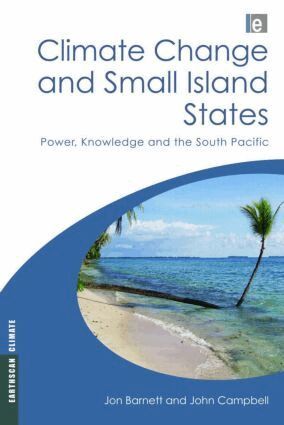
    Climate Change and Small Island States

    Power, Knowledge and the South Pacific

    AvJohn Campbell,Jon Barnett

    Inbunden, Engelska, 2010

    Del i serien Earthscan Climate

    2 423 kr

    Beställningsvara. Skickas inom 10-15 vardagar. Fri frakt över 249 kr.

    Fler format och utgåvor

    E-bok

    939 kr

    E-bok

    866 kr

    Häftad

    794 kr

    Beskrivning

    Small Island Developing States are often depicted as being among the most vulnerable of all places to the effects of climate change, and they are a cause celebre of many involved in climate science, politics and the media. Yet while small island developing states are much talked about, the production of both scientific knowledge and policies to protect the rights of these nations and their people has been remarkably slow. This book is the first to apply a critical approach to climate change science and policy processes in the South Pacific region. It shows how groups within politically and scientifically powerful countries appropriate the issue of island vulnerability in ways that do not do justice to the lives of island people. It argues that the ways in which islands and their inhabitants are represented in climate science and politics seldom leads to meaningful responses to assist them to adapt to climate change. Throughout, the authors focus on the hitherto largely ignored social impacts of climate change, and demonstrate that adaptation and mitigation policies cannot be effective without understanding the social systems and values of island societies.

    Produktinformation

    • Utgivningsdatum:2010-03-31
    • Mått:156 x 234 x 21 mm
    • Vikt:590 g
    • Format:Inbunden
    • Språk:Engelska
    • Serie:Earthscan Climate
    • Antal sidor:232
    • Förlag:Taylor & Francis Ltd
    • ISBN:9781844074945

    Utforska kategorier

    • Geovetenskap inom Naturvetenskap och teknik
    • Referensverk och tvärvetenskap inom Samhälle och politik
    • Tillämpad fysik inom Naturvetenskap och teknik

    Mer om författaren

    Dr Jon Barnett has a PhD in Resource Management and Environmental Science from the Australian National University and is currently an Australian Research Council Fellow at the University of Melbourne. John Campbell has a PhD in Geography from the University of Hawaii and is currently Associate Professor at the Department of Geography, University of Waikato, New Zealand.

    Recensioner i media

    'This is a courageous and provocative book. It challenges the prevailing views and assumptions about the science and policy of climate change. The focus is on Pacific small island states, but the questions raised apply worldwide. This is a timely check on established paradigms and their effectiveness (or otherwise) in contributing to practical adaptation to climate change in vulnerable regions.' Barry Smit, Canada Research Chair in Global Environmental Change, University of Guelph, Canada'Climate Change and Small Island States is a timely and most welcome book. It shows the value of using powerful social science insights to enrich what are often bland and superficial accounts of climate change impacts. Barnett and Campbell's book will contribute to the slowly growing critical literature which challenges the climate change science-and-policy orthodoxy, an orthodoxy which has narrowed our thinking and failed our people. This book is about enabling and trusting the people to take back control of their lives.' Mike Hulme, Tyndall Centre for Climate Change Research'This is a fascinating book about small South Pacific islands and climate change that takes care to highlight the differences between the islands, gives agency to their residents, and shows the significance of history and political economy. Using critical perspectives on power and knowledge, the authors show how science and other discursive formations have represented the vulnerability of small island states and the ways in which these have overlooked the nuances of local experience, structured international debate, and limited the success of adaptation to date. The innovative theoretical perspective gives the book considerable resonance beyond the region.' Diana Liverman, University of Arizona

    Innehållsförteckning

    • 1. The Trouble with Climate Change 2. Environment and Development in Pacific Islands3. The History and Architecture of Climate Science4. Pacific Science Initiatives5. The Architecture of Climate Change Policy6. Doing Climate Change in the Pacific7. Investing in Uncertainty and Vulnerability8. Discourses of Danger9. Conclusions