• Fri frakt över 249 kr
  • •
  • Snabba leveranser
  • •
  • Billiga böcker
Kundservice

Du är på sajten för privatpersoner.

Företag, bibliotek eller offentlig verksamhet?

Du handlar på classic.bokus.com, där alla dina funktioner finns intakta.
Till classic.bokus.com
Bokus logotyp. Gå till startsidan.
  • Erbjudanden
  • Nyheter
  • Student
  • Topplistor
  • Barn & ungdom
  • Bokus Play
  • E-böcker
  • Pocketböcker
  • Spel & pussel

10% rabatt på allt med kod: NYSTART10 →

Sidfot

Mina sidor

    Hjälp

    • Kundservice
    • Vanliga frågor och svar
    • Frakt och leverans
    • Retur vid ångerrätt
    • Reklamera vara
    • Betalning
    • Köpvillkor
    • Allmänna villkor
    • Information om webbplatsens tillgänglighet

    Om Bokus

    • Om oss
    • Pressrum
    • För studenter
    • För företag
    • För bibliotek och offentlig verksamhet
    • För leverantörer
    • Hållbarhet

    Populärt

    • Aktuella erbjudanden
    • Presentkort
    • Studentlitteratur
    • Nya böcker
    • Topplistor
    • Signerade böcker
    • Engelska böcker

    Inspiration

    • Boktips
    • BookTok
    • Populära bokserier
    • Barnbokskaraktärer
    • Populära författare
    Logotyp för Bokus
    Följ oss på Facebook (extern länk)Följ oss på Instagram (extern länk)Följ oss på YouTube (extern länk)Följ oss på TikTok (extern länk)
    bokus @ CookiesAnpassa cookiesIntegritetspolicyKöpvillkor
    Till Citymail hemsida (extern länk)Till Budbee hemsida (extern länk)Till Postnord hemsida (extern länk)Till Schenker hemsida (extern länk)Till Early Bird hemsida (extern länk)Till Walleys hemsida (extern länk)
    1. Juridik
    2. Rättsvetenskap

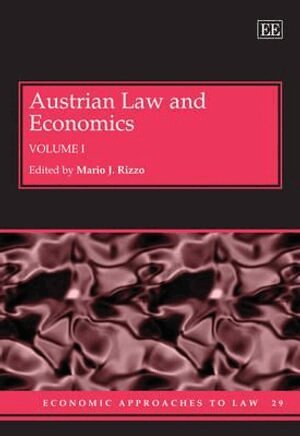
    Austrian Law and Economics

    AvMario J. Rizzo

    Inbunden, Engelska, 2011

    Del 29 i serien Economic Approaches to Law series

    10 880 kr

    Beställningsvara. Skickas inom 5-8 vardagar. Fri frakt över 249 kr.

    Beskrivning

    The use of economics to study law was pioneered by the Austrian School of Economics. The nineteenth century founders of the school believed that economics could contribute to understanding the spontaneous development of common law as well as the nature of legal rights. For this insightful research review Mario Rizzo has selected key papers from today's vibrant Austrian School, focusing on the study of property, market-chosen law, slippery-slope analysis, entrepreneurship, institutions, decentralized social knowledge, and the evolution of legal institutions.This title represents the cutting-edge Austrian contributions to economics and will be an essential reference source for both students and researchers.

    Produktinformation

    • Utgivningsdatum:2011-06-30
    • Mått:169 x 244 x undefined mm
    • Format:Inbunden
    • Språk:Engelska
    • Serie:Economic Approaches to Law series
    • Förlag:Edward Elgar Publishing Ltd
    • ISBN:9781845427535

    Utforska kategorier

    • Rättsvetenskap inom Juridik
    • Ekonomiska system inom Ekonomi och Ledarskap

    Mer om författaren

    Edited by Mario J. Rizzo, Department of Economics, New York University, US

    Innehållsförteckning

    • Contents:Volume IAcknowledgementsIntroductionMario J. RizzoPART IGENERAL SURVEYS OF AUSTRIAN LAW AND ECONOMICS1. Gregory Scott Crespi (1998), ‘Exploring the Complicationist Gambit: An Austrian Approach to the Economic Analysis of Law’2. Linda A. Schwartzstein (1994), ‘An Austrian Economic View of Legal Process’3. Christopher T. Wonnell (1986), ‘Contract Law and the Austrian School of Economics’PART IIMETHODOLOGICAL ISSUES 4. Elisabeth Krecké and Carine Krecké (2007), ‘The Anti-Foundational Dilemma: Normative Implications for the Economic Analysis of Law’5. Elisabeth Krecké (2004), ‘Economic Analysis and Legal Pragmatism’6. Douglas Glen Whitman (2004), ‘Group Selection and Methodological Individualism: Compatible and Complementary’7. Mario J. Rizzo (1999), ‘Which Kind of Legal Order? Logical Coherence and Praxeological Coherence’PART IIIPROPERTY 8. Ludwig von Mises ([1936] 1981), ‘Ownership’9. Jörg Guido Hülsmann (2004), ‘The A Priori Foundations of Property Economics’10. William Barnett II, Walter Block and Gene Callahan (2005), ‘The Paradox of Coase as a Defender of Free Markets’11. Israel M. Kirzner (1979), ‘Entrepreneurship, Entitlement, and Economic Justice’PART IVMENGER, HAYEK AND COMMON LAW 12. Carl Menger ([1963] 1985), ‘The “Organic” Origin of Law and the Exact Understanding Thereof’13. A.I. Ogus (1989), ‘Law and Spontaneous Order: Hayek’s Contribution to Legal Theory’14. Todd J. Zywicki and Anthony B. Sanders (2008), ‘Posner, Hayek, and the Economic Analysis of Law’15. John Hasnas (2005), ‘Hayek, the Common Law, and Fluid Drive’16. Scott A. Beaulier, Peter J. Boettke and Christopher J. Coyne (2005), ‘Knowledge, Economics, and Coordination: Understanding Hayek’s Legal Theory’PART VEVOLUTION AND LAW 17. Douglas Glen Whitman (1998), ‘Hayek contra Pangloss on Evolutionary Systems’18. Suri Ratnapala (1993), ‘The Trident Case and the Evolutionary Theory of F.A. Hayek’19. Suri Ratnapala (2001), ‘Eighteenth-Century Evolutionary Thought and its Relevance in the Age of Legislation’20. Bruce L. Benson (1989), ‘The Spontaneous Evolution of Commercial Law’21. John Hasnas (2005), ‘Toward a Theory of Empirical Natural Rights’22. Todd J. Zywicki (2003), ‘The Rise and Fall of Efficiency in the Common Law: A Supply-Side Analysis’23. Douglas Glen Whitman (2000), ‘Evolution of the Common Law and the Emergence of Compromise’Volume IIAcknowledgementsAn introduction by the editors to both volumes appears in Volume IPART ICOMMON LAW, BALANCING, AND EFFICIENCY 1. Mario J. Rizzo (1980), ‘Law Amid Flux: The Economics of Negligence and Strict Liability in Tort’2. Mario J. Rizzo (1980), ‘The Mirage of Efficiency’3. James M. Buchanan (1969), ‘Private and Social Cost’4. Peter Lewin (1982), ‘Pollution Externalities: Social Cost and Strict Liability’5. Roy E. Cordato (1996), ‘Time Passage and the Economics of Coming to the Nuisance: Reassessing the Coasean Perspective’6. Mario J. Rizzo (1985), ‘Rules Versus Cost-Benefit Analysis in the Common Law’PART IIRULES 7. Richard A. Epstein (2006), ‘Intuition, Custom, and Protocol: How to Make Sound Decisions with Limited Knowledge’8. Douglas Glen Whitman (2009), ‘The Rules of Abstraction’9. Todd J. Zywicki (1998), ‘Epstein and Polanyi on Simple Rules, Complex Systems, and Decentralization’PART III SLIPPERY SLOPE ANALYSIS 10. Mario J. Rizzo and Douglas Glen Whitman (2003), ‘The Camel’s Nose is in the Tent: Rules, Theories, and Slippery Slopes’11. Douglas Glen Whitman and Mario J. Rizzo (2007), ‘Paternalist Slopes’PART IVINSTITUTIONS 12. L.M. Lachmann (1971), ‘On Institutions’ 13. Karol Boudreaux and Paul Dragos Aligica (2007), ‘The Evolutionary Path’14. Karol Boudreaux and Paul Dragos Aligica (2007), ‘An Intellectual Toolbox for the Creation of Property Rights’15. David A. Harper (2003), ‘Institutions I: Rule of Law, Property and Contract’16. David A. Harper (2003), ‘Institutions II: Money, Political and Legal Decentralisation and Economic Freedom’17. Peter J. Boettke, Christopher J. Coyne and Peter T. Leeson (2007), ‘Saving Government Failure Theory from Itself: Recasting Political Economy from an Austrian Perspective’PART VMARKET CHOSEN LAW 18. Edward Stringham (1999), ‘Market Chosen Law’19. Edward Stringham (2003), ‘The Extralegal Development of Securities Trading in Seventeenth-Century Amsterdam’20. Edward Stringham (2002), ‘The Emergence of the London Stock Exchange as a Self-Policing Club’21. Anthony Ogus (1999), ‘Competition Between National Legal Systems: A Contribution of Economic Analysis to Comparative Law’22. Peter T. Leeson (2007), ‘Trading with Bandits’23. Peter T. Leeson (2007), ‘An-arrgh-chy: The Law and Economics of Pirate Organization’PART VIMINIMIZING THE STATE 24. John Hasnas (2003), ‘Reflections on the Minimal State’25. Peter T. Leeson (2008), ‘Coordination Without Command: Stretching the Scope of Spontaneous Order’26. Peter T. Leeson (2006), ‘Efficient Anarchy’27. Peter T. Leeson (2008), ‘How Important is State Enforcement for Trade?’28. Walter Block and Thomas J. DiLorenzo (2000), ‘Is Voluntary Government Possible? A Critique of Constitutional Economics’29. Randall G. Holcombe (2004), ‘Government: Unnecessary but Inevitable’PART VIIDISPERSED KNOWLEDGE AND THE LIMITS OF LAW 30. Mario J. Rizzo (2005), ‘The Problem of Moral Dirigisme: A New Argument Against Moralistic Legislation’