• Fri frakt över 249 kr
  • •
  • Snabba leveranser
  • •
  • Billiga böcker
Kundservice

Du är på sajten för privatpersoner.

Företag, bibliotek eller offentlig verksamhet?

Du handlar på classic.bokus.com, där alla dina funktioner finns intakta.
Till classic.bokus.com
Bokus logotyp. Gå till startsidan.
  • Erbjudanden
  • Nyheter
  • Student
  • Topplistor
  • Barn & ungdom
  • Bokus Play
  • E-böcker
  • Pocketböcker
  • Spel & pussel

10% rabatt på allt med kod: NYSTART10 →

Sidfot

Mina sidor

    Hjälp

    • Kundservice
    • Vanliga frågor och svar
    • Frakt och leverans
    • Retur vid ångerrätt
    • Reklamera vara
    • Betalning
    • Köpvillkor
    • Allmänna villkor
    • Information om webbplatsens tillgänglighet

    Om Bokus

    • Om oss
    • Pressrum
    • För studenter
    • För företag
    • För bibliotek och offentlig verksamhet
    • För leverantörer
    • Hållbarhet

    Populärt

    • Aktuella erbjudanden
    • Presentkort
    • Studentlitteratur
    • Nya böcker
    • Topplistor
    • Signerade böcker
    • Engelska böcker

    Inspiration

    • Boktips
    • BookTok
    • Populära bokserier
    • Barnbokskaraktärer
    • Populära författare
    Logotyp för Bokus
    Följ oss på Facebook (extern länk)Följ oss på Instagram (extern länk)Följ oss på YouTube (extern länk)Följ oss på TikTok (extern länk)
    bokus @ CookiesAnpassa cookiesIntegritetspolicyKöpvillkor
    Till Citymail hemsida (extern länk)Till Budbee hemsida (extern länk)Till Postnord hemsida (extern länk)Till Schenker hemsida (extern länk)Till Early Bird hemsida (extern länk)Till Walleys hemsida (extern länk)
    1. Historia och arkeologi
    2. Historia
    3. Europas historia

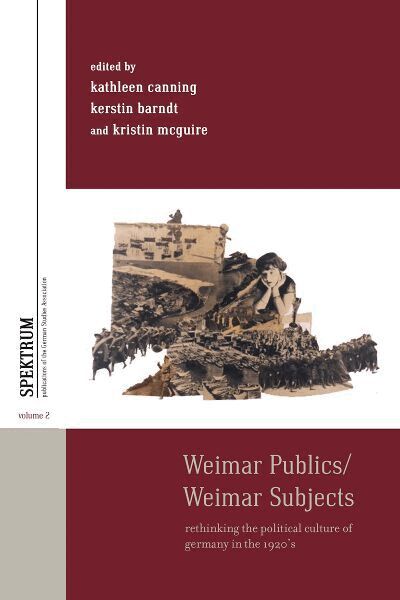
    Weimar Publics/Weimar Subjects

    Rethinking the Political Culture of Germany in the 1920s

    AvKathleen Canning,Kerstin Barndt

    Inbunden, Engelska, 2010

    Del i serien Spektrum: Publications of the German Studies Association

    2 117 kr

    Beställningsvara. Skickas inom 5-8 vardagar. Fri frakt över 249 kr.

    Beskrivning

    In spite of having been short-lived, “Weimar” has never lost its fascination. Until recently the Weimar Republic’s place in German history was primarily defined by its catastrophic beginning and end - Germany’s defeat in 1918 and the Nazi seizure of power in 1933; its history seen mainly in terms of politics and as an arena of flawed decisions and failed compromises. However, a flourishing of interdisciplinary scholarship on Weimar political culture is uncovering arenas of conflict and change that had not been studied closely before, such as gender, body politics, masculinity, citizenship, empire and borderlands, visual culture, popular culture and consumption. This collection offers new perspectives from leading scholars in the disciplines of history, art history, film studies, and German studies on the vibrant political culture of Germany in the 1920s. From the traumatic ruptures of defeat, revolution, and collapse of the Kaiser’s state, the visionaries of Weimar went on to invent a republic, calling forth new citizens and cultural innovations that shaped the republic far beyond the realms of parliaments and political parties.

    Produktinformation

    • Utgivningsdatum:2010-08-01
    • Mått:152 x 229 x 27 mm
    • Vikt:767 g
    • Format:Inbunden
    • Språk:Engelska
    • Serie:Spektrum: Publications of the German Studies Association
    • Antal sidor:420
    • Förlag:Berghahn Books
    • ISBN:9781845456894

    Utforska kategorier

    • Europas historia inom Historia och arkeologi
    • Politik och statsskick inom Samhälle och politik

    Mer om författaren

    Kathleen Canning is Arthur F. Thurnau Professor of History, Women’s Studies, and German at the University of Michigan. She is the author of Languages of Labor and Gender: Female Factory Work in Germany, 1850-1914 (2nd ed., University of Michigan Press 2002) and Gender History in Practice: Historical Perspectives on Bodies, Class, and Citizenship (Cornell University Press 2006). She is currently a board member of Central European History and the Journal of Modern History.

    Recensioner i media

    "The interpretative and methodological pluralism, which is evident throughout [this volume]is a major strength, rendering the volume ideally suited for graduate courses in modern European and German history. By covering an extraordinary range of topics and analytical perspectives, the book opens up a fascinating panoramic view onto ‘the landscapes of ambition and hope, promise and disappointment that galvanized new publics during the Weimar era.’” · Journal of Modern History“…taken together [these articles] provide an excellent and stimulating introduction to current ways of thinking and writing about the Weimar Republic since the ‘cultural turn’. A common theme running through each contribution is the role of individual consciousness and its striving to be heard and expressed in an age when notions of community and collective struggle were also high up on the artistic and political agenda.“  ·  German History“These essays are interesting and useful for the material they present…the efforts it presents in rethinking the existing scholarship and adding new material has much to offer scholars of the Weimar era.”  ·  European History Quarterly

    Innehållsförteckning

    • List of IllustrationsPrefaceList of ContributorsIntroductionKathleen CanningPART I: DEFEAT AND THE LEGACY OF WARChapter 1. The Return of the Undead: Weimar Cinema and the Great WarAnton KaesChapter 2. The Work of Art and the Problem of Politics in Berlin DadaBrigid DohertyChapter 3. The Secret History of Photomontage: on the Origins of the Composite Form and the Weimar Photomontages of Marianne BrandtElizabeth OttoPART II: NEW CITIZENS/NEW SUBJECTIVITIESChapter 4. Mother, Citizens, and Consumers. Female Readers in Weimar GermanyKerstin BarndtChapter 5. Claiming Citizenship: Suffrage and Subjectivity in Germany after the First World WarKathleen CanningChapter 6. Feminist Politics beyond the Reichstag: A Radical Vision of Reform in the Weimar RepublicKristin McGuireChapter 7. Producing Jews: Maternity, Eugenics, and the Embodiment of the Jewish SubjectSharon GillermanPART III: SYMBOLS, RITUALS AND DISCOURSES OF DEMOCRACYChapter 8. Reforming the Reich: Democratic Symbols and Rituals in the Weimar RepublicManuela AchillesChapter 9. High Expectations – Deep Disappointment: Structures of the Public Perception of Politics in the Weimar RepublicThomas MergelChapter 10. Contested Narratives of the Weimar Republic: The Case of the "Kutisker-Barmat Scandal"Martin GeyerChapter 11. Political Violence, Contested Public Space, and Reasserted Masculinity in Weimar GermanyDirk SchumannPART IV: PUBLICS, PUBLICITY AND MASS CULTUREChapter 12.  “A Self-Representation of the Masses”: Siegfried Kracauer's Curious AmericanismMiriam HansenChapter 13. Neither Masses Nor Individuals. Representations of the Collective in Inter-War German CultureStefan JonssonChapter 14. Cultural Capital in Decline:Inflation and the Distress of IntellectualsBernd WiddigPART V: WEIMAR TOPOGRAPHIESChapter 15. Defining the Nation in Crisis: Citizenship Policy in the Early Weimar RepublicAnnemarie SammartinoChapter 16. Gender and Colonial Politics after the Versailles TreatyLora WildenthalChapter 17. The Economy of Experience in Weimar GermanyPeter FritzscheBibliographyIndex