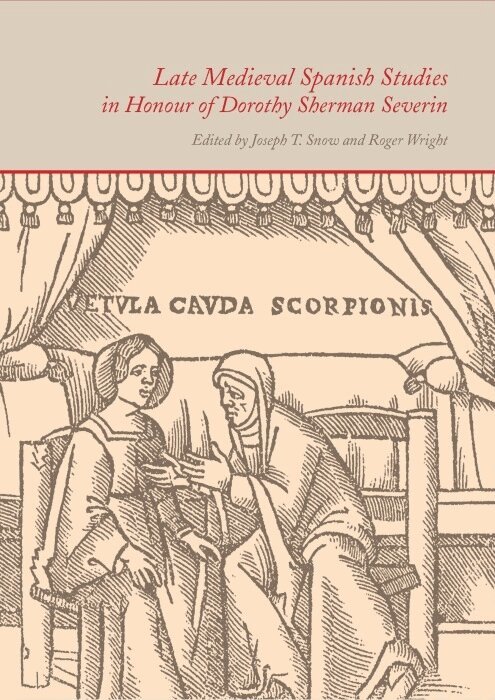
Inbunden, Engelska, 2009
Late Medieval Spanish Studies in Honour of Dorothy Sherman Severin
Av Joseph T. Snow, Roger Wright
2366 kr
Tillfälligt slut
Beskrivning
Produktinformation
- Utgivningsdatum: 2009-02-01
- Mått: 163 x 239 x undefined mm
- Format: Inbunden
- Språk: Engelska
- Antal sidor: 199
- Förlag: Liverpool University Press
- ISBN: 9781846312083
Utforska kategorier
Mer om författaren
Joseph T. Snow of the Department of Romance and Classical Languages, Michigan State University is an expert on medieval Spanish literature, known everywhere that Spanish literature is read and studied for his original work on the Celestina. His critical edition and bibliography of this work have been called "the indispensable starting point for research in this field". Roger Wright is Professor of Spanish at the University of Liverpool. Professor Wright's teaching, publications and research interests lie in Spanish Linguistics (in particular the history of the language) and Spanish oral literature. He is a leading international authority on Late Latin and the development of vernacular Romance languages.
Recensioner i media
This edited volume comprises nineteen chapters in honour of one of the most widely acknowledged scholars in Hispanism: Dorothy Sherman Severin. It opens with a succinct introduction that outlines the intellectual biography of Severin, together with a list of her prolific publications. Although not divided into parts, the majority of the contributions (twelve out of nineteen) deal with some aspect of the theme of Celestina; anyone familiar with Severin's contribution to Celestina studies would readily agree that this apparent thematic inclination does justice to her. Having said that, there is no special arrangement of the Celestina theme, for, despite largely occupying the second half of the volume, the last chapter is not specifically on the same theme. One can surmise that the lack of placement prominence balances out with the thematic prominence and could be viewed as an implicit statement of the breadth of Severin's work in Medieval Spanish literature. Discussions in the first seven chapters deal with the following themes: the extent to which Alfonso X's penal code on defamation could have been applied effectively to songs and poetry; the possible epic origins of the theme of the aggrieved lady who complains and demands justice and vengeance; the intrinsic nature of humour in oral Spanish ballads; how the generic characteristics of Santillana's Proverbios could account for their longevity; the visual as the key to poetic experimentation that highlights the hitherto little-investigated work of Juan de Torres; deciphering a corrupt and problematic poem by Juan de Torres; the relationship between literature (poetry in the main, in the Medieval context) and political power and ideological propaganda; and the role of parody and breaches in its conceptualization in scholarship in the subject. All in all, this volume is an important tool in Spanish Medieval studies for specialists as well as those relatively new to the field. Forum for Modern Language Studies This volume is an important tool in Spanish Medieval studies for specialists as well as those relatively new to the field. Forum for Modern Language Studies This edited volume comprises nineteen chapters in honour of one of the most widely acknowledged scholars in Hispanism: Dorothy Sherman Severin. It opens with a succinct introduction that outlines the intellectual biography of Severin, together with a list of her prolific publications. Although not divided into parts, the majority of the contributions (twelve out of nineteen) deal with some aspect of the theme of Celestina; anyone familiar with Severin's contribution to Celestina studies would readily agree that this apparent thematic inclination does justice to her. Having said that, there is no special arrangement of the Celestina theme, for, despite largely occupying the second half of the volume, the last chapter is not specifically on the same theme. One can surmise that the lack of placement prominence balances out with the thematic prominence and could be viewed as an implicit statement of the breadth of Severin's work in Medieval Spanish literature. Discussions in the first seven chapters deal with the following themes: the extent to which Alfonso X's penal code on defamation could have been applied effectively to songs and poetry; the possible epic origins of the theme of the aggrieved lady who complains and demands justice and vengeance; the intrinsic nature of humour in oral Spanish ballads; how the generic characteristics of Santillana's Proverbios could account for their longevity; the visual as the key to poetic experimentation that highlights the hitherto little-investigated work of Juan de Torres; deciphering a corrupt and problematic poem by Juan de Torres; the relationship between literature ( poetry in the main, in the Medieval context) and political power and ideological propaganda; and the role of parody and breaches in its conceptualization in scholarship in the subject. All in all, this volume is an important tool in Spanish Medieval studies for specialists as well as those relatively new to the field. [doi: 10.1093/fmls/cqr014] Forum for Modern Language Studies, vol 48, no 1 this volume is an important tool in Spanish Medieval studies for specialists as well as those relatively new to the field. Forum for Modern Language Studies, vol 48, no 1
Betyg & recensioner
0 recensioner
Inga recensioner tillgängliga.