• Fri frakt över 249 kr
  • •
  • Snabba leveranser
  • •
  • Billiga böcker
Kundservice

Du är på sajten för privatpersoner.

Företag, bibliotek eller offentlig verksamhet?

Du handlar på classic.bokus.com, där alla dina funktioner finns intakta.
Till classic.bokus.com
Bokus logotyp. Gå till startsidan.
  • Erbjudanden
  • Nyheter
  • Student
  • Topplistor
  • Barn & ungdom
  • Bokus Play
  • E-böcker
  • Pocketböcker
  • Spel & pussel

10% studentrabatt med kod TERM26

Sidfot

Mina sidor

    Hjälp

    • Kundservice
    • Vanliga frågor och svar
    • Frakt och leverans
    • Retur vid ångerrätt
    • Reklamera vara
    • Betalning
    • Köpvillkor
    • Allmänna villkor
    • Information om webbplatsens tillgänglighet

    Om Bokus

    • Om oss
    • Pressrum
    • För studenter
    • För företag
    • För bibliotek och offentlig verksamhet
    • För leverantörer
    • Hållbarhet

    Populärt

    • Aktuella erbjudanden
    • Presentkort
    • Studentlitteratur
    • Nya böcker
    • Topplistor
    • Signerade böcker
    • Engelska böcker

    Inspiration

    • Boktips
    • BookTok
    • Populära bokserier
    • Barnbokskaraktärer
    • Populära författare

    Mina sidor

      Hjälp

      • Kundservice
      • Vanliga frågor och svar
      • Frakt och leverans
      • Retur vid ångerrätt
      • Reklamera vara
      • Betalning
      • Köpvillkor
      • Allmänna villkor
      • Information om webbplatsens tillgänglighet

      Om Bokus

      • Om oss
      • Pressrum
      • För studenter
      • För företag
      • För bibliotek och offentlig verksamhet
      • För leverantörer
      • Hållbarhet

      Populärt

      • Aktuella erbjudanden
      • Presentkort
      • Studentlitteratur
      • Nya böcker
      • Topplistor
      • Signerade böcker
      • Engelska böcker

      Inspiration

      • Boktips
      • BookTok
      • Populära bokserier
      • Barnbokskaraktärer
      • Populära författare
      Logotyp för Bokus
      Följ oss på Facebook (extern länk)Följ oss på Instagram (extern länk)Följ oss på YouTube (extern länk)Följ oss på TikTok (extern länk)
      bokus @ CookiesAnpassa cookiesIntegritetspolicyKöpvillkor
      Till Citymail hemsida (extern länk)Till Budbee hemsida (extern länk)Till Postnord hemsida (extern länk)Till Schenker hemsida (extern länk)Till Early Bird hemsida (extern länk)Till Walleys hemsida (extern länk)
      1. Ekonomi och Ledarskap
      2. Nationalekonomi

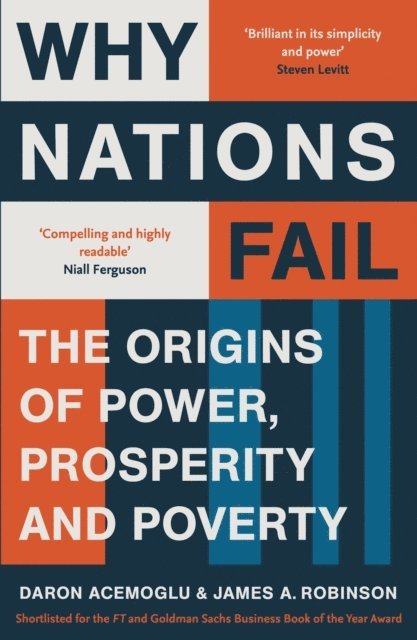
      Why Nations Fail

      FROM THE WINNERS OF THE NOBEL PRIZE IN ECONOMICS: The Origins of Power, Prosperity and Poverty

      AvDaron Acemoglu,James A. Robinson

      E-bok
      Engelska, 2012

      157 kr

      Läs direkt i Bokus Reader – eller ladda ned till din enhet

      Fler format och utgåvor

      Häftad

      178 kr

      Häftad

      204 kr

      Inbunden

      345 kr

      Beskrivning

      BY THE NOBEL PRIZE-WINNING ECONOMISTS DARON ACEMOGLU & JAMES A. ROBINSON Shortlisted for the Financial Times Business Book of the Year AwardWhy are some nations more prosperous than others? Why Nations Fail sets out to answer this question, with a compelling and elegantly argued new theory: that it is not down to climate, geography or culture, but because of institutions. Drawing on an extraordinary range of contemporary and historical examples, from ancient Rome through the Tudors to modern-day China, leading academics Daron Acemoglu and James A. Robinson show that to invest and prosper, people need to know that if they work hard, they can make money and actually keep it - and this means sound institutions that allow virtuous circles of innovation, expansion and peace.Based on fifteen years of research, and answering the competing arguments of authors ranging from Max Weber to Jeffrey Sachs and Jared Diamond, Acemoglu and Robinson step boldly into the territory of Francis Fukuyama and Ian Morris. They blend economics, politics, history and current affairs to provide a new, powerful and persuasive way of understanding wealth and poverty.

      Produktinformation

      • Utgivningsdatum:2012-03-08
      • Språk:Engelska
      • Filformat:EPUB
      • Kopieringsskydd:LCP
      • ISBN:9781847654618
      • Förlag:Profile Books Ltd
      • Utmärkelser:Short-listed for Financial Times/Goldman Sachs Business Book of the Year Award 2012 (UK)

      Utforska kategorier

      • Nationalekonomi inom Ekonomi och Ledarskap

      Mer om författaren

      Daron Acemoglu is Institute Professor at MIT, Faculty Co-Director of MIT's Shaping the Future of Work Initiative, and Research Affiliate at MIT's Blueprint Labs. He has been awarded the John Bates Clark Medal, the BBVA Frontiers Award, the Global Economy Prize and the Nobel Prize in Economics in 2024.James A. Robinson is a University Professor at the Harris School of Public Policy of the University of Chicago, and a world-renowned expert on Latin America and Africa. He received the Nobel Prize in Economics in 2024 for his work on global inequality.

      Recensioner i media

      A must-read. Acemoglu and Robinson are intellectual heavyweights of the first rank Guardian An important book New York Times An intellectually rich book that develops an important thesis with verve FT It's a great read. Like me, you may succumb to reading it in one go, and then you may come back to it again and again. -- Jared Diamond, Pulitzer-prize-winning author A must-read. Acemoglu and Robinson are intellectual heavyweights of the first rank ... they have done you the courtesy of writing a book that while at the intellectual cutting edge is not just readable but engrossing ... erudite and fascinating. -- Paul Collier Observer For those who think that a nation's economic fate is determined by geography or culture, Daron Acemoglu and Jim Robinson have bad news. It's man-made institutions, not the lay of the land or the faith of our forefathers, that determine whether a country is rich or poor. Synthesizing brilliantly the work of theorists from Adam Smith to Douglass North with more recent empirical research by economic historians, Acemoglu and Robinson have produced a compelling and highly readable book. And their conclusion is a cheering one: the authoritarian "extractive" institutions like the one's that drive growth in China today are bound to run out of steam. Without the inclusive institutions that first evolved in the West, sustainable growth is impossible, because only a truly free society can foster genuine innovation and the creative destruction that is its corollary. Niall Ferguson, author of 'The Ascent of Money' This fascinating and readable book centers on the complex joint evolution of political and economic institutions, in good directions and bad. It strikes a delicate balance between the logic of political and economic behavior and the shifts in direction created by contingent historical events, large and small at 'critical junctures'. Acemoglu and Robinson provide an enormous range of historical examples to show how such shifts can tilt toward favorable institutions, progressive innovation and economic success or toward repressive institutions and eventual decay or stagnation. Somehow they can generate both excitement and reflection. -- Robert Solow, Nobel Laureate in Economics It's the politics, stupid! That is Acemoglu and Robinson's simple yet compelling explanation for why so many countries fail to develop. From the absolutism of the Stuarts to the antebellum South, from Sierra Leone to Colombia, this magisterial work shows how powerful elites rig the rules to benefit themselves at the expense of the many. Charting a careful course between the pessimists and optimists, the authors demonstrate history and geography need not be destiny. But they also document how sensible economic ideas and policies often achieve little in the absence of fundamental political change. Dani Rodrik, Kennedy School of Government, Harvard Universitry Two of the world's best and most erudite economists turn to the hardest issue of all: why are some nations poor and others rich? Written with a deep knowledge of economics and political history, this is perhaps the most powerful statement made to date that 'institutions matter.' A provocative, instructive, yet thoroughly enthralling book. -- Joel Mokyr, Robert H. Strotz Professor of Arts and Sciences and Professor of Economics and History, Northwestern University Imagine sitting around a table listening to Jared Diamond, Joseph Schumpeter, and James Madison reflect on over two thousand years of political and economic history. Imagine that they weave their ideas into a coherent theoretical framework based on limiting extraction, promoting creative destruction, and creating strong political institutions that share power and you begin to see the contribution of this brilliant and engagingly written book. -- Scott E. Page, University of Michigan and Santa Fre Institute In this stunningly wide ranging book Acemoglu and Robinson ask a simple but vital question, why do some nations become rich and others remain poor? Their answer is also simple -- because some polities develop more inclusive political institutions. What is remarkable about the book is the crispness and clarity of the writing, the elegance of the argument, and the remarkable richness of historical detail. This book is a must read at a moment where governments right across the western world must come up with the political will to deal with a debt crisis of unusual proportions. -- Steve Pincus, Bradford Durfee Professor of History and International and Area Studies, Yale University Acemoglu and Robinson -- two of the world's leading experts on development -- explain why it is not geography, disease, or culture which explains why some nations are rich and some poor, but rather a matter of institutions and politics. This highly accessible book provides welcome insight to specialists and general readers alike. -- Francis Fukuyama Some time ago a little known Scottish philosopher wrote a book on what makes nations succeed and what makes them fail. The Wealth of Nations is still being read today. With the same perspicacity and with the same broad historical perspective, Daron Acemoglu and James Robinson have re-tackled this same question for our own times. Two centuries from now our great-great-...-great grandchildren will be, similarly, reading Why Nations Fail. -- George Akerlof, Nobel Laureate in Economics, 2001 Acemoglu and Robinson have made an important contribution to the debate as to why similar-looking nations differ so greatly in their economic and political development. Through a broad multiplicity of historical examples, they show how institutional developments, sometimes based on very accidental circumstances, have had enormous consequences. The openness of a society, its willingness to permit creative destruction, and the rule of appear to be decisive for economic development. -- Kenneth J. Arrow This not only a fascinating and interesting book: it is a really important one. The highly original research that Professors Acemoglu and Robinson have done, and continue to do, on how economic forces, politics and policy choices evolve together and constrain each other, and how institutions affect that evolution, is essential to understanding the successes and failures of societies and nations. And here, in this book, these insights come in a highly accessible, indeed riveting form. Those who pick this book up and start reading will have trouble putting it down. Michael Spence Why Nations Fail is a truly awesome book. Acemoglu and Robinson tackle one of the most important problems in the social sciences -- a question that has bedeviled leading thinkers for centuries -- and offer an answer that is brilliant in its simplicity and power. A wonderfully readable mix of history, political science, and economics, this book will change the way we think about economic development. Why Nations Fail is a must read book. Steven Levitt, author of Freakonomics Why Nations Fail is so good in so many ways that I despair of listing them all. It is an excellent book and should be purchased forthwith, so to encourage the authors to keep working. -- Charles C. Mann, author of 1491 and 1493 In this delightfully readable romp through 400 years of history, two of the giants of contemporary social science bring us an inspiring and important message: it is freedom that makes the world rich. Let tyrants everywhere tremble! -- Ian Morris, Stanford University, author of Why the West Rules - For Now The authors convincingly show that countries escape poverty only when they have appropriate economic institutions, especially private property and competition. More originally, they argue countries are more likely to develop the right institiutions when they have an open pluralistic political system with competition for political office, a widespread electorate, and openness to new politcial leaders. This intimate connection between political and economic institutions is the heart of their major contribution, and has resulted in a study of great vitality on one of the crucial questions in economics and political economy. -- Gary S. Becker, Nobel laureate in economics, 1992 This important and insightful book, packed with historical examples, makes the case that inclusive political institiutions in support of inclusive economic institutions iskey to sustained prosperity. The book reviews how some good regimes got launched and then had a virtuous spiral, while bad regimes remain in a vicious spiral. This is important analysis not to be missed. -- Peter Diamond, Nobel laureate in economics, 2010 A brilliant and uplifting book -- yet also a deeply disturbing wake-up call. Acemoglu and Robinson lay out a convincing theory of almost everything to do with economic development. Countries rise when they put in place the right pro-growth political institutions and they fail-often spectacularly-when those instituitons ossify or fail to adapt. Powerful people always and everywhere seek to grab complete control over government, undermining broader social progress for their own greed. Keep those people in check with effective democracy or watch your nation fail. -- Simon Johnson, co-author of 13 Bankers and professor at MIT Sloan a fascinating bit of scholarship that is laden with lots of interesting historical detail Sunday Business Post A must-read that makes sense of recent upheavals Money Week An intellectually rich book that develops an important thesis with verve. It should be widely read. -- Martin Wolf FT A vital work for these times -- William Easterly Wall Street Journal

      Hoppa över listan

      Mer från samma författare

      Daron Acemoglu, Simon Johnson, James A. Robinson - Varför är inte hela världen rik? : om makt, framsteg och teknik, Inbunden
      • -26%

      Varför är inte hela världen rik? : om makt, framsteg och teknik

      Daron Acemoglu, Simon Johnson, James A. Robinson

      Inbunden, 2025

      4,0 utav 5 stjärnor. Totalt antal röster:(4)

      199 kr268 kr

      Daron Acemoglu - What Happened to Liberal Democracy?, Häftad
      • Nyhet

      What Happened to Liberal Democracy?

      Daron Acemoglu

      Häftad, 2026

      204 kr

      Simon Johnson, Daron Acemoglu - Power and Progress, Häftad

      Power and Progress

      Simon Johnson, Daron Acemoglu

      Häftad, 2024

      5,0 utav 5 stjärnor. Totalt antal röster:(1)

      193 kr

      Daron Acemoglu, James A. Robinson - The Narrow Corridor, Häftad

      The Narrow Corridor

      Daron Acemoglu, James A. Robinson

      Häftad, 2020

      5,0 utav 5 stjärnor. Totalt antal röster:(2)

      194 kr

      James A. Robinson, Daron Acemoglu - Why Nations Fail, E-bok

      Why Nations Fail

      James A. Robinson, Daron Acemoglu

      E-bok
      2012

      217 kr

      Daron Acemoglu - What Happened to Liberal Democracy?, Inbunden
      • Nyhet

      What Happened to Liberal Democracy?

      Daron Acemoglu

      Inbunden, 2026

      263 kr

      Simon Johnson, James A. Robinson, Daron Acemoglu - Varför är inte hela världen rik?  Om makt, framsteg och teknik, E-bok

      Varför är inte hela världen rik? Om makt, framsteg och teknik

      Simon Johnson, James A. Robinson, Daron Acemoglu

      E-bok

      213 kr

      Daron Acemoglu - What Happened to Liberal Democracy?, Häftad
      • Nyhet

      What Happened to Liberal Democracy?

      Daron Acemoglu

      Häftad, 2026

      239 kr

      Daron Acemoglu, Simon Johnson - Power and Progress: Our Thousand-Year Struggle Over Technology and Prosperity, Häftad

      Power and Progress: Our Thousand-Year Struggle Over Technology and Prosperity

      Daron Acemoglu, Simon Johnson

      Häftad, 2024

      243 kr

      Daron Acemoglu, David Laibson, John List - Economics, Global Edition, Häftad
      • -10% student

      Economics, Global Edition

      Daron Acemoglu, David Laibson, John List

      Häftad, 2021

      1 227 kr

      Hoppa över listan

      Du kanske också är intresserad av

      Daron Acemoglu, James A. Robinson - Why Nations Fail, Häftad

      Why Nations Fail

      Daron Acemoglu, James A. Robinson

      Häftad, 2013

      4,6 utav 5 stjärnor. Totalt antal röster:(10)

      178 kr

      Daron Acemoglu, James A. Robinson - Why Nations Fail, Häftad

      Why Nations Fail

      Daron Acemoglu, James A. Robinson

      Häftad, 2013

      4,0 utav 5 stjärnor. Totalt antal röster:(1)

      204 kr

      Daron Acemoglu, James A. Robinson - Why Nations Fail, Inbunden

      Why Nations Fail

      Daron Acemoglu, James A. Robinson

      Inbunden, 2012

      4,0 utav 5 stjärnor. Totalt antal röster:(1)

      345 kr

      Daron Acemoglu, Simon Johnson, James A. Robinson - Varför är inte hela världen rik? : om makt, framsteg och teknik, Inbunden
      • -26%

      Varför är inte hela världen rik? : om makt, framsteg och teknik

      Daron Acemoglu, Simon Johnson, James A. Robinson

      Inbunden, 2025

      4,0 utav 5 stjärnor. Totalt antal röster:(4)

      199 kr268 kr

      Simon Johnson, James A. Robinson, Daron Acemoglu - Varför är inte hela världen rik?  Om makt, framsteg och teknik, E-bok

      Varför är inte hela världen rik? Om makt, framsteg och teknik

      Simon Johnson, James A. Robinson, Daron Acemoglu

      E-bok

      213 kr

      Daron Acemoglu, James A. Robinson - Gleichgewicht der Macht, Häftad

      Gleichgewicht der Macht

      Daron Acemoglu, James A. Robinson

      Häftad, 2024

      278 kr

      Daron Acemoglu, James A. Robinson - Warum Nationen scheitern, Häftad

      Warum Nationen scheitern

      Daron Acemoglu, James A. Robinson

      Häftad, 2014

      267 kr

      James A. Robinson, Daron Acemoglu - Narrow Corridor, Ljudbok

      Narrow Corridor

      James A. Robinson, Daron Acemoglu

      Ljudbok
      2019

      182 kr

      Daron Acemoglu, James A. Robinson - Economic Origins of Dictatorship and Democracy, Häftad

      Economic Origins of Dictatorship and Democracy

      Daron Acemoglu, James A. Robinson

      Häftad, 2009

      377 kr

      Daron Acemoglu, James A. Robinson - Por Qué Fracasan Los Países: Los Orígenes del Poder, La Prosperidad Y La Pobreza / Why Nations Fail, Häftad

      Por Qué Fracasan Los Países: Los Orígenes del Poder, La Prosperidad Y La Pobreza / Why Nations Fail

      Daron Acemoglu, James A. Robinson

      Häftad, 2022

      276 kr