• Fri frakt över 249 kr
  • •
  • Snabba leveranser
  • •
  • Billiga böcker
Kundservice

Du är på sajten för privatpersoner.

Företag, bibliotek eller offentlig verksamhet?

Du handlar på classic.bokus.com, där alla dina funktioner finns intakta.
Till classic.bokus.com
Bokus logotyp. Gå till startsidan.
  • Erbjudanden
  • Nyheter
  • Student
  • Topplistor
  • Barn & ungdom
  • Bokus Play
  • E-böcker
  • Pocketböcker
  • Spel & pussel

10% rabatt på allt med kod NYSTART10 →

Sidfot

Mina sidor

    Hjälp

    • Kundservice
    • Vanliga frågor och svar
    • Frakt och leverans
    • Retur vid ångerrätt
    • Reklamera vara
    • Betalning
    • Köpvillkor
    • Allmänna villkor
    • Information om webbplatsens tillgänglighet

    Om Bokus

    • Om oss
    • Pressrum
    • För studenter
    • För företag
    • För bibliotek och offentlig verksamhet
    • För leverantörer
    • Hållbarhet

    Populärt

    • Aktuella erbjudanden
    • Presentkort
    • Studentlitteratur
    • Nya böcker
    • Topplistor
    • Signerade böcker
    • Engelska böcker

    Inspiration

    • Boktips
    • BookTok
    • Populära bokserier
    • Barnbokskaraktärer
    • Populära författare
    Logotyp för Bokus
    Följ oss på Facebook (extern länk)Följ oss på Instagram (extern länk)Följ oss på YouTube (extern länk)Följ oss på TikTok (extern länk)
    bokus @ CookiesAnpassa cookiesIntegritetspolicyKöpvillkor
    Till Citymail hemsida (extern länk)Till Budbee hemsida (extern länk)Till Postnord hemsida (extern länk)Till Schenker hemsida (extern länk)Till Early Bird hemsida (extern länk)Till Walleys hemsida (extern länk)
    1. Data och IT
    2. Systemvetenskap och AI
    3. Artificiell intelligens

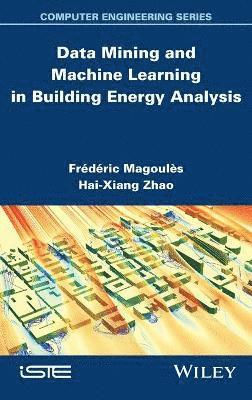
    Data Mining and Machine Learning in Building Energy Analysis

    AvFrédéric Magoules,Hai-Xiang Zhao

    Inbunden, Engelska, 2016

    1 854 kr

    Beställningsvara. Skickas inom 5-8 vardagar. Fri frakt över 249 kr.

    Beskrivning

    The energy consumption of a building has, in recent years, become a determining factor during its design and construction. With carbon footprints being a growing issue, it is important that buildings be optimized for energy conservation and CO2 reduction. This book therefore presents AI models and optimization techniques related to this application. The authors start with a review of recent models for the prediction of building energy consumption: engineering methods, statistical methods, artificial intelligence methods, ANNs and SVMs in particular. The book then focuses on SVMs, by first applying them to building energy consumption, then presenting the principles and various extensions, and SVR. The authors then move on to RDP, which they use to determine building energy faults through simulation experiments before presenting SVR model reduction methods and the benefits of parallel computing. The book then closes by presenting some of the current research and advancements in the field.

    Produktinformation

    • Utgivningsdatum:2016-01-08
    • Mått:163 x 241 x 15 mm
    • Vikt:431 g
    • Format:Inbunden
    • Språk:Engelska
    • Antal sidor:186
    • Förlag:ISTE Ltd and John Wiley & Sons Inc
    • ISBN:9781848214224

    Utforska kategorier

    • Artificiell intelligens inom Data och IT

    Mer om författaren

    Frédéric Magoulès is Professor at the Ecole Centrale Paris in France and Honorary Professor at the University of Pècs in Hungary. His research focuses on parallel computing, numerical linear algebra and machine learning. Hai-Xiang Zhao is Senior Researcher at Amadeus in France. His research focuses on parallel computing, data mining and machine learning.

    Innehållsförteckning

    • Preface ixIntroduction  xiChapter 1. Overview of Building Energy Analysis 11.1. Introduction 11.2. Physical models 31.3. Gray models 61.4. Statistical models 61.5. Artificial intelligence models 81.5.1. Neural networks  81.5.2. Support vector machines 131.6. Comparison of existing models  141.7. Concluding remarks . 16Chapter 2. Data Acquisition for Building Energy Analysis 172.1. Introduction  172.2. Surveys or questionnaires 182.3. Measurements 212.4. Simulation 252.4.1. Simulation software 262.4.2. Simulation process  282.5. Data uncertainty  342.6. Calibration 352.7. Concluding remarks  37Chapter 3. Artificial Intelligence Models 393.1. Introduction  393.2. Artificial neural networks 403.2.1. Single-layer perceptron 413.2.2. Feed forward neural network 433.2.3. Radial basis functions network 443.2.4. Recurrent neural network 473.2.5. Recursive deterministic perceptron 493.2.6. Applications of neural networks 513.3. Support vector machines 533.3.1. Support vector classification 543.3.2. ε-support vector regression 593.3.3. One-class support vector machines 623.3.4. Multiclass support vector machines 633.3.5. v-support vector machines 643.3.6. Transductive support vector machines 653.3.7. Quadratic problem solvers . 673.3.8. Applications of support vector machines 753.4. Concluding remarks  76Chapter 4. Artificial Intelligence for Building Energy Analysis 794.1. Introduction  794.2. Support vector machines for building energy prediction  804.2.1. Energy prediction definition 804.2.2. Practical issues 814.2.3. Support vector machines for prediction 854.3. Neural networks for fault detection and diagnosis 914.3.1. Description of faults  944.3.2. RDP in fault detection 954.3.3. RDP in fault diagnosis 1004.4. Concluding remarks 102Chapter 5. Model Reduction for Support Vector Machines 1035.1. Introduction  1035.2. Overview of model reduction 1045.2.1. Wrapper methods 1055.2.2. Filter methods 1065.2.3. Embedded methods 1075.3. Model reduction for energy consumption 1085.3.1. Introduction 1085.3.2. Algorithm 1095.3.3. Feature set description 1115.4. Model reduction for single building energy 1125.4.1. Feature set selection  1125.4.2. Evaluation in experiments  1145.5. Model reduction for multiple buildings energy 1165.6. Concluding remarks  119Chapter 6. Parallel Computing for Support Vector Machines 1216.1. Introduction  1216.2. Overview of parallel support vector machines 1226.3. Parallel quadratic problem solver  1236.4. MPI-based parallel support vector machines  1276.4.1. Message passing interface programming model  1276.4.2. Pisvm  1296.4.3. Psvm  1306.5. MapReduce-based parallel support vector machines  1306.5.1. MapReduce programming model  1316.5.2. Caching technique 1336.5.3. Sparse data representation 1336.5.4. Comparison of MRPsvm with Pisvm  1346.6. MapReduce-based parallel ε-support vector regression 1386.6.1. Implementation aspects  1386.6.2. Energy consumption datasets 1396.6.3. Evaluation for building energy prediction  1406.7. Concluding remarks  142Summary and Future of Building Energy Analysis  145Bibliography 149Index 163