• Fri frakt över 249 kr
  • •
  • Snabba leveranser
  • •
  • Billiga böcker
Kundservice

Du är på sajten för privatpersoner.

Företag, bibliotek eller offentlig verksamhet?

Du handlar på classic.bokus.com, där alla dina funktioner finns intakta.
Till classic.bokus.com
Bokus logotyp. Gå till startsidan.
  • Erbjudanden
  • Student
  • Topplistor
  • Barn & ungdom
  • Bokus Play
  • E-böcker
  • Ljudböcker
  • Pocketböcker
  • Spel och pussel

5% studentrabatt – använd koden KURSBOK27 →

Sidfot

Mina sidor

    Hjälp

    • Kundservice
    • Vanliga frågor och svar
    • Frakt och leverans
    • Retur vid ångerrätt
    • Reklamera vara
    • Betalning
    • Köpvillkor
    • Allmänna villkor
    • Information om webbplatsens tillgänglighet

    Om Bokus

    • Om oss
    • Pressrum
    • För studenter
    • För företag
    • För bibliotek och offentlig verksamhet
    • För leverantörer
    • Hållbarhet

    Populärt

    • Aktuella erbjudanden
    • Presentkort
    • Studentlitteratur
    • Nya böcker
    • Topplistor
    • Signerade böcker
    • Engelska böcker

    Inspiration

    • Boktips
    • BookTok
    • Barnbokskaraktärer
    • Populära författare
    Logotyp för Bokus
    Följ oss på Facebook (extern länk)Följ oss på Instagram (extern länk)Följ oss på YouTube (extern länk)Följ oss på TikTok (extern länk)
    bokus @ CookiesAnpassa cookiesIntegritetspolicyKöpvillkor
    Till Citymail hemsida (extern länk)Till Budbee hemsida (extern länk)Till Postnord hemsida (extern länk)Till Schenker hemsida (extern länk)Till Early Bird hemsida (extern länk)Till Walleys hemsida (extern länk)
    1. Naturvetenskap och teknik
    2. Teknik och industri
    3. Transportteknik
    4. Flyg- och rymdteknik

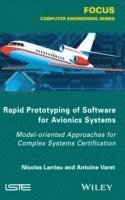
    Rapid Prototyping Software for Avionics Systems

    Model-oriented Approaches for Complex Systems Certification

    AvNicolas Larrieu,Antoine Varet

    Inbunden, Engelska, 2014

    1 800 kr

    Beställningsvara. Skickas inom 5-8 vardagar. Fri frakt över 249 kr.

    Beskrivning

    The design, implementation and validation of avionics and aeronautical systems have become extremely complex tasks due to the increase of functionalities that are deployed in current avionics systems and the need to be able certify them before putting them into production.This book proposes a methodology to enable the rapid prototyping of such a system by considering from the start the certification aspects of the solution produced. This method takes advantage of the model-based design approaches as well as the use of formal methods for the validation of these systems. Furthermore, the use of automatic software code generation tools using models makes it possible to reduce the development phase as well as the final solution testing.This book presents, firstly, an overview of the model-based design approaches such as those used in the field of aeronautical software engineering. Secondly, an original methodology that is perfectly adapted to the field of aeronautical embedded systems is introduced. Finally, the authors illustrate the use of this method using a case study for the design, implementation and testing of a new generation aeronautical router.

    Produktinformation

    • Utgivningsdatum:2014-11-21
    • Mått:165 x 241 x 15 mm
    • Vikt:1 361 g
    • Format:Inbunden
    • Språk:Engelska
    • Antal sidor:160
    • Förlag:ISTE Ltd and John Wiley & Sons Inc
    • ISBN:9781848217645

    Utforska kategorier

    • Flyg- och rymdteknik inom Naturvetenskap och teknik

    Mer om författaren

    Nicolas Larrieu is Full Professor at the research group ResCo at the TELECOM laboratory of ENAC (French Civil Aviation University). His research topics deal with designing new communication architectures and original security architectures for emerging networks such as IP-based aeronautical communication networks or UAV communication networks. He is currently involved in several activities for the SESAR European program where he can extend and validate his research results.Antoine Varet gained his doctorate at the research group ResCo at the TELECOM laboratory of ENAC (French Civil Aviation University). His current research topics concern the improvement and automation of network security protocols and the protection of the privacy of data through innovating network protocols.

    Innehållsförteckning

    • INTRODUCTION ixCHAPTER 1. DEVELOPING MODEL-BASED DESIGN METHODS IN SOFTWARE ENGINEERING 11.1. The history of model-based design 11.2. The Unified Modeling Language, a support for model-based methods 31.2.1. The philosophy and history of the Unified Modeling Language 31.2.2. The Unified Modeling Language normalized diagrams 51.2.3. The advantages of model-based design 121.3. Formal model-based validation techniques 131.3.1. Model Checking 141.3.2. Formal theorem proving 181.3.3. Code assertion 191.3.4. Applying for certification for complex systems 20CHAPTER 2. METHODOLOGY FOR RAPID PROTOTYPING AVIONIC SOFTWARE 232.1. The specificities of the avionic domain 232.1.1. System virtualization: integrated modular avionics 242.1.2. MILS: divide and conquer, to rule over a secure world 272.1.3. Processing security and safety aspects simultaneously 302.2. The certification of an avionic system 322.2.1. The qualification of tools for certification 322.2.2. Model-based development approaches in aeronautics 332.2.3. A sophisticated methodology for the development of complex onboard systems 362.3. Methodology of rapid development in seven stages 362.3.1. Presentation of the different stages 362.3.2. Advantages of the methodology 392.3.3. Example of the benefits of using our model-based methodology 452.3.4. Instantiation of the methodology with different tools 462.4. Chapter summary 59CHAPTER 3. IMPLEMENTING THE PROTOTYPING METHODOLOGY TO DEVELOP A NEXT GENERATION AVIONIC ROUTER 613.1. Introduction to next generation aeronautical communication domains 613.1.1. Avionic and aeronautical network domains 613.1.2. Communication standards and protocols for next generation aeronautics 653.1.3. The benefits of a next generation avionic router: secure next generation router 673.2. Implementing the SNG router 713.2.1. Architecture of the SNG router software 713.2.2. Routing functionalities (IPv4) 743.2.3. Filtering functionalities (IPv4) 793.3. Evaluating the performance of the SNG router 853.3.1. Experimental framework 853.3.2. Metrics and tools for evaluating performance 883.3.3. Results of the performance measurements 963.4. Chapter summary 106CONCLUSION 109BIBLIOGRAPHY 117INDEX 131