• Fri frakt över 249 kr
  • •
  • Snabba leveranser
  • •
  • Billiga böcker
Kundservice

Du är på sajten för privatpersoner.

Företag, bibliotek eller offentlig verksamhet?

Du handlar på classic.bokus.com, där alla dina funktioner finns intakta.
Till classic.bokus.com
Bokus logotyp. Gå till startsidan.
  • Erbjudanden
  • Nyheter
  • Student
  • Topplistor
  • Barn & ungdom
  • Bokus Play
  • E-böcker
  • Pocketböcker
  • Spel & pussel

10% rabatt på allt med kod NYSTART10 →

Sidfot

Mina sidor

    Hjälp

    • Kundservice
    • Vanliga frågor och svar
    • Frakt och leverans
    • Retur vid ångerrätt
    • Reklamera vara
    • Betalning
    • Köpvillkor
    • Allmänna villkor
    • Information om webbplatsens tillgänglighet

    Om Bokus

    • Om oss
    • Pressrum
    • För studenter
    • För företag
    • För bibliotek och offentlig verksamhet
    • För leverantörer
    • Hållbarhet

    Populärt

    • Aktuella erbjudanden
    • Presentkort
    • Studentlitteratur
    • Nya böcker
    • Topplistor
    • Signerade böcker
    • Engelska böcker

    Inspiration

    • Boktips
    • BookTok
    • Populära bokserier
    • Barnbokskaraktärer
    • Populära författare
    Logotyp för Bokus
    Följ oss på Facebook (extern länk)Följ oss på Instagram (extern länk)Följ oss på YouTube (extern länk)Följ oss på TikTok (extern länk)
    bokus @ CookiesAnpassa cookiesIntegritetspolicyKöpvillkor
    Till Citymail hemsida (extern länk)Till Budbee hemsida (extern länk)Till Postnord hemsida (extern länk)Till Schenker hemsida (extern länk)Till Early Bird hemsida (extern länk)Till Walleys hemsida (extern länk)
    1. Data och IT
    2. Människa – datorinteraktion

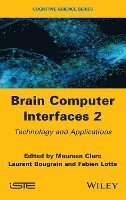
    Brain-Computer Interfaces 2

    Technology and Applications

    AvMaureen Clerc,Laurent Bougrain

    Inbunden, Engelska, 2016

    1 854 kr

    Beställningsvara. Skickas inom 5-8 vardagar. Fri frakt över 249 kr.

    Beskrivning

    Brain–computer interfaces (BCI) are devices which measure brain activity and translate it into messages or commands, thereby opening up many possibilities for investigation and application. This book provides keys for understanding and designing these multi-disciplinary interfaces, which require many fields of expertise such as neuroscience, statistics, informatics and psychology.This second volume, Technology and Applications, is focused on the field of BCI from the perspective of its end users, such as those with disabilities to practitioners. Covering clinical applications and the field of video games, the book then goes on to explore user needs which drive the design and development of BCI. The software used for their design, primarily OpenViBE, is explained step by step, before a discussion on the use of BCI from ethical, philosophical and social perspectives.The basic notions developed in this reference book are intended to be accessible to all readers interested in BCI, whatever their background. More advanced material is also offered, for readers who want to expand their knowledge in disciplinary fields underlying BCI.

    Produktinformation

    • Utgivningsdatum:2016-08-16
    • Mått:165 x 244 x 28 mm
    • Vikt:685 g
    • Format:Inbunden
    • Språk:Engelska
    • Antal sidor:364
    • Förlag:ISTE Ltd and John Wiley & Sons Inc
    • ISBN:9781848219632

    Utforska kategorier

    • Människa – datorinteraktion inom Data och IT

    Mer om författaren

    Maureen Clerc is Senior Researcher at Inria Sophia Antipolis, France.Laurent Bougrain is Associate Professor at the University of Lorraine, France.Fabien Lotte is Junior Researcher at Inria Bordeaux, France. aureen Clerc is Senior Researcher at Inria Sophia Antipolis, France.

    Innehållsförteckning

    • Foreword  xvJosé DEL R. MILLÁNIntroduction  xviiMaureen CLERC, Laurent BOUGRAIN and Fabien LOTTEPart 1. Fields of Application 1Chapter 1. Brain–Computer Interfaces in Disorders of Consciousness  3Jérémie MATTOUT, Jacques LUAUTÉ, Julien JUNG and Dominique MORLET1.1. Introduction  31.2. Altered states of consciousness: etiologies and clinical features  41.3. Functional assessment of patients with altered states of consciousness (passive paradigms)  61.4. Advanced approaches to assessing consciousness (active paradigms)  121.5. Toward the real-time use of functional markers 151.6. Conclusion and future outlook  191.7. Bibliography  21Chapter 2. Medical Applications: Neuroprostheses and Neurorehabilitation 29Laurent BOUGRAIN2.1. Motor deficiencies 302.2. Compensating for motor deficiency 322.3. Conclusions  392.4. Bibliography  39Chapter 3. Medical Applications of BCIs for Patient Communication 43François CABESTAING and Louis MAYAUD3.1. Introduction  433.2. Reactive interfaces for communication 493.3. Active interfaces for communication  533.4. Conclusions  593.5. Bibliography  60Chapter 4. BrainTV: Revealing the Neural Bases of Human Cognition in Real Time 65Jean-Philippe LACHAUX4.1. Introduction and motivation 654.2. Toward first person data accounting 664.3. Bringing subjective and objective data into the same space: conscious experience of the subject  694.4. Technical aspects: the contribution of brain–computer interfaces 704.5. The BrainTV system and its applications  754.6. BrainTV limitations  814.7. Extension to other types of recordings  824.8. Conclusions  824.9. Bibliography 83Chapter 5. BCIs and Video Games: State of the Art with the OpenViBE2 Project 85Anatole LÉCUYER5.1. Introduction  855.2. Video game prototypes controlled by BCI 885.3. Industrial prototypes: the potential for very different kinds of games  935.4. Discussion 965.5. Conclusion 985.6. Bibliography  98Part 2. Practical Aspects of BCI Implementation  101Chapter 6. Analysis of Patient Need for Brain–Computer Interfaces 103Louis MAYAUD, Salvador CABANILLES and Eric AZABOU6.1. Introduction  1036.2. Types of users 1086.3. Interpretation of needs in BCI usage contexts  1136.4. Conclusions  1176.5. Bibliography  119Chapter 7. Sensors: Theory and Innovation 123Jean-Michel BADIER, Thomas LONJARET and Pierre LELEUX7.1. EEG electrodes 1257.2. Invasive recording 1287.3. Latest generation sensors 1307.4. Magnetoencephalography  1377.5. Conclusions  1397.6. Bibliography  140Chapter 8. Technical Requirements for High-quality EEG Acquisition 143Emmanuel MABY8.1. Electrodes 1448.2. Montages . 1458.3. Amplifiers 1478.4. Analog filters  1528.5. Analog-to-digital conversion 1528.6. Event synchronization with the EEG  1558.7. Conclusions  1598.8. Bibliography  160Chapter 9. Practical Guide to Performing an EEG Experiment  163Emmanuel MABY9.1. Study planning 1639.2. Equipment 1669.3. Experiment procedure 1709.4. Bibliography  177Part 3 . Step by Step Guide to BCI Design with OpenViBE 179Chapter 10. OpenViBE and Other BCI Software Platforms 181Jussi LINDGREN and Anatole LECUYER10.1. Introduction  18110.2. Using BCI for control  18310.3. BCI processing stages  18410.4. Exploring BCI  18710.5. Comparison of platforms  18910.6. Choosing a platform 19510.7. Conclusion  19610.8. Bibliography 197Chapter 11. Illustration of Electrophysiological Phenomena with OpenViBE  199Fabien LOTTE and Alison CELLARD11.1. Visualization of raw EEG signals and artifacts  20011.2. Visualization of alpha oscillations 20111.3. Visualization of the beta rebound  20311.4. Visualization of the SSVEP 20611.5. Conclusions  20811.6. Bibliography 209Chapter 12. Classification of Brain Signals with OpenViBE 211Laurent BOUGRAIN and Guillaume SERRIÈRE12.1. Introduction  21112.2. Classification 21212.3. Evaluation 21612.4. Conclusions  22412.5. Bibliography 224Chapter 13. OpenViBE Illustration of a P300 Virtual Keyboard  227Nathanaël FOY, Théodore PAPADOPOULO and Maureen CLERC13.1. Target/non-target classification 22813.2. Illustration of a P300 virtual keyboard 23513.3. Bibliography 240Chapter 14. Recreational Applications of OpenViBE: Brain Invaders and Use-the-Force 241Anton ANDREEV, Alexandre BARACHANT, Fabien LOTTE and Marco CONGEDO14.1. Brain Invaders  24114.2. Implementation  24814.3. Use-The-Force!  25114.4. Conclusions  25614.5. Bibliography 257Part 4. Societal Challenges and Perspectives  259Chapter 15. Ethical Reflections on Brain–Computer Interfaces 261Florent BOCQUELET, Gaëlle PIRET, Nicolas AUMONIER and Blaise YVERT15.1. Introduction  26215.2. The animal  26415.3. Human beings  26715.4. The human species  27415.5. Conclusions  27915.6. Bibliography 281Chapter 16. Acceptance of Brain–machine Hybrids: How is Their Brain Perceived In Vivo?  289Bernard ANDRIEU16.1. Ethical problem  28916.2. The method  29116.3. Ethics of experimentation: Matthew Nagle, the first patient  29316.4. Body language in performance 29616.5. Ethics of autonomous (re)socialization 29716.6. Conclusions . 30316.7. Bibliography 30416.8. Appendix (verbatim video retranscriptions)  304Chapter 17. Conclusion and Perspectives  311Maureen CLERC, Laurent BOUGRAIN and Fabien LOTTE17.1. Introduction  31117.2. Reinforcing the scientific basis of BCIs  31417.3. Using BCI in practice  31617.4. Opening up BCI technologies to new applications and fields 31817.5. Concern about ethical issues  32117.6. Conclusions  32117.7. Bibliography 322List of Authors  325Index  329Contents of Volume 1 333