• Fri frakt över 249 kr
  • •
  • Snabba leveranser
  • •
  • Billiga böcker
Kundservice

Du är på sajten för privatpersoner.

Företag, bibliotek eller offentlig verksamhet?

Du handlar på classic.bokus.com, där alla dina funktioner finns intakta.
Till classic.bokus.com
Bokus logotyp. Gå till startsidan.
  • Erbjudanden
  • Nyheter
  • Student
  • Topplistor
  • Barn & ungdom
  • Bokus Play
  • E-böcker
  • Pocketböcker
  • Spel & pussel

10% rabatt på allt med kod NYSTART10 →

Sidfot

Mina sidor

    Hjälp

    • Kundservice
    • Vanliga frågor och svar
    • Frakt och leverans
    • Retur vid ångerrätt
    • Reklamera vara
    • Betalning
    • Köpvillkor
    • Allmänna villkor
    • Information om webbplatsens tillgänglighet

    Om Bokus

    • Om oss
    • Pressrum
    • För studenter
    • För företag
    • För bibliotek och offentlig verksamhet
    • För leverantörer
    • Hållbarhet

    Populärt

    • Aktuella erbjudanden
    • Presentkort
    • Studentlitteratur
    • Nya böcker
    • Topplistor
    • Signerade böcker
    • Engelska böcker

    Inspiration

    • Boktips
    • BookTok
    • Populära bokserier
    • Barnbokskaraktärer
    • Populära författare
    Logotyp för Bokus
    Följ oss på Facebook (extern länk)Följ oss på Instagram (extern länk)Följ oss på YouTube (extern länk)Följ oss på TikTok (extern länk)
    bokus @ CookiesAnpassa cookiesIntegritetspolicyKöpvillkor
    Till Citymail hemsida (extern länk)Till Budbee hemsida (extern länk)Till Postnord hemsida (extern länk)Till Schenker hemsida (extern länk)Till Early Bird hemsida (extern länk)Till Walleys hemsida (extern länk)
    1. Psykologi och pedagogik
    2. Psykologi
    3. Kognitiv psykologi

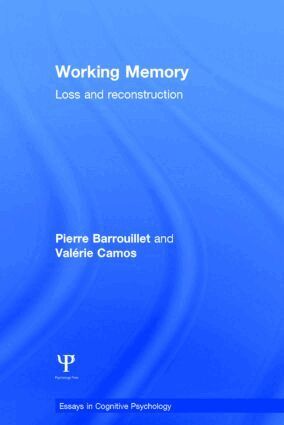
    Working Memory

    Loss and reconstruction

    AvPierre Barrouillet,Valérie Camos

    Inbunden, Engelska, 2014

    Del i serien Essays in Cognitive Psychology

    2 354 kr

    Beställningsvara. Skickas inom 10-15 vardagar. Fri frakt över 249 kr.

    Fler format och utgåvor

    Häftad

    867 kr

    Beskrivning

    Working memory is the cognitive system in charge of the temporary maintenance of information in view of its on-going processing. Lying at the centre of cognition, it has become a key concept in psychological science. The book presents a critical review and synthesis of the working memory literature, and also presents an innovative new theory - the Time-Based Resource-Sharing (TBRS) model.Tracing back the evolution of the concept of working memory, from its introduction by Baddeley and Hitch in 1974 and the development of their modal model, Barrouillet and Camos explain how an alternative conception could have been developed from the very beginning, and why it is needed today. This alternative model takes into account the temporal dynamics of mental functioning. The book describes a new architecture for working memory, and provides a description of its functioning, its development, the sources of individual differences, and hints about neural substrates. The authors address central and debated questions about working memory, and also more general issues about cognitive architecture and functioning. Working Memory: Loss and Reconstruction will be essential reading for advanced students and researchers of the psychology of memory.

    Produktinformation

    • Utgivningsdatum:2014-09-23
    • Mått:156 x 234 x 18 mm
    • Vikt:476 g
    • Format:Inbunden
    • Språk:Engelska
    • Serie:Essays in Cognitive Psychology
    • Antal sidor:240
    • Förlag:Taylor & Francis Ltd
    • ISBN:9781848722651

    Utforska kategorier

    • Kognitiv psykologi inom Psykologi och pedagogik

    Mer om författaren

    Pierre Barrouillet is Professor of developmental psychology at the University of Geneva, Switzerland, and Director of the Archives Jean Piaget. His research investigates the development of numerical cognition, conditional reasoning, as well as the functioning and development of working memory.Valérie Camos is Professor of developmental psychology at the Université of Fribourg, Switzerland. She created and currently heads the Fribourg Center for Cognition, a multidisciplinary research centre. Aside from her research on working memory, she is also still interested in numerical cognition.

    Recensioner i media

    'One of the central questions within current cognitive psychology concerns the puzzle of how an apparently simple measure, working memory span, is able to predict performance across a wide range of areas from language comprehension to attentional control, rivalling conventional intelligence tests in its predictive breadth and capacity. Barrouillet and Camos describe an extensive series of studies focused on this issue. They were the first to demonstrate that measures of working memory span do not require complex subtasks such as language comprehension and arithmetic processing, but can be obtained based extremely simple operations, provided these are made continuous, allowing no opportunity for participants to insert even brief periods of rehearsal. They develop their Time Based Resource Sharing (TBRS) model to account for these results, postulating the need for temporary storage which in turn requires attentional refreshing if the relevant memory trace is not to fade. They place their work in a broad historic context, argue cogently for their concept of decay rather than the more popular proposal of forgetting through interference, going on to apply their approach across a wide range of situations and populations. Their work makes an important contribution to a topic of central importance. This book does a service to the field in summarising their extensive research program, presenting it clearly, and comparing it with alternative interpretations. This book should certainly be on the shelves of anyone interested in individual differences in cognition and their basis in working memory.' – Alan Baddeley, Department of Psychology, University of York, UK'In this era of brain images, one might assume that there is little left to learn using the primary tool that has been available to researchers of cognition for the past half-century: computers that can present visual and acoustic events and can record the speed and accuracy of human responses to these events. This assumption would be quite wrong for a number of topics, including the present topic of working memory. It is the small amount of information one can hold in mind to allow ideas to be constructed, language to be understood, problems to be solved, and intelligent actions to be carried out, and it improves as children develop. Barrouillet and Camos document this exciting, ongoing field of research in which incredible new discoveries are being made at a rapid rate: discoveries related to how long humans can hold a thought in mind, how many thoughts can co-exist, how they can be shielded from loss or reconstructed from memory, and how new concepts can be constructed from old ones. This rapidly-advancing field still hosts controversies about basic mechanisms of the mind, comparable to how physics hosts controversies about elementary particles. The authors are at the forefront of the working memory debate because of their own ground-breaking research, well-explained in this book that represents various views well and yet is an effective advocate for the authors’ own comprehensive view. Readers get a historical perspective and are also taken to current research battlefronts in an organized, engaging, succinct, and easy-to-read summary.' - Nelson Cowan, Department of Psychological Sciences, University of Missouri-Columbia, USA'The Time-Based Resource-Sharing (TBRS) model takes a promising approach to understanding the mechanisms of working memory. It not only helps explain a wide range of key phenomena in this field but also provides predictions and directions for on-going working memory research. This sophisticated framework captures the temporal dynamics of working memory function quite nicely, as well as its development and inter-individual variations. This book commences with a comprehensive review of short-term and working memory research based on various historical and theoretical considerations, followed by a detailed presentation of the TBRS model and the introduction of some novel concepts. While the contents of this book are easily accessible and appealing to postgraduate students, active researchers in the field of human memory will also find the contents stimulating, as the issues covered in this volume are at the theoretical vanguard and include hot, up-to-date debates in the field.' – Satoru Saito, Associate Professor, Department of Cognitive Psychology in Education, Kyoto University, Japan'Specialists in working memory and attention will be grateful for the detail with which the authors explain the studies they believe are central support for their viewpoint. ... Barrouillet and Casmos's willingness to reconsider ideas that have guided decades of research is critical to our field's forward progress. ... Barrouillet and Camos invite us to consider the road less traveled by. This invitation promises us the chance to move our understanding of working memory forward.' – Kristi S. Multhaup and Blaire J. Weidler, PsycCRITIQUES, 2015'Barrouillet and Camos develop an argument for their own model of working memory [...] Barrouillet and Camos demonstrate a tremendous grasp of the extant research literature on working memory.' -K.S. Millar, Earlham College

    Innehållsförteckning

    • 1. What is working memory? 2. Time and working memory 3. Time-based resource sharing 4. Working memory loss 5. Working memory reconstruction 6. A working memory architecture 7. Working memory in development and individual differences 8. Controversies and prospects in working memory Epilogue: Searching for working memory