• Fri frakt över 249 kr
  • •
  • Snabba leveranser
  • •
  • Billiga böcker
Kundservice

Du är på sajten för privatpersoner.

Företag, bibliotek eller offentlig verksamhet?

Du handlar på classic.bokus.com, där alla dina funktioner finns intakta.
Till classic.bokus.com
Bokus logotyp. Gå till startsidan.
  • Erbjudanden
  • Student
  • Topplistor
  • Barn & ungdom
  • Bokus Play
  • E-böcker
  • Ljudböcker
  • Pocketböcker
  • Spel & pussel

Upp till 25% på utvalda nyheter →

Sidfot

Mina sidor

    Hjälp

    • Kundservice
    • Vanliga frågor och svar
    • Frakt och leverans
    • Retur vid ångerrätt
    • Reklamera vara
    • Betalning
    • Köpvillkor
    • Allmänna villkor
    • Information om webbplatsens tillgänglighet

    Om Bokus

    • Om oss
    • Pressrum
    • För studenter
    • För företag
    • För bibliotek och offentlig verksamhet
    • För leverantörer
    • Hållbarhet

    Populärt

    • Aktuella erbjudanden
    • Presentkort
    • Studentlitteratur
    • Nya böcker
    • Topplistor
    • Signerade böcker
    • Engelska böcker

    Inspiration

    • Boktips
    • BookTok
    • Populära bokserier
    • Barnbokskaraktärer
    • Populära författare
    Logotyp för Bokus
    Följ oss på Facebook (extern länk)Följ oss på Instagram (extern länk)Följ oss på YouTube (extern länk)Följ oss på TikTok (extern länk)
    bokus @ CookiesAnpassa cookiesIntegritetspolicyKöpvillkor
    Till Citymail hemsida (extern länk)Till Budbee hemsida (extern länk)Till Postnord hemsida (extern länk)Till Schenker hemsida (extern länk)Till Early Bird hemsida (extern länk)Till Walleys hemsida (extern länk)
    1. Data och IT
    2. Programmeringsböcker

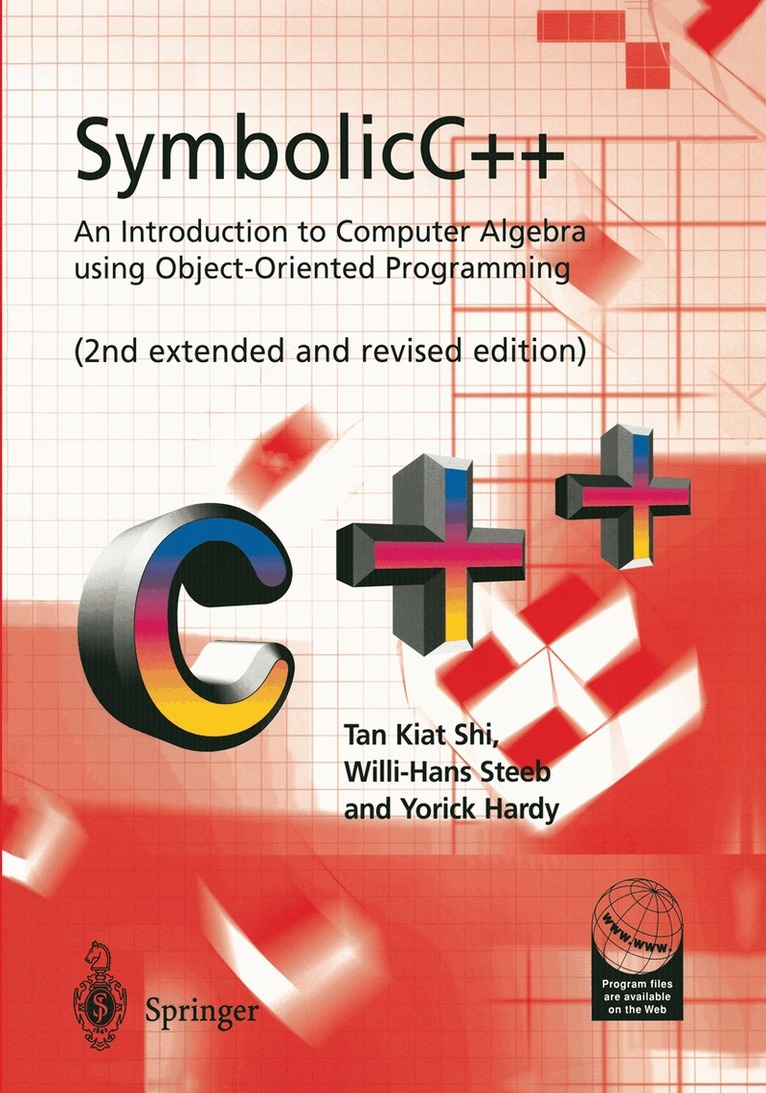
    SymbolicC++:An Introduction to Computer Algebra using Object-Oriented Programming

    An Introduction to Computer Algebra using Object-Oriented Programming

    AvKiat Shi Tan,Willi-Hans Steeb

    Häftad, Engelska, 2000

    563 kr

    Beställningsvara. Skickas inom 10-15 vardagar. Fri frakt över 249 kr.

    Beskrivning

    Symbolic C++: An Introduction to Computer Algebra Using Object-Oriented Programming provides a concise introduction to C++ and object-oriented programming, using a step-by-step construction of a new object-oriented designed computer algebra system - Symbolic C++. It shows how object-oriented programming can be used to implement a symbolic algebra system and how this can then be applied to different areas in mathematics and physics. This second revised edition:- *Explains the new powerful classes that have been added to Symbolic C++. *Includes the Standard Template Library. *Extends the Java section. *Contains useful classes in scientific computation. *Contains extended coverage of Maple, Mathematica, Reduce and MuPAD.

    Produktinformation

    • Utgivningsdatum:2000-02-02
    • Mått:155 x 235 x 37 mm
    • Vikt:1 272 g
    • Format:Häftad
    • Språk:Engelska
    • Antal sidor:692
    • Upplaga:2
    • Förlag:Springer London Ltd
    • ISBN:9781852332600

    Utforska kategorier

    • Programmeringsböcker inom Data och IT
    • Programspråk inom Data och IT

    Innehållsförteckning

    • 1 Introduction.- 1.1 What is Computer Algebra ?.- 1.2 Properties of Computer Algebra Systems.- 1.3 Pitfalls in Computer Algebra Systems.- 1.4 Design of a Computer Algebra System.- 2 Mathematics for Computer Algebra.- 2.1 Rings and Fields.- 2.2 Integers.- 2.3 Rational Numbers.- 2.4 Real Numbers.- 2.5 Complex Numbers.- 2.6 Vectors and Matrices.- 2.7 Quaternions.- 2.8 Polynomials.- 2.9 Differentiation.- 2.10 Integration.- 2.11 Commutativity and Noncommutativity.- 2.12 Tensor and Kronecker Product.- 2.13 Exterior Product.- 3 Computer Algebra Systems.- 3.1 Introduction.- 3.2 Reduce.- 3.3 Maple.- 3.4 Axiom.- 3.5 Mathematica.- 3.6 MuPAD.- 4 Object-Oriented Programming.- 4.1 Objects, Classes and Abstract Data Types.- 4.2 Message Passing.- 4.3 Inheritance.- 4.4 Polymorphism.- 4.5 Object-Oriented Languages.- 4.6 Summary.- 5 Basic Tools in C++.- 5.1 Pointers and References.- 5.2 Classes.- 5.3 Constructors and Destructor.- 5.4 Copy Constructor and Assignment Operator.- 5.5 Type Conversion.- 5.6 Operator Overloading.- 5.7 Class Templates.- 5.8 Function Templates.- 5.9 Friendship.- 5.10 Inheritance.- 5.11 Virtual Functions.- 5.12 Wrapper Class.- 5.13 Standard Template Library.- 5.14 Recursion.- 5.15 Summary.- 6 Classes for Computer Algebra.- 6.1 The Verylong Integer Class.- 6.2 The Rational Number Class.- 6.3 The Complex Number Class.- 6.4 The Quaternion Class.- 6.5 The Derive Class.- 6.6 The Vector Class.- 6.7 The Matrix Class.- 6.8 Array Classes.- 6.9 The String Class.- 6.10 Bit Vectors.- 6.11 The Linked List Class.- 6.12 The Polynomial Class.- 6.13 The Set Class.- 6.14 Summary.- 7 The Symbolic Class.- 7.1 Object-Oriented Design.- 7.2 Data Fields and Types of Symbol.- 7.3 Constructors.- 7.4 Operators.- 7.5 Functions.- 7.6 Simplification.- 7.7 Commutativity.- 7.8 Symbolic and Numeric Interface.- 7.9 Summary.- 8 Applications.- 8.1 Bit Vector Class.- 8.2 Verylong Class.- 8.3 Verylong and Rational Classes.- 8.4 Verylong, Rational and Derive Classes.- 8.5 Verylong, Rational and Complex Classes.- 8.6 Symbolic Class.- 8.7 Symbolic Class and Symbolic Differentiation.- 8.8 Matrix Class.- 8.9 Array and Symbolic Classes.- 8.10 Polynomial and Symbolic Classes.- 8.11 Lie Series Techniques.- 8.12 Spectra of Small Spin Clusters.- 8.13 Nonlinear Maps and Chaotic Behaviour.- 8.14 Numerical-Symbolic Application.- 8.15 Summary.- 9 Lisp and Computer Algebra.- 9.1 Introduction.- 9.2 Basic Functions of Lisp.- 9.3 Examples from Symbolic Computation.- 9.4 Lisp System based on C++.- 10 Program Listing.- 10.1 Verylong Class.- 10.2 Rational Class.- 10.3 Complex Class.- 10.4 Quaternion Class.- 10.5 Derive Class.- 10.6 Vector Class.- 10.7 Matrix Class.- 10.8 Array Class.- 10.9 String Class.- 10.10Bit Vector Class.- 10.11Linked List Class.- 10.12Polynomial Class.- 10.13Set Class.- 10.14Symbolic Class.- 11 PVM and Abstract Data Types.- 12 Error Handling Techniques.- 12.1 Error State.- 12.2 Exception Handling.- 13 Gnuplot and PostScript.