• Fri frakt över 249 kr
  • •
  • Snabba leveranser
  • •
  • Billiga böcker
Kundservice

Du är på sajten för privatpersoner.

Företag, bibliotek eller offentlig verksamhet?

Du handlar på classic.bokus.com, där alla dina funktioner finns intakta.
Till classic.bokus.com
Bokus logotyp. Gå till startsidan.
  • Erbjudanden
  • Nyheter
  • Student
  • Topplistor
  • Barn & ungdom
  • Bokus Play
  • E-böcker
  • Pocketböcker
  • Spel & pussel

10% rabatt på allt med kod NYSTART10 →

Sidfot

Mina sidor

    Hjälp

    • Kundservice
    • Vanliga frågor och svar
    • Frakt och leverans
    • Retur vid ångerrätt
    • Reklamera vara
    • Betalning
    • Köpvillkor
    • Allmänna villkor
    • Information om webbplatsens tillgänglighet

    Om Bokus

    • Om oss
    • Pressrum
    • För studenter
    • För företag
    • För bibliotek och offentlig verksamhet
    • För leverantörer
    • Hållbarhet

    Populärt

    • Aktuella erbjudanden
    • Presentkort
    • Studentlitteratur
    • Nya böcker
    • Topplistor
    • Signerade böcker
    • Engelska böcker

    Inspiration

    • Boktips
    • BookTok
    • Populära bokserier
    • Barnbokskaraktärer
    • Populära författare
    Logotyp för Bokus
    Följ oss på Facebook (extern länk)Följ oss på Instagram (extern länk)Följ oss på YouTube (extern länk)Följ oss på TikTok (extern länk)
    bokus @ CookiesAnpassa cookiesIntegritetspolicyKöpvillkor
    Till Citymail hemsida (extern länk)Till Budbee hemsida (extern länk)Till Postnord hemsida (extern länk)Till Schenker hemsida (extern länk)Till Early Bird hemsida (extern länk)Till Walleys hemsida (extern länk)
    1. Naturvetenskap och teknik
    2. Teknik och industri
    3. Elektronik och kommunikationer

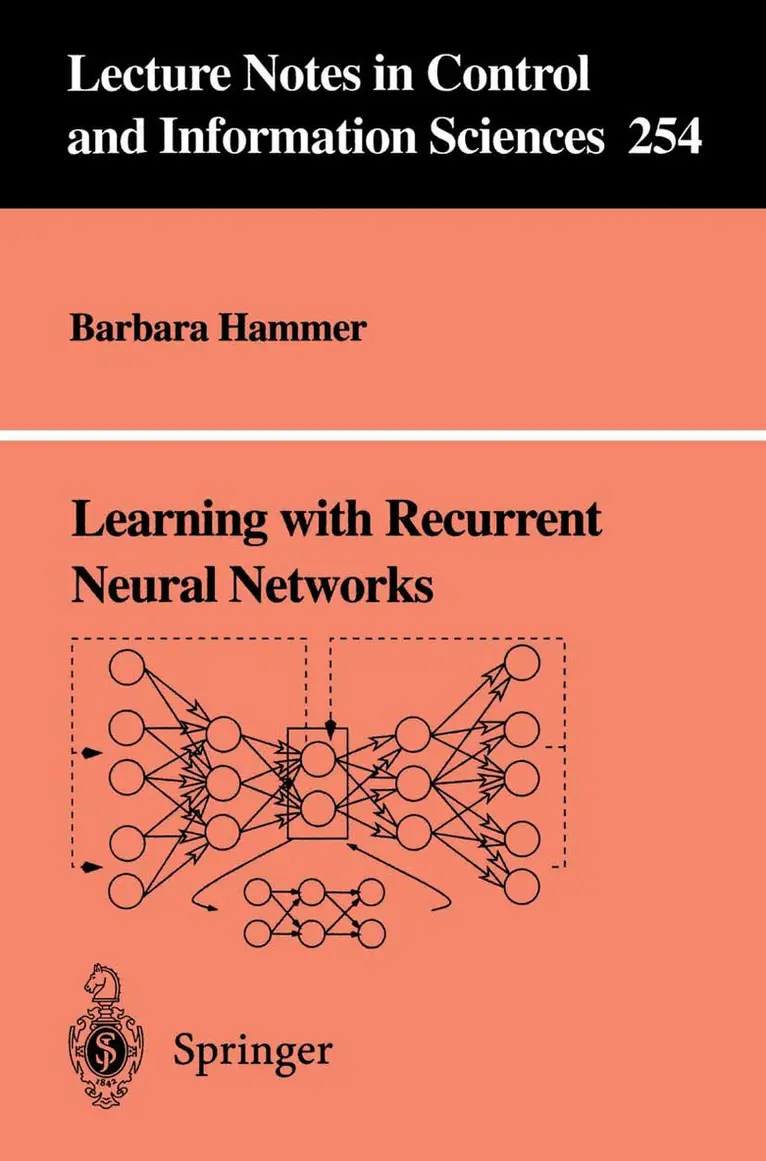
    Learning with Recurrent Neural Networks

    AvBarbara Hammer

    Häftad, Engelska, 2000

    Del 254 i serien Lecture Notes in Control and Information Sciences

    546 kr

    Beställningsvara. Skickas inom 10-15 vardagar. Fri frakt över 249 kr.

    Fler format och utgåvor

    E-bok

    712 kr

    Beskrivning

    Folding networks, a generalisation of recurrent neural networks to tree structured inputs, are investigated as a mechanism to learn regularities on classical symbolic data, for example. The architecture, the training mechanism, and several applications in different areas are explained. Afterwards a theoretical foundation, proving that the approach is appropriate as a learning mechanism in principle, is presented: Their universal approximation ability is investigated- including several new results for standard recurrent neural networks such as explicit bounds on the required number of neurons and the super Turing capability of sigmoidal recurrent networks. The information theoretical learnability is examined - including several contribution to distribution dependent learnability, an answer to an open question posed by Vidyasagar, and a generalisation of the recent luckiness framework to function classes. Finally, the complexity of training is considered - including new results on the loading problem for standard feedforward networks with an arbitrary multilayered architecture, a correlated number of neurons and training set size, a varying number of hidden neurons but fixed input dimension, or the sigmoidal activation function, respectively.

    Produktinformation

    • Utgivningsdatum:2000-05-30
    • Mått:155 x 235 x 10 mm
    • Vikt:257 g
    • Format:Häftad
    • Språk:Engelska
    • Serie:Lecture Notes in Control and Information Sciences
    • Antal sidor:150
    • Upplaga:2000
    • Förlag:Springer London Ltd
    • ISBN:9781852333430

    Utforska kategorier

    • Elektronik och kommunikationer inom Naturvetenskap och teknik
    • Systemvetenskap och AI inom Data och IT

    Innehållsförteckning

    • Introduction, Recurrent and Folding Networks: Definitions, Training, Background, Applications.- Approximation Ability: Foundationa, Approximation in Probability, Approximation in the Maximum Norm, Discussions and Open Questions.- Learnability: The Learning Scenario, PAC Learnability, Bounds on the VC-dimension of Folding Networks, Consquences for Learnability, Lower Bounds for the LRAAM, Discussion and Open Questions.- Complexity: The Loading Problem, The Perceptron Case, The Sigmoidal Case, Discussion and Open Questions.- Conclusion.