• Fri frakt över 249 kr
  • •
  • Snabba leveranser
  • •
  • Billiga böcker
Kundservice

Du är på sajten för privatpersoner.

Företag, bibliotek eller offentlig verksamhet?

Du handlar på classic.bokus.com, där alla dina funktioner finns intakta.
Till classic.bokus.com
Bokus logotyp. Gå till startsidan.
  • Erbjudanden
  • Nyheter
  • Student
  • Topplistor
  • Barn & ungdom
  • Bokus Play
  • E-böcker
  • Pocketböcker
  • Spel & pussel

Må bättre, för mindre! Upp till 50% rabatt på hälsoböcker

Sidfot

Mina sidor

    Hjälp

    • Kundservice
    • Vanliga frågor och svar
    • Frakt och leverans
    • Retur vid ångerrätt
    • Reklamera vara
    • Betalning
    • Köpvillkor
    • Allmänna villkor
    • Information om webbplatsens tillgänglighet

    Om Bokus

    • Om oss
    • Pressrum
    • För studenter
    • För företag
    • För bibliotek och offentlig verksamhet
    • För leverantörer
    • Hållbarhet

    Populärt

    • Aktuella erbjudanden
    • Presentkort
    • Studentlitteratur
    • Nya böcker
    • Topplistor
    • Signerade böcker
    • Engelska böcker

    Inspiration

    • Boktips
    • BookTok
    • Populära bokserier
    • Barnbokskaraktärer
    • Populära författare
    Logotyp för Bokus
    Följ oss på Facebook (extern länk)Följ oss på Instagram (extern länk)Följ oss på YouTube (extern länk)Följ oss på TikTok (extern länk)
    bokus @ CookiesAnpassa cookiesIntegritetspolicyKöpvillkor
    Till Citymail hemsida (extern länk)Till Budbee hemsida (extern länk)Till Postnord hemsida (extern länk)Till Schenker hemsida (extern länk)Till Early Bird hemsida (extern länk)Till Walleys hemsida (extern länk)
    1. Ekonomi och Ledarskap
    2. Nationalekonomi
    3. Mikroekonomi

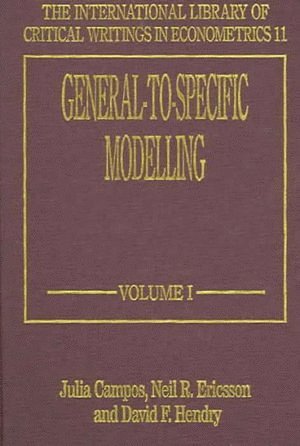
    General-to-Specific Modelling

    AvJulia Campos,Neil R. Ericsson

    Inbunden, Engelska, 2005

    Del 11 i serien The International Library of Critical Writings in Econometrics series

    11 746 kr

    Beställningsvara. Skickas inom 5-8 vardagar. Fri frakt över 249 kr.

    Beskrivning

    Economists have long sought to develop quantitative models of economic behaviour, which blend economic theory with data evidence. Econometric modelling of economic time series has strived to achieve this by seeking to discover sustainable and interpretable relationships. This important two-volume collection focuses on a central method used in selecting such models, namely simplification of an initially general model that adequately characterizes the empirical evidence within the investigators' theoretical framework. The volumes feature a wealth of evidence that has accrued over the last five years displaying its excellent abilities for model selection, based on Monte Carlo studies of automatic algorithms. These also throw light on several major methodological issues, and prompt many new ideas, which are discussed. The collection will be valuable to all empirical economists and econometricians.

    Produktinformation

    • Utgivningsdatum:2005-10-27
    • Mått:169 x 244 x undefined mm
    • Format:Inbunden
    • Språk:Engelska
    • Serie:The International Library of Critical Writings in Econometrics series
    • Förlag:Edward Elgar Publishing Ltd
    • ISBN:9781852786694

    Utforska kategorier

    • Mikroekonomi inom Ekonomi och Ledarskap
    • Nationalekonomi inom Ekonomi och Ledarskap

    Mer om författaren

    Edited by Julia Campos, Professor of Econometrics, Universidad de Salamanca, Spain, Neil R. Ericsson, George Washington University, US and David F. Hendry, Professor of Economics, Fellow, Nuffield College and Chairman, Economics Department, University of Oxford, UK

    Recensioner i media

    'As data sets have become larger, computers greatly increased in capacity and speed, exploratory techniques have grown more sophisticated and models are now multivariate, dynamic, and possibly nonlinear. The number of models that could be considered, and thus compared, have become immense. Econometricians need to be helped through this tangled maze and this help can be found in these volumes. Here leading advocates of a variety of well-tried and appreciated approaches to modeling display their expert knowledge.'

    Innehållsförteckning

    • Contents:Volume I AcknowledgementsIntroduction Julia Campos, Neil R. Ericsson and David F. HendryPART IINTRODUCTION TO THE METHODOLOGY 1. Christopher L. Gilbert (1986), ‘Professor Hendry’s Econometric Methodology’2. David F. Hendry (1983), ‘Econometric Modelling: The “Consumption Function” in Retrospect’3. Christopher L. Gilbert (1989), ‘LSE and the British Approach to Time Series Econometrics’4. Aris Spanos (1989), ‘On Rereading Haavelmo: A Retrospective View of Econometric Modeling’5. Adrian Pagan (1987), ‘Three Econometric Methodologies: A Critical Appraisal’6. P.C.B. Phillips (1988), ‘Reflections on Econometric Methodology’7. Neil R. Ericsson, Julia Campos and Hong-Anh Tran (1990), ‘PC-Give and David Hendry’s Econometric Methodology’PART II THEORY OF REDUCTION 8. David F. Hendry (1987), ‘Econometric Methodology: A Personal Perspective’9. David F. Hendry and Jean-François Richard (1982), ‘On the Formulation of Empirical Models in Dynamic Econometrics’10. Tjalling C. Koopmans (1950), ‘When is an Equation System Complete for Statistical Purposes?’11. A.W. Phillips (1956), ‘Some Notes on the Estimation of Time-Forms of Reactions in Interdependent Dynamic Systems’12. J.-F. Richard (1980), ‘Models with Several Regimes and Changes in Exogeneity’13. Robert F. Engle, David F. Hendry and Jean-François Richard (1983), ‘Exogeneity’PART IIIDYNAMIC SPECIFICATION 14. David F. Hendry, Adrian R. Pagan and J. Denis Sargan (1984), ‘Dynamic Specification’15. David F. Hendry and Grayham E. Mizon (1978), ‘Serial Correlation as a Convenient Simplification, Not a Nuisance: A Comment on a Study of the Demand for Money by the Bank of England’16. J.D. Sargan (1980), ‘Some Tests of Dynamic Specification for a Single Equation’17. J.D. Sargan (1961), ‘The Maximum Likelihood Estimation of Economic Relationships with Autoregressive Residuals’18. Søren Johansen and Katarina Juselius (1990), ‘Maximum Likelihood Estimation and Inference on Cointegration – With Applications to the Demand for Money’PART IVMODEL SELECTION PROCEDURES 19. T.W. Anderson (1962), ‘The Choice of the Degree of a Polynomial Regression as a Multiple Decision Problem’20. Thomas A. Yancey and George G. Judge (1976), ‘A Monte Carlo Comparison of Traditional and Stein-Rule Estimators Under Squared Error Loss’21. Grayham E. Mizon (1977), ‘Model Selection Procedures’22. N.E. Savin (1980), ‘The Bonferroni and the Scheffé Multiple Comparison Procedures’23. Halbert White (1990), ‘A Consistent Model Selection Procedure Based on m-testing’24. P.C.B. Phillips (1991), ‘Optimal Inference in Cointegrated Systems’Name IndexVolume IIAcknowledgementsAn introduction by the editors to both volumes appears in Volume IPART IMODEL SELECTION CRITERIA 1. Hirotugu Akaike (1981), ‘Likelihood of a Model and Information Criteria’2. Gideon Schwarz (1978), ‘Estimating the Dimension of a Model’3. E.J. Hannan and B.G. Quinn (1979), ‘The Determination of the Order of an Autoregression’4. A.C. Atkinson (1981), ‘Likelihood Ratios, Posterior Odds and Information Criteria’5. K.R. Sawyer (1983), ‘Testing Separate Families of Hypotheses: An Information Criterion’6. Peter C.B. Phillips (1996), ‘Econometric Model Determination’PART IIMODEL COMPARISONS 7. D.R. Cox (1961), ‘Tests of Separate Families of Hypotheses’8. D.R. Cox (1962), ‘Further Results on Tests of Separate Families of Hypotheses’9. Phoebus J. Dhrymes, E. Philip Howrey, Saul H. Hymans, Jan Kmenta, Edward E. Leamer, Richard E. Quandt, James B. Ramsey, Harold T. Shapiro and Victor Zarnowitz (1972), ‘Criteria for Evaluation of Econometric Models’10. M.H. Pesaran (1974), ‘On the General Problem of Model Selection’PART IIIENCOMPASSING 11. Grayham E. Mizon and Jean-François Richard (1986), ‘The Encompassing Principle and its Application to Testing Non-nested Hypotheses’12. David F. Hendry and Jean-François Richard (1989), ‘Recent Developments in the Theory of Encompassing’13. Jeffrey M. Wooldridge (1990), ‘An Encompassing Approach to Conditional Mean Tests with Applications to Testing Nonnested Hypotheses’14. Maozu Lu and Grayham E. Mizon (1996), ‘The Encompassing Principle and Hypothesis Testing’15. David F. Hendry (1988), ‘The Encompassing Implications of Feedback Versus Feedforward Mechanisms in Econometrics’16. Yock Y. Chong and David F. Hendry (1986), ‘Econometric Evaluation of Linear Macro-Economic Models’17. Neil R. Ericsson (1992), ‘Parameter Constancy, Mean Square Forecast Errors, and Measuring Forecast Performance: An Exposition, Extensions, and Illustration’18. Neil R. Ericsson and Jaime Marquez (1993), ‘Encompassing the Forecasts of U.S. Trade Balance Models’19. David F. Hendry and Grayham E. Mizon (1993), ‘Evaluating Dynamic Econometric Models by Encompassing the VAR’PART IVCOMPUTER AUTOMATION 20. Michael C. Lovell (1983), ‘Data Mining’21. Frank T. Denton (1985), ‘Data Mining as an Industry’22. Kevin D. Hoover and Stephen J. Perez (1999), ‘Data Mining Reconsidered: Encompassing and the General-to-Specific Approach to Specification Search’23. David F. Hendry and Hans-Martin Krolzig (1999), ‘Improving on “Data Mining Reconsidered” by K.D. Hoover and S.J. Perez’24. Kevin D. Hoover and Stephen J. Perez (1999), ‘Reply to our Discussants’PART VEMPIRICAL APPLICATIONS 25. P.K. Trivedi (1970), ‘The Relation between the Order-Delivery Lag and the Rate of Capacity Utilization in the Engineering Industry in the United Kingdom, 1958–1967’26. James E.H. Davidson, David F. Hendry, Frank Srba and Stephen Yeo (1978), ‘Econometric Modelling of the Aggregate Time-Series Relationship Between Consumers’ Expenditure and Income in the United Kingdom’27. James E.H. Davidson and David F. Hendry (1981), ‘Interpreting Econometric Evidence: The Behaviour of Consumers’ Expenditure in the UK’28. David F. Hendry (1979), ‘Predictive Failure and Econometric Modelling in Macroeconomics: The Transactions Demand for Money’29. Hildegart A. Ahumada (1985), ‘An Encompassing Test of Two Models of the Balance of Trade for Argentina’30. Ronald MacDonald and Mark P. Taylor (1992), ‘A Stable US Money Demand Function, 1874–1975’31. Søren Johansen (1992), ‘Testing Weak Exogeneity and the Order of Cointegration in UK Money Demand Data’32. Kıvılcım Metin (1998), ‘The Relationship Between Inflation and the Budget Deficit in Turkey’33. Julia Campos and Neil R. Ericsson (1999), ‘Constructive Data Mining: Modeling Consumers’ Expenditure in Venezuela’Name Index