
• Fri frakt över 249 kr
  • •
  • Snabba leveranser
  • •
  • Billiga böcker
Kundservice

Du är på sajten för privatpersoner.

Företag, bibliotek eller offentlig verksamhet?

Du handlar på classic.bokus.com, där alla dina funktioner finns intakta.
Till classic.bokus.com
Bokus logotyp. Gå till startsidan.
  • Erbjudanden
  • Nyheter
  • Student
  • Topplistor
  • Barn & ungdom
  • Bokus Play
  • E-böcker
  • Pocketböcker
  • Spel & pussel

10% studentrabatt med kod TERM26

Sidfot

Mina sidor

    Hjälp

    • Kundservice
    • Vanliga frågor och svar
    • Frakt och leverans
    • Retur vid ångerrätt
    • Reklamera vara
    • Betalning
    • Köpvillkor
    • Allmänna villkor
    • Information om webbplatsens tillgänglighet

    Om Bokus

    • Om oss
    • Pressrum
    • För studenter
    • För företag
    • För bibliotek och offentlig verksamhet
    • För leverantörer
    • Hållbarhet

    Populärt

    • Aktuella erbjudanden
    • Presentkort
    • Studentlitteratur
    • Nya böcker
    • Topplistor
    • Signerade böcker
    • Engelska böcker

    Inspiration

    • Boktips
    • BookTok
    • Populära bokserier
    • Barnbokskaraktärer
    • Populära författare

    Mina sidor

      Hjälp

      • Kundservice
      • Vanliga frågor och svar
      • Frakt och leverans
      • Retur vid ångerrätt
      • Reklamera vara
      • Betalning
      • Köpvillkor
      • Allmänna villkor
      • Information om webbplatsens tillgänglighet

      Om Bokus

      • Om oss
      • Pressrum
      • För studenter
      • För företag
      • För bibliotek och offentlig verksamhet
      • För leverantörer
      • Hållbarhet

      Populärt

      • Aktuella erbjudanden
      • Presentkort
      • Studentlitteratur
      • Nya böcker
      • Topplistor
      • Signerade böcker
      • Engelska böcker

      Inspiration

      • Boktips
      • BookTok
      • Populära bokserier
      • Barnbokskaraktärer
      • Populära författare
      Logotyp för Bokus
      Följ oss på Facebook (extern länk)Följ oss på Instagram (extern länk)Följ oss på YouTube (extern länk)Följ oss på TikTok (extern länk)
      bokus @ CookiesAnpassa cookiesIntegritetspolicyKöpvillkor
      Till Citymail hemsida (extern länk)Till Budbee hemsida (extern länk)Till Postnord hemsida (extern länk)Till Schenker hemsida (extern länk)Till Early Bird hemsida (extern länk)Till Walleys hemsida (extern länk)
      1. Ekonomi och Ledarskap
      2. Nationalekonomi
      3. Mikroekonomi

      ECONOMICS OF LOCATION

      AvMelvin L. Greenhut,George Norman

      Inbunden, Engelska, 1995

      Del 42 i serien The International Library of Critical Writings in Economics series

      14 100 kr

      Beställningsvara. Skickas inom 5-8 vardagar. Fri frakt över 249 kr.

      Beskrivning

      The Economics of Location traces developments in location theory, the economics of space and value and spatial microeconomics from its early beginnings in the work of von Thunen to the most recent applications in modern industrial organization and international trade.

      Produktinformation

      • Utgivningsdatum:1995-01-01
      • Mått:169 x 244 x undefined mm
      • Format:Inbunden
      • Språk:Engelska
      • Serie:The International Library of Critical Writings in Economics series
      • Förlag:Edward Elgar Publishing Ltd
      • ISBN:9781852788674

      Utforska kategorier

      • Mikroekonomi inom Ekonomi och Ledarskap
      • E-handel inom Ekonomi och Ledarskap
      • Industrier och branscher inom Ekonomi och Ledarskap

      Mer om författaren

      Edited by the late Melvin L. Greenhut, Formerly Abell Professor of Liberal Arts and Distinguished Professor of Economics, Emeritus, Texas A & M University, US and George Norman, Professor of Economics and Cummings Family Chair of Entrepreneurship and Business Economics Emeritus, formerly Tufts University, US

      Recensioner i media

      'These edited volumes will prove important additions to teaching libraries at those institutions where backruns of material are scant; offer a convenient access point to those moving into the field; and, for the specialist, they offer important reference material.'

      Innehållsförteckning

      • THE ECONOMICS OF LOCATION ICONTENTSPART ILEAST COST LOCATION THEORY1. Mark Blaug (1979), ‘The German Hegemony of Location Theory: A Puzzle in the History of Economic Thought’2. Benjamin H. Stevens (1967), ‘Location Theory and Programming Models: The von Thünen Case’3. Paul A. Samuelson (1983), ‘Thünen at Two Hundred’4. François Louveaux, Jacques-François Thisse and Hubert Bequin (1982), ‘Location Theory and Transportation Costs’5. Morris Altman (1986), ‘Resource Endowments and Location Theory in Economic History:: A Case Study of Quebec and Ontario at the Turn of the Twentieth Century’6. Jeffrey P. Osleeb and Robert G. Cromley (1978), ‘The Location of Plants of the Uniform Delivered Price Manufacturer: A Case Study of Coca-Cola Ltd.’7. Hisao Nashioka (1962), ‘A Reconsideration of the Economic Location Theory - A Note On Characteristics of the Location Theory’8. Donald W. Jones and John R. Krummel (1987), ‘The Location Theory of the Plantation’9. Jan Nowak and Hanna Romanowska (1985), ‘Locational Patterns of the Food-Processing Industry in Poland’PART IILOCATIONAL INTERDEPENDENCE AND MARKET AREAS10. A. P. Lerner and H. W. Singer (1967), ‘Some Notes on Duopoly and Spatial Competition’11. Frank A. Fetter (1924), ‘The Economic Law of Market Areas’12. Morris A. Copeland (1940), ‘Competing Products and Monopolistic Competition’13. James V. Pinto (1977), ‘Launhardt and Location Theory: Rediscovery of a Neglected Book’14. Melvin L. Greenhut (1952), ‘Integrating the Leading Theories of Plant Location’15. R. P. Oakey and S. Y. Cooper (1989), ‘High Technology Industry, Agglomeration and the Potential for Peripherally Sited Small Firms’16. Brian J. L. Berry and William L. Garrison (1958), ‘A Note on Central Place Theory and the Range of a Good’17. W. Arthur Lewis (1945), ‘Competition in Retail Trade’18. Melvin L. Greenhut (1952), ‘The Size and Shape of the Market Area of a Firm’19. August Lösch (1938), ‘The Nature of Economic Regions’20. John M. Hartwick (1973), ‘Lösch’s Theorem on Hexagonal Market Areas’21. Toshiharu Ishikawa and Masao Toda (1990), ‘Spatial Configurations, Competition and Welfare’22. A. de Palma, V. Ginsburgh, Y.Y. Papageorgiou and J.-F. Thisse (1985), ‘The Principle of Minimum Differentiation Holds under Sufficient Heterogeneity’23. Ali al-Nowaihi and George Norman (1992), ‘Spatial Competition by Quantity-Setting Firms: A Comparison of Simultaneous and Two-Stage Quantity-Location Games’24. Melvin L. Greenhut (1955), ‘A General Theory of Plant Location’25. Jacques-François Thisse (1987), ‘Location Theory, Regional Science, and Economics’26. Gardiner Ackley (1942), ‘Spatial Competition in a Discontinuous Market’27. Walter Isard (1949), ‘The General Theory of Location and Space-Economy’28. Chao-Cheng Mai and Hong Hwang (1992), ‘Production-Location Decision and Free Entry Oligopoly’29. Edward C. Prescott and Michael Visscher (1977), ‘Sequential Location Among Firms with Foresight’30. C. d’Aspremont, J. Jaskold Gabszewicz and J.-F. Thisse (1979), ‘On Hotelling’s “Stability in Competition”’31. Yeung-Nan Shieh (1990), ‘FOB Mill Pricing and Plant Location When Demand is Linear but Non-Uniform’32. Michael Webber and S.P.H. Foot (1988), ‘Profitability and Accumulation’33. Phillip J. Lederer (1994), ‘Competitive Delivered Pricing and Production’34. Martin J. Beckmann (1976), ‘Spatial Price Policies Revisited’35. Phillip J. Lederer and Arthur P. Hurter (1986), ‘Competition of Firms: Discriminatory Pricing and Location’36. Melvin L. Greenhut (1957), ‘Games, Capitalism and General Location Theory’THE ECONOMICS OF LOCATION IICONTENTSPART ISPATIAL PRICING: FOB AND DISCRIMINATORY1. Martin J. Beckmann and Charles A. Ingene (1978), ‘The Profit Equivalence of Mill and Uniform Pricing Policies’2. A. de Palma, M. Labbé and J. -F. Thisse (1986), ‘On the Existence of Price Equilibria Under Mill and Uniform Delivered Price Policies’3. Edgar M.J. Hoover Jr. (1936-37), ‘Spatial Discrimination’4. John G. Greenhut and M.L. Greenhut (1975), ‘Spatial Price Discrimination, Competition and Locational Effects’5. George Normal (1981), ‘Spatial Competition and Spatial Price Discrimination’6. Dennis R. Capozza and Robert Van Order (1978), ‘A Generalized Model of Spatial Competition’7. George Normal (1981), ‘Uniform Pricing as an Optimal Spatial Pricing Policy’8. Louis Phlips (1988), ‘Price Discrimination: A Survey of the Theory’9. Fred S. Inaba and Nancy E. Wallace (1989), ‘Spatial Price Competition and the Demand for Freight Transportation’10. David D. Haddock (1982), ‘Basing-Point Pricing: Competitive vs. Collusive Theories’11. Stephen H. Karlson (1990), ‘Competition and Cement Basing Points: F.O.B. Destination, Delivered from Where?’12. H. Ohta (1980), ‘Spatial Competition, Concentration and Welfare’13. Bruce L. Benson (1984), ‘Spatial Price Theory and an Efficient Congestion Toll Established by the Free Market’14. John J. Greenhut and M. L. Greenhut (1977), ‘Nonlinearity of Delivered Price Schedules and Predatory Pricing’PART IISPATIAL PRICE THEORY15. Paul A. Samuelson (1957), ‘Intertemporal Price Equilibrium: A Prologue to the Theory of Speculation’16. M.L. Greenhut (1978), ‘Impacts of Distance on Microeconomic Theory’17. Louis Phlips (1980), ‘Intertemporal Price Discrimination and Sticky Prices’18. Dennis R. Capozza and Robert Van Order (1987), ‘Spatial Competition’19. John G. Greenhut (1977), ‘On the Economic Advantages of Spatially Discriminatory Prices Compared with F.O.B. Prices’20. H. Ohta (1981), ‘The Price Effects of Spatial Competition’21. William L. Holahan (1975), ‘The Welfare Effects of Spatial Price Discrimination’22. Benjamin Hobbs (1986), ‘Mill Pricing Versus Spatial Price Discrimination Under Bertrand and Cournot Spatial Competition’23. Kenneth G. Elzinga and Thomas F. Hogarty (1973), ‘The Problem of Geographic Market Delineation in Antimerger Suits’24. Bruce L. Benson (1980), ‘Spatial Competition: Implications for Market Area Delineation in Antimerger Cases’25. Timothy Gronberg and Jack Meyer (1981), ‘Competitive Equilibria in Uniform Delivered Pricing Models’26. James W. Friedman (1971), ‘A Non-cooperative Equilibrium for Supergames’27. Jonathan Hamilton, Jacques-François Thisse and Anita Weskamp (1989), ‘Spatial Discrimination: Bertrand vs. Cournot in a Model of Location Choice’28. Jacques-François Thisse and Xavier Vives (1988), ‘On the Strategic Choice of Spatial Price Policy’THE ECONOMICS OF LOCATION IIICONTENTSPART ITHE NEW ECONOMICS1. Stephen Enke (1942), ‘Space and Value’2. Richard Schmalensee (1972), ‘A Note on Monopolistic Competition and Excess Capacity’3. Harold Demsetz (1959), ‘The Nature of Equilibrium in Monopolistic Competition’4. H. Ohta (1977), ‘On the Excess Capacity Controversy’5. Dennis R. Capozza and Robert Van Order (1980), ‘Unique Equilibria, Pure Profits, and Efficiency in Location Models’6. J.M.A. Gee (1976), ‘A Model of Location ad Industrial Efficiency with Free Entry’7. B. Curtis Eaton and Richard G. Lipsey (1977), ‘The Introduction of Space into the Neoclassical Model of Value Theory’8. William J. Baumol (1982), ‘Contestable Markets: An Uprising in the Theory of Industry Structure’9. William G. Shephard (1984), ‘“Contestability” vs. Competition’10. David Ulph (1983), ‘Rational Conjectures in the Theory of Oligopoly’11. M.L. Greenhut and W.J. Lane (1989), ‘A Theory of Oligopolistic Competition’12. Michael Waterson (1982), ‘Vertical Integration, Variable Proportions and Oligopoly’13. H. Ohta (1976), ‘On Efficiency of Production Under Conditions of Imperfect Competition’14. M.L. Greenhut and H. Ohta (1979), ‘Vertical Integration of Successive Oliogopolists’PART IISPATIAL FRAMEWORK ANALOGUES15. François Perroux (1950), ‘Economic Space: Theory and Applications’16. Edward H. Chamberlin (1953), ‘The Product as an Economic Variable’17. D. Neven (1986), ‘“Address” Models of Differentiation’18. William Novshek (1980), ‘Equilibrium in Simple Spatial (or Differentiated Product) Models’19. Avinar Dixit and Joseph E. Stiglitz (1977), ‘Monopolistic Competition and Optimum Product Diversity’20. George Norman (1989), ‘Monopolistic Competition: Some Extensions from Spatial Competition’21. Louis Phlips and Jacques-François Thisse (1982), ‘Spatial Competition and the Theory of Differentiated Markets: An Introduction’22. Richard K. Anderson, Donald House and Michael B. Ormiston (1981), ‘A Theory of Physician Behavior With Supplier-Induced Demand’23. M.L. Greenhut, C.S. Hung, G. Norman and C.W. Smithson (1985), ‘An Anomaly in the Service Industry: The Effect of Entry on Fees’24. Michael L. Walden (1990), ‘Testing Implications of Spatial Economics Models: Some Evidence from Food Retailing’25. John J. Greenhut and Melvin L. Greenhut (1992), ‘Alternative Uses of Spatial Microeconomics’26. A. S. De Vany and T. R. Saving (1977), ‘Product Quality, Uncertainty, and Regulation: The Trucking Industry’PART IIITHE LAND MARKET, INTERNATIONAL TRADE AND MULTINATIONALS27. Harry W. Richardson (1977), ‘A Generalization of Residential Location Theory’28. J.H. Love (1989), ‘External Takeover and Regional Economic Development: A Survey and Critique’29. Patsy Healey and Susan M. Barrett (1990), ‘Structure and Agency in Land and Property Development Processes: Some Ideas for Research’30. M.L. Greenhut (1967), ‘Interregional Programming and the Demand Factor of Location’31. Robert B. Ekelund Jr. and Donald L. Hooks (1972), ‘Joint Demand, Discriminating Two-Part Tariffs and Location Theory: An Early American Contribution’32. James A. Brander (1981), ‘Intra-Industry Trade in Identical Commodities’33. Thomas Horst (1971), ‘The Theory of the Multinational Firm: Optimal Behavior under Different Tariff and Tax Rates’34. Peter J. Buckley and Mark Casson (1981), ‘The Optimal Timing of a Foreign Direct Investment’35. Ignatius J. Horstmann and James R Markusen (1987), ‘Strategic Investments and the Development of Multinationals’36. Alasdair Smith (1987), ‘Strategic Investment, Multinational Corporations and Trade Policy’37. S. I. Abumere (1978), ‘Multinationals, Location Theory and Regional Development: Case Study of Bendel State of Nigeria’38. M.L. Greenhut, H. Ohta and Joel Sailor (1985), ‘Reverse Dumping: A Form of Spatial Price Discrimination’39. Paul Krugman (1991), ‘Increasing Returns and Economic Geography’
      Hoppa över listan

      Du kanske också är intresserad av

      Stefano Zamagni, Elettra Agliardi - Time in Economic Theory, Inbunden
      Del 175

      Time in Economic Theory

      Stefano Zamagni, Elettra Agliardi

      Inbunden, 2004

      14 100 kr

      David Martimort - Economic Theory of Incentives, Inbunden
      Del 338

      Economic Theory of Incentives

      David Martimort

      Inbunden, 2017

      14 100 kr

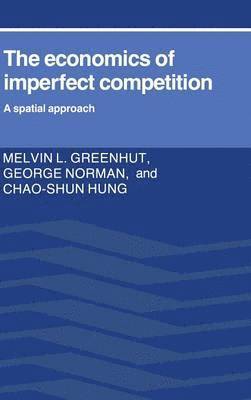
      Melvin L. Greenhut, George Norman, Chao-Shun Hung - The Economics of Imperfect Competition, Inbunden

      The Economics of Imperfect Competition

      Melvin L. Greenhut, George Norman, Chao-Shun Hung

      Inbunden, 1987

      1 682 kr

      Melvin L. Greenhut, George Norman, Chao-Shun Hung - The Economics of Imperfect Competition, Häftad

      The Economics of Imperfect Competition

      Melvin L. Greenhut, George Norman, Chao-Shun Hung

      Häftad, 1987

      560 kr

      Irma - Banking, Finance, and Accounting, Inbunden

      Banking, Finance, and Accounting

      Irma

      Inbunden, 2014

      14 102 kr

      Irma - Hospitality, Travel, and Tourism, Inbunden

      Hospitality, Travel, and Tourism

      Irma

      Inbunden, 2014

      14 102 kr

      Irma - Banking, Finance, and Accounting, Inbunden

      Banking, Finance, and Accounting

      Irma

      Inbunden, 2014

      14 102 kr

      Melvin L. Greenhut - Location Economics, Inbunden

      Location Economics

      Melvin L. Greenhut

      Inbunden, 1995

      2 704 kr

      Melvin L. Greenhut - Plant Location in Theory and in Practice, Inbunden

      Plant Location in Theory and in Practice

      Melvin L. Greenhut

      Inbunden, 1982

      1 083 kr

      George Norman, Darlene C. Chisholm - Dictionary of Industrial Organization, Inbunden

      Dictionary of Industrial Organization

      George Norman, Darlene C. Chisholm

      Inbunden, 2014

      2 965 kr