• Fri frakt över 249 kr
  • •
  • Snabba leveranser
  • •
  • Billiga böcker
Kundservice

Du är på sajten för privatpersoner.

Företag, bibliotek eller offentlig verksamhet?

Du handlar på classic.bokus.com, där alla dina funktioner finns intakta.
Till classic.bokus.com
Bokus logotyp. Gå till startsidan.
  • Erbjudanden
  • Nyheter
  • Student
  • Topplistor
  • Barn & ungdom
  • Bokus Play
  • E-böcker
  • Pocketböcker
  • Spel & pussel

10% rabatt på allt med kod: NYSTART10 →

Sidfot

Mina sidor

    Hjälp

    • Kundservice
    • Vanliga frågor och svar
    • Frakt och leverans
    • Retur vid ångerrätt
    • Reklamera vara
    • Betalning
    • Köpvillkor
    • Allmänna villkor
    • Information om webbplatsens tillgänglighet

    Om Bokus

    • Om oss
    • Pressrum
    • För studenter
    • För företag
    • För bibliotek och offentlig verksamhet
    • För leverantörer
    • Hållbarhet

    Populärt

    • Aktuella erbjudanden
    • Presentkort
    • Studentlitteratur
    • Nya böcker
    • Topplistor
    • Signerade böcker
    • Engelska böcker

    Inspiration

    • Boktips
    • BookTok
    • Populära bokserier
    • Barnbokskaraktärer
    • Populära författare
    Logotyp för Bokus
    Följ oss på Facebook (extern länk)Följ oss på Instagram (extern länk)Följ oss på YouTube (extern länk)Följ oss på TikTok (extern länk)
    bokus @ CookiesAnpassa cookiesIntegritetspolicyKöpvillkor
    Till Citymail hemsida (extern länk)Till Budbee hemsida (extern länk)Till Postnord hemsida (extern länk)Till Schenker hemsida (extern länk)Till Early Bird hemsida (extern länk)Till Walleys hemsida (extern länk)
    1. Psykologi och pedagogik
    2. Psykologi
    3. Psykologiska teorier och skolor

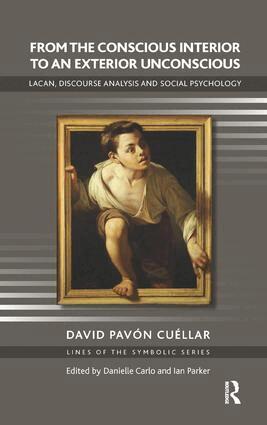
    From the Conscious Interior to an Exterior Unconscious

    Lacan, Discourse Analysis and Social Psychology

    AvDavid Pavon Cuellar,Danielle Carlo

    Häftad, Engelska, 2010

    Del i serien Lines of the Symbolic Series

    716 kr

    Beställningsvara. Skickas inom 10-15 vardagar. Fri frakt över 249 kr.

    Fler format och utgåvor

    Inbunden

    1 998 kr

    E-bok

    847 kr

    E-bok

    847 kr

    Beskrivning

    This striking Lacanian contribution to discourse analysis is also a critique of contemporary psychological abstraction, as well as a reassessment of the radical opposition between psychology and psychoanalysis. This original introduction to Lacans work bridges the gap between discourse-analytical debates in social psychology and the social-theoretical extensions of discourse theory. David Pavon Cuellar provides a precise definition and a detailed explanation of key Lacanian concepts, and illustrates how they may be put to work on a concrete discourse, in this case a fragment of an interview obtained by the author from the Mexican underground Popular Revolutionary Forces (EPR).Throughout the book, Lacanian concepts are compared to their counterparts in psychology. Such a comparison reveals insuperable incompatibilities between the two series of concepts. The author shows that Lacan's psychoanalytical terminology can neither be translated nor assimilated to the terms of current psychology. Among the notions in actual or potential competition with Lacanian concepts, the book deals with those proposed by semiology, Marxism, phenomenology, constructionism, deconstruction, and hermeneutics. Taking a stand on those theoretical positions, each chapter includes detailed discussion of the contribution of classical approaches to language; including Barthes, Bakhtin, Althusser, Politzer, Wittgenstein, Berger and Luckmann, Derrida, and Ricoeur. There is sustained reference in the body of the text to the arguments of Lacan and Lacanians, of Miller, Milner, Soler, and Zizek. At the same time, in the extensive notes accompanying the text, there is a systematic reappraisal and reinterpretation of debates and pieces of research work in social psychology, especially in a discursive and critical domain that has incorporated elements of psychoanalytic theory.

    Produktinformation

    • Utgivningsdatum:2010-12-31
    • Mått:147 x 230 x undefined mm
    • Format:Häftad
    • Språk:Engelska
    • Serie:Lines of the Symbolic Series
    • Antal sidor:392
    • Förlag:Taylor & Francis Ltd
    • ISBN:9781855757943

    Utforska kategorier

    • Psykologiska teorier och skolor inom Psykologi och pedagogik
    • Socialpsykologi och gruppsykologi inom Psykologi och pedagogik

    Mer om författaren

    David Pavon Cuellar is Professor at the Universidad Michoacana de San Nicolas de Hidalgo, Morelia, Michoacan, Mexico. He has taught philosophy and psychoanalysis at universities in Mexico, Portugal and France. Besides books and papers on political discourse and guerrilla warfare, he has recently published a number of articles on social theory and Lacanian psychoanalysis in 'Lettre Mensuelle' (Ecole de la Cause Freudienne, 2005), 'Letterina' (Association du Champ Freudien, 2006), 'Dilema' (Universidad de Valencia, 2006, 2007), 'Filosofia' (Revista da Faculdade de Letras da Universidade do Porto, 2008) and 'Araucaria' (Revista Iberoamericana de Filosofia, Politica y Humanidades, 2009). He also has forthcoming publications in the 'Annual Review of Critical Psychology' and 'Revista Latinoamericana de Psicologia'. Ian Parker is Professor of Psychology in the Discourse Unit at Manchester Metropolitan University, UK. He is widely published, and his books include 'The Crisis in Modern Social Psychology' (1989), 'Psychoanalytic Culture: Psychoanalytic Discourse in Western Society' (1997), 'Critical Discursive Psychology' (2002), 'Slavoj Zizek: A Critical Introduction' (2004) and 'Psychoanalytic Practice and State Regulation' (2008).

    Recensioner i media

    'Pavon Cuellar not only rejuvenates the field of discourse analysis, he completely redefines it, opening it up via the multiple conceptual resources available within Lacanian psychoanalysis. More than a primer to a new form of discourse analysis, this text functions as a handbook for critical qualitative methodology more generally, and as a source book for the analytical potential for combining social psychology and Lacanian thought.'- Derek Hook, Social Psychology, London School of Economics, UK'David Pavon Cuellar's thorough and uncompromising book on Lacan, discourse analysis, and social psychology should open up new paths in discourse analysis for those with a psychoanalytic interest or those who profess such an interest. Discursive psychology is a very smart field, and this is an enormously significant contribution to its continued innovation in the future.'- Kareen Ror Malone, Professor, University of West Georgia, Member, Apres Coup, New York, USA'David Pavon Cuellar's From the Conscious Interior to an Exterior Unconscious will be invaluable for anyone interested in the relation between Lacanian psychoanalysis, discourse analysis and contemporary psychology. It gives a scholarly and in-depth interpretation of Lacanian key-concepts, while at the same time reframing Lacan's clinical ideas such that they become instruments for detailed critical text analysis.'- Stijn Vanheule, Department of Psychoanalysis and Clinical Consulting, Ghent University, Belgium'I would argue that this book offers an exceptionally systematic and clear presentation of Lacan's work, a thorough engagement from a Lacanian perspective with dominant theories in psychology and the social sciences and a scholarly proposal for an approach to discourse analysis deriving from Lacanian theory. I think that it constitutes a landmark in the field of psychoanalytically inspired discursive approaches and should be read by everyone working or interested in this field.'- Eugenie Georgaca, Department of Psychology, Aristotle University of Thessaloniki, Greece

    Innehållsförteckning

    • Preface -- Introduction -- The symbolic and the imaginary -- The signifier and the signified -- Full speech and empty speech -- Enunciation and enunciated -- The subject as a signifier to another signifier -- The unconscious as the discourse of the Other -- The representative of the subject -- The discourse of the master -- The being of speech -- The interpretation of wisdom -- Conclusion