• Fri frakt över 249 kr
  • •
  • Snabba leveranser
  • •
  • Billiga böcker
Kundservice

Du är på sajten för privatpersoner.

Företag, bibliotek eller offentlig verksamhet?

Du handlar på classic.bokus.com, där alla dina funktioner finns intakta.
Till classic.bokus.com
Bokus logotyp. Gå till startsidan.
  • Erbjudanden
  • Nyheter
  • Student
  • Topplistor
  • Barn & ungdom
  • Bokus Play
  • E-böcker
  • Pocketböcker
  • Spel & pussel

10% rabatt på allt med kod: NYSTART10 →

Sidfot

Mina sidor

    Hjälp

    • Kundservice
    • Vanliga frågor och svar
    • Frakt och leverans
    • Retur vid ångerrätt
    • Reklamera vara
    • Betalning
    • Köpvillkor
    • Allmänna villkor
    • Information om webbplatsens tillgänglighet

    Om Bokus

    • Om oss
    • Pressrum
    • För studenter
    • För företag
    • För bibliotek och offentlig verksamhet
    • För leverantörer
    • Hållbarhet

    Populärt

    • Aktuella erbjudanden
    • Presentkort
    • Studentlitteratur
    • Nya böcker
    • Topplistor
    • Signerade böcker
    • Engelska böcker

    Inspiration

    • Boktips
    • BookTok
    • Populära bokserier
    • Barnbokskaraktärer
    • Populära författare
    Logotyp för Bokus
    Följ oss på Facebook (extern länk)Följ oss på Instagram (extern länk)Följ oss på YouTube (extern länk)Följ oss på TikTok (extern länk)
    bokus @ CookiesAnpassa cookiesIntegritetspolicyKöpvillkor
    Till Citymail hemsida (extern länk)Till Budbee hemsida (extern länk)Till Postnord hemsida (extern länk)Till Schenker hemsida (extern länk)Till Early Bird hemsida (extern länk)Till Walleys hemsida (extern länk)
    1. Psykologi och pedagogik
    2. Psykologi
    3. Psykologiska teorier och skolor
    4. Freudiansk psykologi

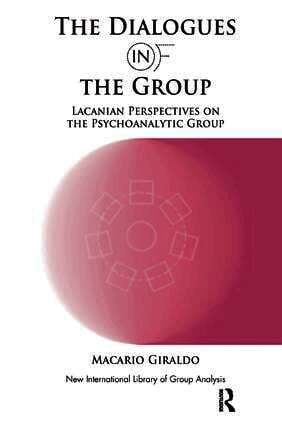
    Dialogues in and of the Group

    Lacanian Perspectives on the Psychoanalytic Group

    AvMacario Giraldo

    Häftad, Engelska, 2012

    Del i serien New International Library of Group Analysis

    498 kr

    Beställningsvara. Skickas inom 10-15 vardagar. Fri frakt över 249 kr.

    Fler format och utgåvor

    Inbunden

    2 352 kr

    E-bok

    622 kr

    E-bok

    622 kr

    Beskrivning

    This book is intended to be an introductory presentation of some key concepts of Lacanian Psychoanalysis as applied to the psychoanalytic group. The author describes his own encounter with Lacan and gives a biographical summary of Lacan's life and influence in contemporary psychoanalytic theory and other related fields. He makes use of clinical vignettes to introduce Lacan's basic concepts into the work with the group. The clinician is oriented to think in a way that restores to the "talking cure" the importance of listening to language and its uses in the transference. The author also introduces his own concepts of the dialogues IN and OF the group to distinguish the discourse of the ego in contrast with the flow of the unconscious in the group analytic session.It is written for the psychoanalytic group therapist or analyst as an introduction of basic Lacanian concepts in a style that intends to invite a new attitude to the reading of the group phenomena.

    Produktinformation

    • Utgivningsdatum:2012-12-31
    • Mått:147 x 230 x 13 mm
    • Vikt:234 g
    • Format:Häftad
    • Språk:Engelska
    • Serie:New International Library of Group Analysis
    • Antal sidor:128
    • Förlag:Taylor & Francis Ltd
    • ISBN:9781855758674

    Utforska kategorier

    • Freudiansk psykologi inom Psykologi och pedagogik
    • Socialpsykologi och gruppsykologi inom Psykologi och pedagogik

    Mer om författaren

    Macario Giraldo came to the United States of America in 1961 with a Fulbright scholarship to study linguistics at Georgetown University. After his MS in Applied Linguistics, he went to the Catholic University of America for his Ph.D. in clinical psychology. He has been faculty at the Washington School of Psychiatry since 1974. He has written textbooks for the teaching of English in Columbia, as well as a number of papers and articles for academic books and journals.

    Recensioner i media

    'Macario Giraldo has taken on a formidable task, the study of psychoanalytic groups using the lens and translation of Jacques Lacan. Although Lacan was not a group analyst, he was strongly influenced by the work of Bion and Rickman. Not only does Dr Giraldo make Lacan accessible, but also he brings his own joy and excitement to the reader. Clinicians and social scientists will enjoy this fresh multi-disciplined approach to the work of Lacan.'- Beatrice Liebenberg, MSW, Distinguished Fellow, American Group Psychotherapy Association Faculty, The Washington School of Psychiatry'Macario Giraldo's book is important for many reasons, in particular for succeeding in the demanding task of applying Lacanian principles used in individual therapy to group work. What Macario Giraldo's book has done in bringing French ideas into English, and psychoanalysis to group analysis, is an important achievement and a pioneering work in the field. He links Lacanian theoretical development with the group phenomenon in a way that brings the ideas to life. His explanations are clear but without simplifications. He does not shy from using his own subjectivity carefully to bring the reader to an appreciation of the subject. He has the gift of keeping the reader so involved that he is unable to stop reading this book until the very last chapter.'- Claude Spielmann, a psychoanalyst in Paris and member of Le Cercle Freudien'The Dialogues in and of the Group is a most welcome book. Offering access to unconscious processes as informed by the work of Jacques Lacan, it is a highly readable primer for all practitioners interested in the application of the principles of Lacanian psychoanalysis. to groups and group work. Well argued and clearly written. Macario Giraldo develops the idea of two basic dialogues` operative at different levels in the group. One is the dialogue between individual group members and the other the dialogue of the group as a whole, the latter bringing out what the author calls "the signifier of desire". To distinguish the two, he focuses on Lacans crucial concepts of the Imaginary, the Symbolic and the Real whose interplay he illustrates by a wealth of clinical material which I am sure will be of interest to clinicians of all schools.- Dieter Nitzgen, MA, group analyst (GAS International, IGA/Heidelberg), psychoanalyst (Association of Freudian Psychoanalysis)'The conceptual space separating group analysis and Lacanian theory is too wide. This lucid text offers the reader a welcome bridge across this space. My pleasure in reading was enhanced by the evident joy that Macario Giraldo takes in being able to show how he uses Lacan's ideas to further his understanding of the group processes. Fortunately, there is a growing convergence between Foulkesian group analysis in the recognition of discourse, and dialogue in and of the group. My repeated efforts to grasp the values of Lacanian theories are replaced by appreciation as Giraldo lays out before us his growing understanding of his patients' experiences in groups. I resonate to these words: "I have found in Lacan powerful incentives... to understand and reach a bit closer to the human in me and in my patients." It was a particular pleasure to find that both Lacan and Foulkes enjoyed listening to barber shop conversations. Giraldo is passionate, humorous, serious: a very fine teacher.'- Malcolm Pines, FRCPsych., DPM [dist.], past President, International Association of Group Psychotherapy and former Consultant, Tavistock Clinic, London, and Maudsley Hospital, London

    Innehållsförteckning

    • Series Editor’s Foreword -- Introduction -- Part I -- Jacques Lacan 1901–1981 -- The other in the group and the other of the group: two basic dialogues -- “The subject supposed to know” (Le sujet suppose savoir) -- What happens in the venerable halls of language when there is no space for the word -- From need, through demand, to desire -- Revolution, evolution: change and desire -- Part II -- Revolution, evolution: change and desire -- On knowing too much -- Between being and meaning: between drive and desire -- Conclusion