• Fri frakt över 249 kr
  • •
  • Snabba leveranser
  • •
  • Billiga böcker
Kundservice

Du är på sajten för privatpersoner.

Företag, bibliotek eller offentlig verksamhet?

Du handlar på classic.bokus.com, där alla dina funktioner finns intakta.
Till classic.bokus.com
Bokus logotyp. Gå till startsidan.
  • Erbjudanden
  • Nyheter
  • Student
  • Topplistor
  • Barn & ungdom
  • Bokus Play
  • E-böcker
  • Pocketböcker
  • Spel & pussel

10% rabatt på allt med kod: NYSTART10 →

Sidfot

Mina sidor

    Hjälp

    • Kundservice
    • Vanliga frågor och svar
    • Frakt och leverans
    • Retur vid ångerrätt
    • Reklamera vara
    • Betalning
    • Köpvillkor
    • Allmänna villkor
    • Information om webbplatsens tillgänglighet

    Om Bokus

    • Om oss
    • Pressrum
    • För studenter
    • För företag
    • För bibliotek och offentlig verksamhet
    • För leverantörer
    • Hållbarhet

    Populärt

    • Aktuella erbjudanden
    • Presentkort
    • Studentlitteratur
    • Nya böcker
    • Topplistor
    • Signerade böcker
    • Engelska böcker

    Inspiration

    • Boktips
    • BookTok
    • Populära bokserier
    • Barnbokskaraktärer
    • Populära författare
    Logotyp för Bokus
    Följ oss på Facebook (extern länk)Följ oss på Instagram (extern länk)Följ oss på YouTube (extern länk)Följ oss på TikTok (extern länk)
    bokus @ CookiesAnpassa cookiesIntegritetspolicyKöpvillkor
    Till Citymail hemsida (extern länk)Till Budbee hemsida (extern länk)Till Postnord hemsida (extern länk)Till Schenker hemsida (extern länk)Till Early Bird hemsida (extern länk)Till Walleys hemsida (extern länk)
    1. Ekonomi och Ledarskap
    2. Nationalekonomi
    3. Mikroekonomi

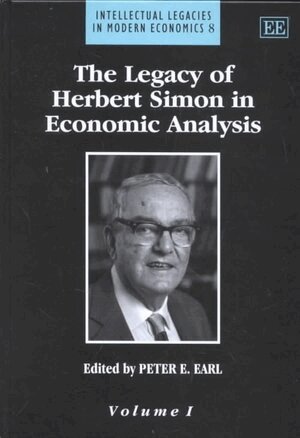
    Legacy of Herbert Simon in Economic Analysis

    AvPeter E. Earl,Peter E. Earl

    Inbunden, Engelska, 2001

    Del 8 i serien Intellectual Legacies in Modern Economics series

    9 994 kr

    Beställningsvara. Skickas inom 5-8 vardagar. Fri frakt över 249 kr.

    Beskrivning

    Herbert A. Simon has been a leading contributor to cognitive psychology, computer science, public administration, philosophy and statistics, and is the winner of the 1978 Nobel Memorial Prize in economics. As this authoritative collection demonstrates, his impact on economics has been felt in areas as diverse as the theory of the firm and economic organization, consumer behaviour, law and economics, and environmental economics. Central to his work is the notion of bounded rationality - the mismatch between human decision-making capacities and the scale of the decision problems that people face, which results in satisficing rather than optimising behaviour - and his belief that economic research should start from the study of actual behaviour rather than being based on convenient but unrealistic assumptions. Peter Earl's choice of articles shows both the kind of economics that emerges when Simon's philosophy is followed comprehensively, and what happens when neo-classical economists partially adopt his ideas.

    Produktinformation

    • Utgivningsdatum:2001-09-26
    • Mått:172 x 281 x 97 mm
    • Vikt:2 278 g
    • Format:Inbunden
    • Språk:Engelska
    • Serie:Intellectual Legacies in Modern Economics series
    • Förlag:Edward Elgar Publishing Ltd
    • ISBN:9781858985268

    Utforska kategorier

    • Mikroekonomi inom Ekonomi och Ledarskap
    • Nationalekonomi inom Ekonomi och Ledarskap

    Mer om författaren

    Edited by Peter E. Earl, Senior Lecturer in Business Economics, University of Queensland, Australia

    Recensioner i media

    'Editing two volumes on The Legacy of Herbert Simon in Economic Analysis is no easy task, which makes the reader all the more appreciative of the superb service Peter Earl has rendered here.'

    Innehållsförteckning

    • Contents:Volume I:AcknowledgementsIntroduction Peter E. EarlPART ITHE NOBEL LAUREATE 1. The Royal Swedish Academy of Sciences (1979), ‘The Nobel Memorial Prize in Economics 1978: The Official Announcement of the Royal Academy of Sciences’2. William J. Baumol (1979) ‘On the Contributions of Herbert A. Simon to Economics’3. Albert Ando (1979), ‘On the Contributions of Herbert A. Simon to Economics’4. Herbert A. Simon (1979), ‘Rational Decision Making in Business Organizations’PART IIBOUNDED RATIONALITY (1): OVERVIEW 5. Herbert A. Simon (1972), ‘Theories of Bounded Rationality’6. Roy Radner (1975), ‘Satisficing’7. Reinhard Selten (1998), ‘Aspiration Adaptation Theory’8. John Conlisk (1996), ‘Why Bounded Rationality: The Much Too Long Version’PART IIIBOUNDED RATIONALITY (2): IN NEOCLASSICAL ECONOMICS 9. Neil M. Kay (1995), ‘Alchian and the "Alchian Thesis"’10. Barton L. Lipman (1995), ‘Information Processing and Bounded Rationality: A Survey’11. Robert J. Aumann (1997), ‘Rationality and Bounded Rationality’12. Esther-Mirjam Sent (1997), ‘Sargent versus Simon: Bounded Rationality Unbound’PART IVBOUNDED RATIONALITY (3): BEHAVIOURAL APPROACHES 13. Denis A. Lussier and Richard W. Olshavsky (1979), ‘Task Complexity and Contingent Processing in Brand Choice’14. Gerd Gigerenzer and Daniel G. Goldstein (1996), ‘Reasoning the Fast and Frugal Way: Models of Bounded Rationality’15. Steven M. Shugan (1980), ‘The Cost of Thinking’16. Bruce E. Kaufman (1999), ‘Emotional Arousal as a Source of Bounded Rationality’17. Mark Pingle and Richard H. Day (1996), ‘Modes of Economizing Behavior: Experimental Evidence’18. Arnold C. Cooper, Timothy B. Folta and Carolyn Woo (1995), ‘Entrepreneurial Information Search’19. Andrew L. Zacharakis and G. Dale Meyer (1998), ‘A Lack of Insight: Do Venture Capitalists Really Understand their own Decision Process?’20. Cristiano Antonelli (1989), ‘A Failure-Inducement Model of Research and Development Expenditure’21. Kenneth W. Koput (1997), ‘A Chaotic Model of Innovative Search: Some Answers, Many Questions’22. Eric von Hippel and Marcie J. Tyre (1995), ‘How Learning by Doing is Done: Problem Identification in Novel Process Equipment’23. Pamela S. Barr and Anne S. Huff (1997), ‘Seeing isn’t Believing: Understanding Diversity in the Timing of Strategic Response’PART VBOUNDED RATIONALITY (4): SYMPATHETIC CRITICS 24. Brian J. Loasby (1989), ‘Herbert Simon’s Human Rationality’25. Marina Bianchi (1990), ‘The Unsatisfactoriness of Satisficing: From Bounded Rationality to Innovative Rationality’26. Geoffrey M. Hodgson (1997), ‘The Ubiquity of Habits and Rules’PART VIDECOMPOSABILITY AND HIERARCHY 27. Herbert A. Simon (1962) ‘The Architecture of Complexity’28. Roy Radner (1992), ‘Hierarchy: The Economics of Managing’29. Ron Sanchez and Joseph T. Mahoney (1996), ‘Modularity, Flexibility, and Knowledge Management in Product and Organization Design’Name IndexVolume II:AcknowledgementsIntroduction Peter E. EarlPART ICOMPETITION AND MARKET PROCESSES 1. Peter Reid Dickson (1992), ‘Toward a General Theory of Competitive Rationality’2. Richard R. Nelson and Sidney G. Winter (1978), ‘Forces Generating and Limiting Concentration under Schumpeterian Competition’3. Timothy M. Wakeley (1997), ‘The Output Decision of the Firm - A Behavioural Algorithm’4. Robert E. Krider and Charles B. Weinberg (1997), ‘Spatial Competition and Bounded Rationality: Retailing at the Edge of Chaos’5. Philip Mirowski and Koye Somefun (1998), ‘Markets as Evolving Computational Entities’6. John D. Sterman (1985), ‘A Behavioral Model of the Economic Long Wave’PART IIECONOMICS OF BUSINESS ORGANIZATION 7. Oliver E. Williamson (1973), ‘Markets and Hierarchies: Some Elementary Considerations’8. Oliver E. Williamson, Michael L. Wachter and Jeffrey E. Harris (1975), ‘Understanding the Employment Relation: The Analysis of Idiosyncratic Exchange’9. Peter J. Buckley and Malcolm Chapman (1997), ‘The Perception and Measurement of Transaction Costs’10. Peter W. Roberts and Royston Greenwood (1997), ‘Integrating Transaction Cost and Institutional Theories: Toward a Constrained-Efficiency Framework for Understanding Organizational Design Adoption’11. Herbert A. Simon (1951), ‘A Formal Theory of the Employment Relationship’12. Peter D. Sherer, Nikolai Rogovsky and Norman Wright (1998), ‘What Drives Employment Relationships in Taxicab Organizations? Linking Agency to Firm Capabilities and Strategic Opportunities’13. Kathleen R. Conner and C.K. Prahalad (1996), ‘A Resource-based Theory of the Firm: Knowledge Versus Opportunism’14. Robert M. Grant (1996), ‘Toward a Knowledge-Based Theory of the Firm’15. Gunnar Eliasson (1990), ‘The Firm as a Competent Team’PART IIILAW AND ECONOMICS 16. Jon D. Hanson and Douglas A. Kysar (1999), ‘Taking Behavioralism Seriously: Some Evidence of Market Manipulation’PART IVECOLOGICAL ECONOMICS 17. Stephen J. DeCanio (1999), ‘Estimating the Non-Environmental Consequences of Greenhouse Gas Reductions is Harder Than You Think’18. Sylvie Faucheux and Géraldine Froger (1995), ‘Decision-Making under Environmental Uncertainty’19. Ronald D. Brunner and Tim W. Clark (1997), ‘A Practice-Based Approach to Ecosystem Management’PART VTHE PUBLIC SECTOR 20. Charles A.M. de Bartolome (1995), ‘Which Tax Rate do People Use: Average or Marginal?’21. L. Douglas Kiel and Barry J. Seldon (1998), ‘Measuring Temporal Complexity in the External Environment: Nonlinearity and the Bounds of Rational Action’22. Linda F. Dennard (1995), ‘Neo-Darwinism and Simon’s Bureaucratic Antihero’Select Bibliography of the Writings of Herbert A. SimonName Index