• Fri frakt över 249 kr
  • •
  • Snabba leveranser
  • •
  • Billiga böcker
Kundservice

Du är på sajten för privatpersoner.

Företag, bibliotek eller offentlig verksamhet?

Du handlar på classic.bokus.com, där alla dina funktioner finns intakta.
Till classic.bokus.com
Bokus logotyp. Gå till startsidan.
  • Erbjudanden
  • Nyheter
  • Student
  • Topplistor
  • Barn & ungdom
  • Bokus Play
  • E-böcker
  • Pocketböcker
  • Spel & pussel

10% rabatt på allt med kod: NYSTART10 →

Sidfot

Mina sidor

    Hjälp

    • Kundservice
    • Vanliga frågor och svar
    • Frakt och leverans
    • Retur vid ångerrätt
    • Reklamera vara
    • Betalning
    • Köpvillkor
    • Allmänna villkor
    • Information om webbplatsens tillgänglighet

    Om Bokus

    • Om oss
    • Pressrum
    • För studenter
    • För företag
    • För bibliotek och offentlig verksamhet
    • För leverantörer
    • Hållbarhet

    Populärt

    • Aktuella erbjudanden
    • Presentkort
    • Studentlitteratur
    • Nya böcker
    • Topplistor
    • Signerade böcker
    • Engelska böcker

    Inspiration

    • Boktips
    • BookTok
    • Populära bokserier
    • Barnbokskaraktärer
    • Populära författare
    Logotyp för Bokus
    Följ oss på Facebook (extern länk)Följ oss på Instagram (extern länk)Följ oss på YouTube (extern länk)Följ oss på TikTok (extern länk)
    bokus @ CookiesAnpassa cookiesIntegritetspolicyKöpvillkor
    Till Citymail hemsida (extern länk)Till Budbee hemsida (extern länk)Till Postnord hemsida (extern länk)Till Schenker hemsida (extern länk)Till Early Bird hemsida (extern länk)Till Walleys hemsida (extern länk)
    1. Ekonomi och Ledarskap
    2. Nationalekonomi

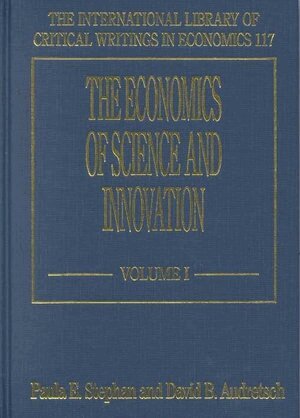
    Economics of Science and Innovation

    AvPaula E. Stephan,David B. Audretsch

    Inbunden, Engelska, 2000

    Del 117 i serien The International Library of Critical Writings in Economics series

    8 341 kr

    Beställningsvara. Skickas inom 5-8 vardagar. Fri frakt över 249 kr.

    Beskrivning

    Science and innovation plays an increasingly important role in the growth of economies throughout the world. This two volume collection of previously published articles seeks to provide a comprehensive overview of this key area of the global economy.The first volume presents important material on scientific knowledge, including property rights and reward structures to the productivity of scientists. In the second volume, the role of science in industry and the commercialization of science are discussed, together with an examination of the economic effects of R&D in terms of investment and gain, both for individual companies and national economies. The final section discusses whether public policies to control scientific growth are either necessary or desirable.

    Produktinformation

    • Utgivningsdatum:2000-02-24
    • Mått:169 x 244 x undefined mm
    • Format:Inbunden
    • Språk:Engelska
    • Serie:The International Library of Critical Writings in Economics series
    • Förlag:Edward Elgar Publishing Ltd
    • ISBN:9781858987552

    Utforska kategorier

    • Nationalekonomi inom Ekonomi och Ledarskap
    • Naturvetenskap:allmänt inom Naturvetenskap och teknik

    Mer om författaren

    Edited by Paula E. Stephan, Andrew Young School of Policy Studies, Georgia State University, US and David B. Audretsch, Distinguished Professor, Indiana University, USA, and Professor, the aspire! Center for Entrepreneurship, Innovation and Social Competence, University of Klagenfurt, Austria

    Recensioner i media

    'The great virtue of such a collection is the opportunity it gives to re-read the classic papers in the subject, all of which I found more complex and more insightful than I had remembered them. It also shows that much more could be achieved if scholars in the field would read one another's contributions more critically and carefully.'

    Innehållsförteckning

    • Contents:Volume I:Acknowledgements • IntroductionPart I:An Overview1. Paula E. Stephan (1996), ‘The Economics of Science’2. Richard R. Nelson (1959), ‘The Simple Economics of Basic Scientific Research’3. Nathan Rosenberg and L.E. Birdzell, Jr., ‘Science, Technology and the Western Miracle’Part II:The Public Nature of Scientific Knowledge4. Kenneth J. Arrow (1962), ‘Economic Welfare and the Allocation of Resources for Invention’5. Michel Callon (1994), ‘Is Science a Public Good? Fifth Mullins Lecture’6. Partha Dasgupta and Paul A. David (1994), ‘Toward a New Economics of Science’7. Harry G. Johnson (1972), ‘Some Economic Aspects of Science’Part III: The Production of Scientific Knowledge8. Mary Frank Fox (1983), ‘Publication Productivity Among Scientists: A Critical Review’9. Diana Hicks (1995), ‘Published Papers, Tacit Competencies and Corporate Management of the Public/Private Character of Knowledge’10. Bernard Barber and Renée C. Fox (1962), ‘The Case of the Floppy-Eared Rabbits: An Instance of Serendipity Gained and Serendipity Lost’Part IV: The Reward Structure of Science11. Robert K. Merton (1957), ‘Priorities in Scientific Discovery: A Chapter in the Sociology of Science’12. Harriet Zuckerman (1992), ‘The Proliferation of Prizes: Nobel Complements and Nobel Surrogates in the Reward System of Science’13. Arthur M. Diamond, Jr. (1986), ‘What is a Citation Worth?’14. Paula E. Stephan and Sharon G. Levin (1992), ‘How Science is Done; Why Science is Done’15. Paula E. Stephan and Stephen S. Everhart (1998), ‘The Changing Rewards to Science: The Case of Biotechnology’Part V:Characteristics of Discovery16. Partha Dasgupta and Eric Maskin (1987), ‘The Simple Economics of Research Portfolios’17. Alfred J. Lotka (1926), ‘Statistics: The Frequency Distribution of Scientific Productivity’18. Robert K. Merton (1968), ‘The Matthew Effect in Science’Part VI:Priority Rights and Property Rights19. Partha Dasgupta and Paul A. David (1987), ‘Information Disclosure and the Economics of Science and Technology’20. Rebecca S. Eisenberg (1987), ‘Proprietary Rights and the Norms of Science in Biotechnology Research’Part VII: Careers in Science21. Paul D. Allison and John A. Stewart (1974), ‘Productivity Differences Among Scientists: Evidence for Accumulative Advantage’22. Sharon G. Levin and Paula E. Stephan (1991), ‘Research Productivity Over the Life Cycle: Evidence for Academic Scientists’23. Arthur M. Diamond, Jr. (1986), ‘The Life-Cycle Research Productivity of Mathematicians and Scientists’24. David L. Hull, Peter D. Tessner and Arthur M. Diamond (1978), ‘Planck’s Principle: Do Younger Scientists Accept New Scientific Ideas With Greater Alacrity Than Older Scientists?’Name IndexVolume II:Part I:Labor Markets for Scientists1. Larry R. Leslie and Ronald L. Oaxaca (1993), ‘Scientist and Engineer Supply and Demand’2. Ronald G. Ehrenberg (1992), ‘The Flow of New Doctorates’3. R.B. Freeman (1975), ‘Supply and Salary Adjustments to the Changing Science Manpower Market: Physics, 1948-1973’Part II:Scientists in Industry4. Wesley M. Cohen and Daniel A. Levinthal (1989), ‘Innovation and Learning: The Two Faces of R&D’5. Edwin Mansfield (1995), ‘Academic Research Underlying Industrial Innovations: Sources, Characteristics, and Financing’6. Richard R. Nelson (1962), ‘The Link Between Science and Invention: The Case of the Transistor’7. Nathan Rosenberg (1990), ‘Why Do Firms Do Basic Research (With Their Own Money)?’8. Frank R. Lichtenberg (1988), ‘The Private R&D Investment Response to Federal Design and Technical Competitions’Part III:The Commercialization of Science9. David B. Audretsch and Paula E. Stephan (1996), ‘Company-Scientist Locational Links: The Case of Biotechnology’10. Lynne G. Zucker, Michael R. Darby and Marilynn B. Brewer (1998), ‘Intellectual Human Capital and the Birth of U.S. Biotechnology Enterprises’11. Edwin Mansfield (1991), ‘Academic Research and Industrial Innovation’12. Keith Pavitt (1991), ‘What Makes Basic Research Economically Useful?’Part IV:The Relationship Between Science and Technology13. Nathan Rosenberg (1974), ‘Science, Invention and Economic Growth’14. F.M. Scherer (1982), ‘Demand-Pull and Technological Invention: Schmookler Revisted’15. Michael Gibbons and Ron Johnston (1974), ‘The Roles of Science in Technological Innovation’Part V:Science and Growth16. Paul M. Romer (1994), ‘The Origins of Endogenous Growth’Part VI:Knowledge Spillovers17. Zvi Griliches (1992), ‘The Search for R&D Spillovers’18. Adam B. Jaffe (1989), ‘Real Effects of Academic Research’19. David B. Audretsch and Maryann P. Feldman (1996), ‘R&D Spillovers and the Geography of Innovation and Production’20. Zoltan J. Acs, David B. Audretsch and Maryann P. Feldman (1994), ‘R&D Spillovers and Recipient Firm Size’21. Lynne G. Zucker, Michael R. Darby and Jeff Armstrong (1998), ‘Geographically Localized Knowledge: Spillovers or Markets?’Part VII:Public Policy22. Richard R. Nelson and Paul M. Romer (1996), ‘Science, Economic Growth, and Public Policy’23. Henry Ergas (1987), ‘Does Technology Policy Matter?’24. Nathan Rosenberg (1994), ‘Critical Issues in Science Policy Research’Name Index