• Fri frakt över 249 kr
  • •
  • Snabba leveranser
  • •
  • Billiga böcker
Kundservice

Du är på sajten för privatpersoner.

Företag, bibliotek eller offentlig verksamhet?

Du handlar på classic.bokus.com, där alla dina funktioner finns intakta.
Till classic.bokus.com
Bokus logotyp. Gå till startsidan.
  • Erbjudanden
  • Nyheter
  • Student
  • Topplistor
  • Barn & ungdom
  • Bokus Play
  • E-böcker
  • Pocketböcker
  • Spel & pussel

10% rabatt på allt med kod: NYSTART10 →

Sidfot

Mina sidor

    Hjälp

    • Kundservice
    • Vanliga frågor och svar
    • Frakt och leverans
    • Retur vid ångerrätt
    • Reklamera vara
    • Betalning
    • Köpvillkor
    • Allmänna villkor
    • Information om webbplatsens tillgänglighet

    Om Bokus

    • Om oss
    • Pressrum
    • För studenter
    • För företag
    • För bibliotek och offentlig verksamhet
    • För leverantörer
    • Hållbarhet

    Populärt

    • Aktuella erbjudanden
    • Presentkort
    • Studentlitteratur
    • Nya böcker
    • Topplistor
    • Signerade böcker
    • Engelska böcker

    Inspiration

    • Boktips
    • BookTok
    • Populära bokserier
    • Barnbokskaraktärer
    • Populära författare
    Logotyp för Bokus
    Följ oss på Facebook (extern länk)Följ oss på Instagram (extern länk)Följ oss på YouTube (extern länk)Följ oss på TikTok (extern länk)
    bokus @ CookiesAnpassa cookiesIntegritetspolicyKöpvillkor
    Till Citymail hemsida (extern länk)Till Budbee hemsida (extern länk)Till Postnord hemsida (extern länk)Till Schenker hemsida (extern länk)Till Early Bird hemsida (extern länk)Till Walleys hemsida (extern länk)
    1. Ekonomi och Ledarskap
    2. Företagsekonomi
    3. Redovisning och finansiering
    4. Finansiering

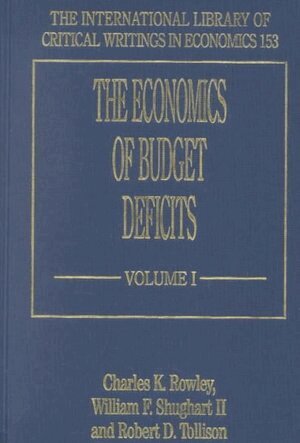
    Economics of Budget Deficits

    AvCharles K. Rowley,William F. Shughart II

    Inbunden, Engelska, 2002

    Del 153 i serien The International Library of Critical Writings in Economics series

    9 127 kr

    Beställningsvara. Skickas inom 5-8 vardagar. Fri frakt över 249 kr.

    Beskrivning

    The Economics of Budget Deficits provides a comprehensive overview of the scholarly literature exploring the causes and consequences of deficit spending and the public debt. Incorporating classical, Keynesian and public choice analyses of debt-financed public expenditures, the two volumes contain major theoretical and empirical contributions to the debate. They cover such critical fiscal policy issues as the history and measurement of budget deficits, the question of who bears the burden of the public debt, the use of deficits to solve problems of dynamic policy inconsistency and the relative effectiveness of fiscal rules and constitutional constraints as mechanisms for achieving budget balance. The editors provide an authoritative introduction to the two volumes and separate overviews of each of the seven parts. The Economics of Budget Deficits is an indispensable reference for all scholars and students interested in fiscal policy and for all policymakers.

    Produktinformation

    • Utgivningsdatum:2002-11-27
    • Mått:169 x 244 x undefined mm
    • Format:Inbunden
    • Språk:Engelska
    • Serie:The International Library of Critical Writings in Economics series
    • Förlag:Edward Elgar Publishing Ltd
    • ISBN:9781858987989

    Utforska kategorier

    • Finansiering inom Ekonomi och Ledarskap
    • Makroekonomi inom Ekonomi och Ledarskap

    Mer om författaren

    Edited by the late Charles K. Rowley, former General Director, The Locke Institute, Duncan Black Professor of Economics and Director, Program in Economics, Politics and the Law, James M. Buchanan Center for Political Economy, George Mason University, US, William F. Shughart II, J. Fish Smith Professor in Public Choice, Utah State University, US and the late Robert D. Tollison, formerly Professor of Economics, Clemson University, US

    Recensioner i media

    '. . . a valuable resource for anyone interested in public finance issues. The editors have pulled together the most important and influential articles in the field. From Adam Smith to the present, the two-volume set is a comprehensive guide to the budget deficit debate.'

    Innehållsförteckning

    • Contents:Volume IAcknowledgementsIntroduction Charles K. Rowley, William F. Shughart II and Robert D. TollisonPART ITHE HISTORY AND MEASUREMENT OF BUDGET DEFICITS Part I Overview Charles K. Rowley, William F. Shughart II and Robert D Tollison1. Gary M. Anderson (1986), ‘The US Federal Deficit and National Debt: A Political and Economic History’2. Alberto Alesina (2000), ‘The Political Economy of the Budget Surplus in the United States’3. Mario I. Blejer and Adrienne Cheasty (1991), ‘The Measurement of Fiscal Deficits: Analytical and Methodological Issues’4. Laurence J. Kotlikoff and Bernd Raffelhüschen (1999), ‘Generational Accounting Around the Globe’5. Jody W. Lipford (2001), ‘How Transparent is the U.S. Budget?’PART IICLASSICAL PUBLIC DEBT THEORY Part II Overview Charles K. Rowley, William F. Shughart II and Robert D. Tollison6. Adam Smith (1776/1976), ‘Of Publick Debts’7. T.R. Malthus (1803/1992), ‘Of Poor-laws, continued’8. David Ricardo (1817/1951), ‘Taxes on Other Commodities than Raw Produce’9. John Stuart Mill (1848/1965), ‘Of a National Debt’PART IIIKEYNESIAN PUBLIC DEBT THEORY Part III Overview Charles K. Rowley, William F. Shughart II and Robert D Tollison10. John Maynard Keynes (1936/1973), ‘The Marginal Propensity to Consume and the Multiplier’11. Abba P. Lerner (1943), ‘Functional Finance and the Federal Debt’12. Abba P. Lerner (1948), ‘The Burden of the National Debt’13. Paul A. Samuelson (1948), ‘Fiscal Policy and Full Employment without Inflation’14. Paul A. Samuelson (1970), ‘Fiscal Policy and Full Employment without Inflation’PART IVTHE BURDEN OF DEBT REEXAMINED Part IV Overview Charles K. Rowley, William F. Shughart II and Robert D. Tollison15. J.E. Meade (1958), ‘Is the National Debt a Burden?’16. J.E. Meade (1959), ‘Is the National Debt a Burden? A Correction’17. James M. Buchanan (1958), ‘Concerning Future Generations’, Chapter Four, and ‘A Suggested Conceptual Revaluation of the National Debt’18. Richard A. Musgrave (1959), ‘Classical Theory of Public Debt’19. Abba P. Lerner (1961), ‘The Burden of Debt’20. Franco Modigliani (1961), ‘Long-Run Implications of Alternative Fiscal Policies and the Burden of the National Debt’21. James M. Buchanan (1964), ‘Public Debt, Cost Theory, and the Fiscal Illusion’22. James Tobin (1965), ‘The Burden of the Public Debt: A Review Article’23. James M. Buchanan (1966), ‘The Icons of Public Debt’24. James Tobin (1966), ‘Reply’Name IndexVolume II AcknowledgementsAn introduction by the editors to both volumes appears in Volume IPART IRICARDIAN EQUIVALENCE IN THE DOCK Part I Overview Charles K. Rowley, William F. Shughart and Robert D. Tollison1. Robert J. Barro (1974), ‘Are Government Bonds Net Wealth?’2. Martin Feldstein (1976), ‘Perceived Wealth in Bonds and Social Security: A Comment’3. James M. Buchanan (1976), ‘Barro on the Ricardian Equivalence Theorem’4. Robert J. Barro (1976), ‘Reply to Feldstein and Buchanan’5. Gerald P. O’Driscoll, Jr. (1977), ‘The Ricardian Nonequivalence Theorem’6. Robert J. Barro (1979), ‘On the Determination of the Public Debt’7. Geoffrey Brennan and James M. Buchanan (1980), ‘The Logic of the Ricardian Equivalence Theorem’8. Paul Evans (1993), ‘Consumers are not Ricardian: Evidence from Nineteen Countries’9. T.D. Stanley (1998), ‘New Wine in Old Bottles: A Meta-Analysis of Ricardian Equivalence’PART IIPUBLIC CHOICE AND PUBLIC DEBT: THEORY AND EVIDENCE Part II Overview Charles K. Rowley, William F. Shughart and Robert D. Tollison10. Edgar K. Browning (1975), ‘Why the Social Insurance Budget is too Large in a Democracy’11. Torsten Persson and Lars E.O. Svensson (1989), ‘Why a Stubborn Conservative Would Run a Deficit: Policy with Time-Inconsistent Preferences’12. Amihai Glazer (1989), ‘Politics and the Choice of Durability’13. Alberto Alesina and Guido Tabellini (1990), ‘A Positive Theory of Fiscal Deficits and Government Debt’14. Guido Tabellini and Alberto Alesina (1990), ‘Voting on the Budget Deficit’15. Timothy Besley and Anne Case (1995), ‘Does Electoral Accountability Affect Economic Policy Choices? Evidence from Gubernatorial Term Limits’16. W. Mark Crain and Robert D. Tollison (1993), ‘Time Inconsistency and Fiscal Policy: Empirical Analysis of U.S. States, 1969–89’17. W. Mark Crain and Lisa K. Oakley (1995), ‘The Politics of Infrastructure’PART IIIDEFICIT FINANCE IN CONSTITUTIONAL PERSPECTIVE Part III Overview Charles K. Rowley, William F. Shughart and Robert D. Tollison18. James M. Buchanan (1985), ‘The Moral Dimension of Debt Financing’19. Robert D. Tollison and Richard E. Wagner (1986), ‘Balanced Budgets and Beyond’20. Milton Friedman (1978), ‘The Limitations of Tax Limitation’21. Alvin Rabushka (1982/1987), ‘A Compelling Case for a Constitutional Amendment to Balance the Budget and Limit Taxes’22. Henry Hazlitt (1983/1987), ‘A Proposal for Two Constitutional Amendments’23. Aaron Wildavsky (1985), ‘Equality, Spending Limits, and the Growth of Government’24. W. Mark Crain and James C. Miller III (1990), ‘Budget Process and Spending Growth’25. Jürgen von Hagen (1991), ‘A Note on the Empirical Effectiveness of Formal Fiscal Constraints’26. James M. Poterba (1994), ‘State Responses to Fiscal Crises: The Effects of Budgetary Institutions and Politics’27. W. Mark Crain and Timothy J. Muris (1995), ‘Legislative Organization of Fiscal Policy’28. Edward M. Gramlich (1995), ‘The Politics and Economics of Budget Deficit Control: Policy Questions and Research Questions’29. James M. Buchanan (1997), ‘The Balanced Budget Amendment: Clarifying the Arguments’30. James M. Poterba (1997), ‘Do Budget Rules Work?’31. Robert D. Reischauer (1997), ‘Comment’32. David Romer (1997), ‘Comment’33. W. Mark Crain and Nicole Verrier Crain (1998), ‘Fiscal Consequences of Budget Baselines’34. Charles K. Rowley (2000), ‘Budget Deficits and the Size of Government in the UK and US: A Public Choice Perspective on the Thatcher and Reagan Years’Name Index