• Fri frakt över 249 kr
  • •
  • Snabba leveranser
  • •
  • Billiga böcker
Kundservice

Du är på sajten för privatpersoner.

Företag, bibliotek eller offentlig verksamhet?

Du handlar på classic.bokus.com, där alla dina funktioner finns intakta.
Till classic.bokus.com
Bokus logotyp. Gå till startsidan.
  • Erbjudanden
  • Nyheter
  • Student
  • Topplistor
  • Barn & ungdom
  • Bokus Play
  • E-böcker
  • Pocketböcker
  • Spel & pussel

Må bättre, för mindre! Upp till 50% rabatt på hälsoböcker

Sidfot

Mina sidor

    Hjälp

    • Kundservice
    • Vanliga frågor och svar
    • Frakt och leverans
    • Retur vid ångerrätt
    • Reklamera vara
    • Betalning
    • Köpvillkor
    • Allmänna villkor
    • Information om webbplatsens tillgänglighet

    Om Bokus

    • Om oss
    • Pressrum
    • För studenter
    • För företag
    • För bibliotek och offentlig verksamhet
    • För leverantörer
    • Hållbarhet

    Populärt

    • Aktuella erbjudanden
    • Presentkort
    • Studentlitteratur
    • Nya böcker
    • Topplistor
    • Signerade böcker
    • Engelska böcker

    Inspiration

    • Boktips
    • BookTok
    • Populära bokserier
    • Barnbokskaraktärer
    • Populära författare
    Logotyp för Bokus
    Följ oss på Facebook (extern länk)Följ oss på Instagram (extern länk)Följ oss på YouTube (extern länk)Följ oss på TikTok (extern länk)
    bokus @ CookiesAnpassa cookiesIntegritetspolicyKöpvillkor
    Till Citymail hemsida (extern länk)Till Budbee hemsida (extern länk)Till Postnord hemsida (extern länk)Till Schenker hemsida (extern länk)Till Early Bird hemsida (extern länk)Till Walleys hemsida (extern länk)
    1. Ekonomi och Ledarskap
    2. Nationalekonomi

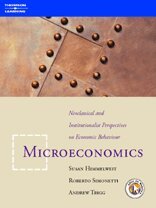
    Microeconomics

    Neoclassical and Institutional Perspectives on Economic Behaviour

    AvSusan Himmelweit,Roberto Simonetti

    Häftad, Engelska, 2001

    1 331 kr

    Beställningsvara. Skickas inom 5-8 vardagar. Fri frakt över 249 kr.

    Beskrivning

    In economics the dominant framework for exploring the structure of market economies is provided by the neoclassical school of thought. This text aims to show how neoclassical theory is used to model market mechanisms, both in particular markets and in the market economy as a whole. Underpinning this analysis is an examination of what neoclassical economists regard as key decision makers in a market economy, namely households and firms. In analysing these demand and supply activities, this text aims to provide an introduction to the microeconomics of markets, that is, the behaviour of individual units of economic activity. However, individuals do not behave as independent entities in the economy. They make economic decisions in the context of a variety of institutional structures. The text presents an alternative to neoclassicism by introducing the institutionalist perspective of economic thought. In this approach the social interactions between individuals are placed at the heart of economic activity. Perspectives are presented as a critique of neoclassical economics by providing an appraisal of neoclassical theory and developing an alternative.

    Produktinformation

    • Utgivningsdatum:2001-07-05
    • Mått:190 x 33 x 243 mm
    • Vikt:1 130 g
    • Format:Häftad
    • Språk:Engelska
    • Antal sidor:592
    • Förlag:Cengage Learning
    • ISBN:9781861525390

    Utforska kategorier

    • Nationalekonomi inom Ekonomi och Ledarskap

    Recensioner i media

    1. INTRODUCTION:NEOCLASSICAL AND INSTITUTIONALIST PERSPECTIVES. Introduction. Neoclassical economics. Institutional economics. Differences between the schools of thought. Conclusion. CONSUMPTION. 2. CONSUMER SOVEREIGNTY. Introduction. The neoclassical theory of consumption. The structure of the demand curve. Questioning the assumptions of consumer theory. Conclusion. 3. CONSUMER DEPENDENCY. Introduction. Conspicuous consumption. Case studies in marketing and consumption. Implications for neoclassical theory. Problems with conspicuous consumption. The theory of ?Distinction?. Want creation by institutions. Conclusion. 4. MEASURING WELFARE: ARE PEOPLE BETTER OFF? Introduction. Utility in the development of welfare economics. The measurement of household well-being. Equivalence scales. Agency conceptions of human flourishing. Are judgements of well-being objective or socially generated? Conclusion. HOUSEHOLDS 5. THE HOUSEHOLD IN THE ECONOMY. Introduction. Neoclassical approaches to household decision making. The division of labour within the household. The institutional economics of the household. Where next? 6. DECISION MAKING IN HOUSEHOLDS. Introduction. Decision making based on household utility functions. Co-operative and non-co-operative household decision making. The models compared. Gender and power in the household. 7. CARING FOR CHILDREN. Introduction. Case study: declining fertility in the Mediterranean countries of Europe. Explaining care. Changing norms. Understanding change. FIRMS. 8. MODELLING THE FIRM. Introduction. The case of Digital Equipment Corporation. Neoclassical theories of firms? behaviour. New institutionalism and the boundaries of the firm. ?Old? institutionalism and evolutionary theory. Conclusion. 9. CONTRACTS, INFORMATION AND THE FIRM?S BEHAVIOUR. Introduction: contracts and markets. Time and contracts: short-and long-term contracting. Incomplete information and contracting behaviour. Incomplete information: incentives and firms? objectives. Conclusion: contracting and firm?s behaviour. 10. FIRMS AND EFFICIENCY. Introduction: efficiency, competition and strategy. Production techniques and the production function. Choice of technique and scale by the profit-maximizing firm. Static and dynamic efficiency of firms. Conclusion. 11. A STRATEGIC VIEW OF COMPETITION. Introduction: the ?cola wars?. Market structure and barriers to entry. Strategic entry deterrence. Strategy and market behaviour. Collusion. Trust. Conclusion. LABOUR 12. THE FIRM AND THE LABOUR MARKET. Introduction. The neoclassical approach to labour demand. Labour market equilibrium. Labour market adjustment. Influences on equilibrium unemployment. Conclusion. 13. DISCRIMINATION AND SEGMENTATION. Introduction. Labour market disadvantage. Forms of discrimination. Neoclassical models of discrimination. Segmented labour markets. Feedback effects in the labour markets. Conclusion. 14. TRUST AND CONTROL: LABOUR USE WITHIN THE FIRM. Introduction. The distinctive characteristics of labour. Trust and control. New institutionalist theories of the employment contract. Efficiency wages: discipline, supervision and commitment. The theory of hierarchical control systems. New employer strategies towards labour. Conclusion. TECHNOLOGY AND FINANCE 15. TECHNOLOGICAL CHANGE. Introduction. Technological change in the Industrial Revolution. The production function, technological change and economic growth. Technological change and general equilibrium analysis. Linear models of innovation. The steam engine. An evolutionary view of technical change. Conclusion. Appendix: Solow?s growth accounting model. 16. EVOLUTIONARY THEORIES OF TECHNOLOGICAL AND ECONOMIC CHANGE. Introduction. Evolutionary theories of economic change. Path dependency and economic and economic evolution. Methodological issues: theory and evidence. Conclusion: economic experiments and economic growth. 17. FINANCIAL SYSTEMS AND INNOVATION. Introduction. Stock market-based and bank-based financial systems. Financial systems and innovation. Innovation: differences among industries. Conclusion. MARKETS . 18. COMPETITIVE GENERAL ANALYSIS. Introduction. The Walrasian model. The determination of prices. Some more models of general equilibrium. Competitive equilibrium and welfare economics. 19. SOCIAL MARKETS. Introduction. ?Managed markets? and ?quasi-markets in health care. Private provision through public contracting: auction markets in social goods. Making social markets work: social norms in social markets. Conclusion. References. Index.

    Innehållsförteckning

    • 1. Introduction: Neoclassical and Institutionalist Perspectives. PART I: CONSUMPTION. 2. Consumer Sovereignty.4. Measuring Welfare: Are People Better Off? PaRT II: HOUSEHOLDS.5. The Household in the Economy.6. Decision Making in Households.7. Caring for Children. PART III: FIRMS. 8. Modelling the Firm. 9. Contracts, Information and the Firm''s Behaviour.10. Firms and Efficiency. 11. A Strategic View of Competition.PART IV: LABOUR.12. The Firm and the Labour Market. 13. Discriminationj and Segmentation. 14. Trust and Control: Labour Use Within the Firm.PART V: TECHNOLOGY AND FINANCE.15. Technological Change.16. Evolutionary Theories of Technological and Economic Change. 17. Financial Systems and Innovation. PART VI: MARKETS. 18. Competitive General Analysis. 19. Social Markets.References. Index.