• Fri frakt över 249 kr
  • •
  • Snabba leveranser
  • •
  • Billiga böcker
Kundservice

Du är på sajten för privatpersoner.

Företag, bibliotek eller offentlig verksamhet?

Du handlar på classic.bokus.com, där alla dina funktioner finns intakta.
Till classic.bokus.com
Bokus logotyp. Gå till startsidan.
  • Erbjudanden
  • Student
  • Topplistor
  • Barn & ungdom
  • Bokus Play
  • E-böcker
  • Ljudböcker
  • Pocketböcker
  • Spel och pussel

Pocketfynda! Hundratals böcker för 49 kr/st →

Sidfot

Mina sidor

    Hjälp

    • Kundservice
    • Vanliga frågor och svar
    • Frakt och leverans
    • Retur vid ångerrätt
    • Reklamera vara
    • Betalning
    • Köpvillkor
    • Allmänna villkor
    • Information om webbplatsens tillgänglighet

    Om Bokus

    • Om oss
    • Pressrum
    • För studenter
    • För företag
    • För bibliotek och offentlig verksamhet
    • För leverantörer
    • Hållbarhet

    Populärt

    • Aktuella erbjudanden
    • Presentkort
    • Studentlitteratur
    • Nya böcker
    • Topplistor
    • Signerade böcker
    • Engelska böcker

    Inspiration

    • Boktips
    • BookTok
    • Barnbokskaraktärer
    • Populära författare
    Logotyp för Bokus
    Följ oss på Facebook (extern länk)Följ oss på Instagram (extern länk)Följ oss på YouTube (extern länk)Följ oss på TikTok (extern länk)
    bokus @ CookiesAnpassa cookiesIntegritetspolicyKöpvillkor
    Till Citymail hemsida (extern länk)Till Budbee hemsida (extern länk)Till Postnord hemsida (extern länk)Till Schenker hemsida (extern länk)Till Early Bird hemsida (extern länk)Till Walleys hemsida (extern länk)
    1. Ekonomi och Ledarskap
    2. Nationalekonomi
    3. Miljöekonomi

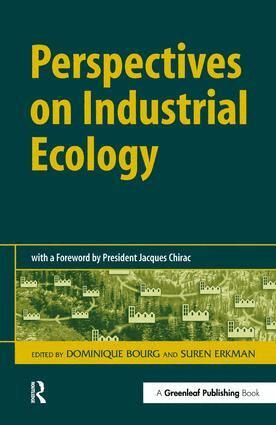
    Perspectives on Industrial Ecology

    AvDominique Bourg,Suren Erkman

    Inbunden, Engelska, 2003

    2 713 kr

    Beställningsvara. Skickas inom 10-15 vardagar. Fri frakt över 249 kr.

    Beskrivning

    Business-as-usual in terms of industrial and technological development – even if based on a growing fear of pollution and shortages of natural resources – will never deliver sustainable development. However, the growing interest in recent years in the new science of industrial ecology (IE), and the idea that industrial systems should mimic the quasi-cyclical functions of natural ecosystems in an 'industrial food chain', holds promise in addressing not only short-term environmental problems but also the long-term holistic evolution of industrial systems.This possibility requires a number of key conditions to be met, not least the restructuring of our manufacturing and consumer society to reduce the effects of material and energy flows at the very point in history when globalisation is rapidly increasing them. This book sets out to address the theoretical considerations that should be made implicit in future research as well as practical implementation options for industry. The systematic recovery of industrial wastes, the minimisation of losses caused by dispersion, the dematerialisation of the economy, the requirement to decrease our reliance on fuels derived from hydrocarbons and the need for management systems that help foster inter-industry collaboration and networks are among the topics covered.The book is split into four sections. First, the various definitions of IE are outlined. Here, important distinctions are made between industrial metabolism and IE. Second, a number of different industrial sectors, including glass, petroleum and electric power, are assessed with regard to the operationalisation of industrial ecology. Eco-industrial Parks and Networks are also analysed. Third, the options for overcoming obstacles that stand in the way of the closing of cycles such as the separation and screening of materials are considered and, finally, a number of implications for the future are assessed. The contributions to Perspectives on Industrial Ecology come from the leading thinkers working in this field at the crossroads between a number of different disciplines: engineering, ecology, bio-economics, geography, the social sciences and law.

    Produktinformation

    • Utgivningsdatum:2003-03-01
    • Mått:156 x 234 x undefined mm
    • Vikt:814 g
    • Format:Inbunden
    • Språk:Engelska
    • Antal sidor:384
    • Förlag:Taylor & Francis Ltd
    • ISBN:9781874719465

    Utforska kategorier

    • Miljöekonomi inom Ekonomi och Ledarskap

    Mer om författaren

    Dominique Bourg is a Professor at the Troyes University of Technology, France, where he is head of the Centre of Research and Interdisciplinary Studies on Sustainable Development (Centre du Recherches et d'Etudes Interdisciplinaires sur le Développement Durable [CREIDD]). He also teaches at the National Foundation of Political Sciences, Paris. His fields of research are linked to environmental ethics, technology and risk assessment, as well as public debate. Among his recent publications are: L'Homme-artifice: Le sens de la technique (Gallimard, 1996); and Le Nouvel âge de l'écologie (Descartes et Cie, forthcoming).Suren Erkman has an academic background in philosophy and biology. After working for a number of years as a science and business journalist for various media, he created in 1994 a company headquartered in Geneva, the Institute for Communication and Analysis of Science and Technology (ICAST). He is also a lecturer in industrial ecology at the Swiss Federal Institute of Technology and at the Université de Technologie de Troyes as well as an editor of The Journal of Industrial Ecology.

    Recensioner i media

    "This book contains a wealth of intriguing ideas and practical examples of the emerging transdisciplinary science of industrial ecology. This collection of papers comprehensively covers the implications of the seemingly simple concept of redesigning human activities along natural ecological dynamics. Contained in the book are fascinating ideas, examples, facts that offer many new insights into old problems for SEA scholars. Industrial ecology has not been the subject of much rigorous analysis by SEA, hopefully after digesting this material this will be put right", Social and Environmental Accounting

    Innehållsförteckning

    • ForewordJacques ChiracIntroductionDominique Bourg, Troyes University of Technology, FrancePart 1: Concepts and ideas1. Industrial ecology and material flow analysis: basic concepts, policy relevance and some case studiesStefan Bringezu, Wuppertal Institute, Germany2. On the history of industrial metabolismMarina Fischer-Kowalski, Institute for Interdisciplinary Studies, University of Vienna, Austria3. Technology, global change and industrial ecologyArnulf Grübler, International Institute for Applied Systems Analysis, Austria4. Industrial ecology: philosophical and political meaningsDominique Bourg, Troyes University of Technology, FrancePart 2: Ideas in action5. Industrial ecology and services to enterprises: cell metabolism versus industrial metabolismAnne Bablon, CReeD, France6. Physicochemical characterisation and recycling of industrial residuesMaurice Morency, University of Quebec at Montreal and Environmental Research Centre UQAM/Sorel-Tracy, Canada, and Denise Fontaine and Guoji Shan, University of Quebec at Montreal, Canada7. The ecodesign processThierry Kazazian, O2 France8. Eco-industrial sites and networksJean-François Vallès, Oree Association, France9. Metropolitan industrial ecosystem developmentJudy Kincaid, Triangle J Council of Governments, USA10. Towards a methodology for assessing effectiveness of recovery systems: a process system approachKjetil Røine and Helge Brattebø, Norwegian University of Science and Technology (NTNU) Industrial Ecology Programme11. Recycling of zinc-containing secondary products from the galvanising and steel industries: a new case of applied industrial ecologyJean-Paul Wiaux, Titalyse SA, Switzerland12. The chemical industry from an industrial ecology perspectiveColin G. Francis, Institute for the Communication and Analysis of Science and Technology (ICAST), Switzerland13. Industrial ecology in motion: enterprise integrationRaymond Nyer, IBM Europe-Middle East-Africa, France, and Diana Bendz, IBM Corporation, USA14. Electric power consumption and sustainable consumptionPaul Baudry and Arnaud Ansart, Electricité de France15. Industrial ecology and metallurgyRolf Marstrander, Hydro Aluminium Metal Products, Norway16. Industrial ecology and the oil industryBernard Tramier, Elf Aquitaine, France17. Industrial ecology and the glass industryGuy Tackels, Saint-Gobain Conceptions Verrieres, France18. Applied industrial ecology and technology transposition: steelmaking slag and dust co-products, and secondary slag metallurgyClaude N. Gentaz, TRANSTEC, SwitzerlandPart 3: Future challenges19. The future of the industrial systemIndur M. Goklany, US Department of the Interior20. Obstacles and opportunities for a "green" industrial policyJan Nill and Ulrich Petschow, Institute for Ecological Economic Research (IOeW), Germany21. A systems option for sustainable techno-metabolism: an ecological assessment of Japan's industrial technology systemChihiro Watanabe and Bing Zhu, Tokyo Institute of Technology, Japan22. The functional society: the service economyWalter R. Stahel, The Product-Life Institute, Switzerland23. Urban transportation and industrial ecologyThomas E. Graedel and Michael Jensen, Yale University, USA24. The adoption of cleaner production technology and the emergence of industrial ecology activity: consequences for employmentLaurent Grimal, Laboratoire Intelligence des Organisations, Universite de Haute Alsace, France25. The relevance of industrial ecology in developing countriesRamesh Ramaswamy, Independent Consultant and Associate, Institute for Communication and Analysis of Science and Technology (ICAST), Switzerland26. The impact of industrial ecology on university curriculaHelge Brattebø, Norwegian University of Science and Technology (NTNU)27. From ecology of natural systems to industrial ecology: the need for an extension of the scope of ecologyGilles Billen, UMR Sisyphe; Centre National de Recherche; Universite Pierre et Marie Curie, France28. Perspectives on industrial ecologySuren Erkman, Institute for Communication and Analysis of Science and Technology (ICAST), SwitzerlandBibliography