• Fri frakt över 249 kr
  • •
  • Snabba leveranser
  • •
  • Billiga böcker
Kundservice

Du är på sajten för privatpersoner.

Företag, bibliotek eller offentlig verksamhet?

Du handlar på classic.bokus.com, där alla dina funktioner finns intakta.
Till classic.bokus.com
Bokus logotyp. Gå till startsidan.
  • Erbjudanden
  • Nyheter
  • Student
  • Topplistor
  • Barn & ungdom
  • Bokus Play
  • E-böcker
  • Pocketböcker
  • Spel & pussel

10% rabatt på allt med kod: NYSTART10 →

Sidfot

Mina sidor

    Hjälp

    • Kundservice
    • Vanliga frågor och svar
    • Frakt och leverans
    • Retur vid ångerrätt
    • Reklamera vara
    • Betalning
    • Köpvillkor
    • Allmänna villkor
    • Information om webbplatsens tillgänglighet

    Om Bokus

    • Om oss
    • Pressrum
    • För studenter
    • För företag
    • För bibliotek och offentlig verksamhet
    • För leverantörer
    • Hållbarhet

    Populärt

    • Aktuella erbjudanden
    • Presentkort
    • Studentlitteratur
    • Nya böcker
    • Topplistor
    • Signerade böcker
    • Engelska böcker

    Inspiration

    • Boktips
    • BookTok
    • Populära bokserier
    • Barnbokskaraktärer
    • Populära författare
    Logotyp för Bokus
    Följ oss på Facebook (extern länk)Följ oss på Instagram (extern länk)Följ oss på YouTube (extern länk)Följ oss på TikTok (extern länk)
    bokus @ CookiesAnpassa cookiesIntegritetspolicyKöpvillkor
    Till Citymail hemsida (extern länk)Till Budbee hemsida (extern länk)Till Postnord hemsida (extern länk)Till Schenker hemsida (extern länk)Till Early Bird hemsida (extern länk)Till Walleys hemsida (extern länk)
    1. Naturvetenskap och teknik
    2. Geovetenskap
    3. Miljövetenskap och miljöpolitik

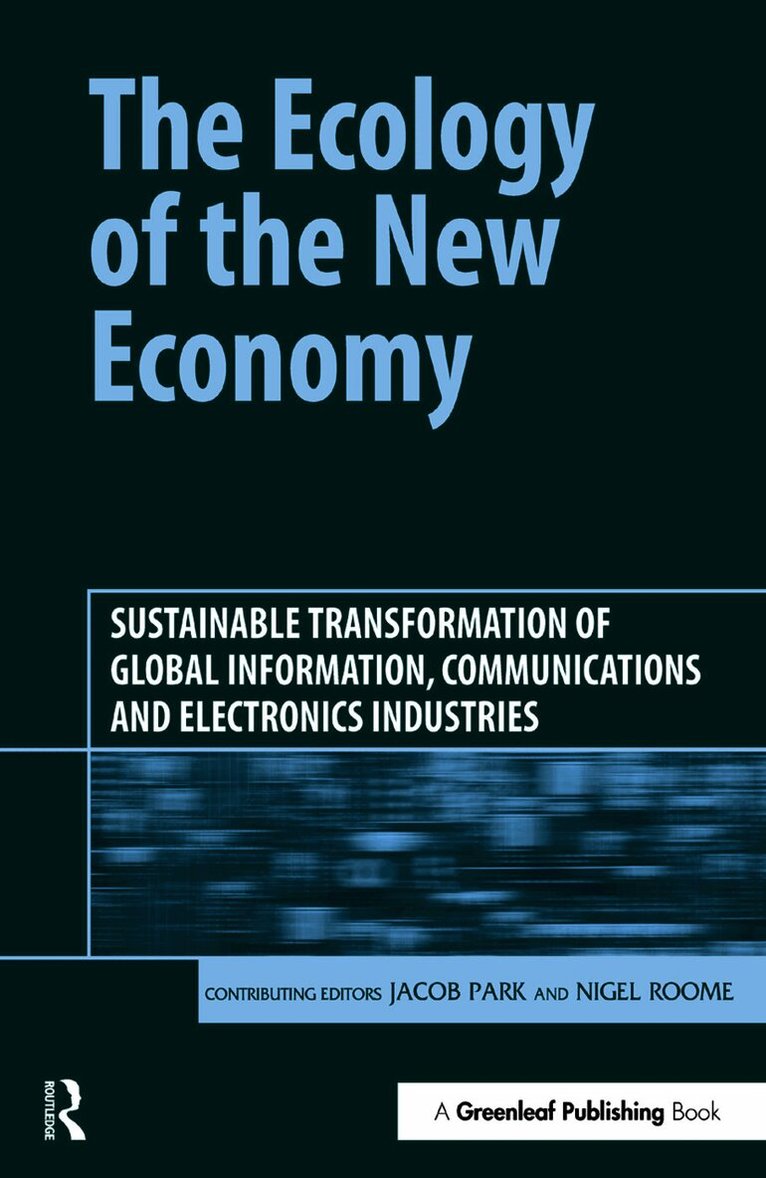
    Ecology of the New Economy

    Sustainable Transformation of Global Information, Communications and Electronics Industries

    AvJacob Park,Nigel Roome

    Inbunden, Engelska, 2002

    2 645 kr

    Beställningsvara. Skickas inom 10-15 vardagar. Fri frakt över 249 kr.

    Beskrivning

    A "revolution" is taking place in the development of global information and communications technologies. In slightly more than a decade, the World Wide Web has gone from the idea of an obscure English scientist to a consumer-oriented technology system with an expected one billion users by 2005. The technologies that enable this to happen are advancing rapidly, which is leading to both an unprecedented number of start-up companies and a host of innovative new alliances between companies. The growth has been so rapid and unexpected that little research and analysis has yet been done on what impact this transformation has had or will have on the ability of companies to meet the global sustainability challenge. As environmental strategy has traditionally been portrayed in terms of risk cutting and resource efficiency, there is a danger that critical business issues such as information technology, R&D and e-commerce development are examined in isolation from the wider sustainable business perspective. An important objective of the book is to explore, document and raise awareness of sustainability concerns arising from the emerging global information economy. The information economy is defined in the broadest sense possible, including software, hardware, telecommunication – traditional and wireless – and advanced communication technologies. Some of the key issues and questions that are examined include:Case studies on how and to what degree sustainability concerns are being integrated into the business model of electronic, telecommunication and dot.com firms.The relationship between the diffusion of information and communication technologies and the energy and resource intensity of companies.The role of information and communication technologies in the shaping of policies for sustainability, its impacts on sustainable or unsustainable lifestyles and its implications for the interaction between companies and other actors.Corporations and the global digital divide.The Ecology of the New Economy will be of interest to academics, governments, businesses, and non-governmental groups who are trying to understand the linkages and relationship between the two of our greatest global challenges: the information revolution and environmental sustainability.

    Produktinformation

    • Utgivningsdatum:2002-05-01
    • Mått:156 x 234 x undefined mm
    • Vikt:637 g
    • Format:Inbunden
    • Språk:Engelska
    • Antal sidor:284
    • Förlag:Taylor & Francis Ltd
    • ISBN:9781874719472

    Utforska kategorier

    • Miljövetenskap och miljöpolitik inom Naturvetenskap och teknik
    • Media och underhållning inom Ekonomi och Ledarskap

    Mer om författaren

    JACOB PARK is a research scholar in the Harrison Program on the Future Global Agenda, University of Maryland, USA, and a senior research consultant specialising in Japanese and Asian equities for corporate governance and socially responsible investment, Friends Ivory & Sime. A fellow of the Environmental Leadership Program, a working interim group member of the Greening of Industry Network and a member of Center for Environmental Citizenship’s board of directors, he will become an assistant professor in the business and economic department at Green Mountain College (Vermont, USA) in the fall of 2002. NIGEL ROOME is the Head of Department and Chair of Sustainable Enterprise and Transformation, Erasmus Centre for Sustainable Development and Management, Erasmus University Rotterdam. He is also the Chair of the Information and Communication Technologies Project, Industrial Transformation Programme, International Human Dimensions Programme on Global Environment Change.

    Recensioner i media

    This book is an informative read and well recommended. It provides the reader with current information and diverse analyses from the worlds of research, business and government/policy makers on this increasingly topical issue. Further it provides some inspirational thoughts for integrating sustainability into the digital economy. - Environmental Assessment Policy and Management.Wow! This book will convince even the most hard-nosed bean counter ... that environmental stewardship, green thinking and sustainable development have a place in the global arena of communication, dot.com, e-commerce and information technology. All the sections make extensive use of case studies and examples which help to give a reality perspective which is crucial for the skeptic and the conservative. - Eagle BulletinThe volume provides an excellent snapshot of the dot-com era and its long-term effects on corporate citizenship theory and practice ... The authors clearly believe that understanding the evolution and importance of the digital economy requires macro- and microanalysis along natural, digital and competitive domains. Sustainable e-business practice demands a competent grasp of the interdependencies among these realms. - The Journal of Corporate Citizenship... the doomsayers predict ICCE technologies will fuel further need for electricity, whereas the optimists project net savings. The scholarship encompassed by The Ecology of the New Economy suggests the truth is probably somewhere in between and is largly dependent on how these new technologies are deployed and whether their deployment is guided by sustainable development considerations... The Ecology of the New Economy is an important work in beginning that debate. - The Journal of Industrial Ecology

    Innehållsförteckning

    • Foreword Jonathan Lash, President, World Resources Institute  Introduction. Atom to bits: e-sustainability in the global economy Jacob Park, University of Maryland, USA, and Nigel Roome, Erasmus University Rotterdam, the Netherlands   Part I: Sustainability challenges and implications of a global information economy1. Sustainable business strategies in the Internet economy Klaus Fichter, Borderstep: Institution for Innovation and Sustainability, Germany  2. E-logistics and the natural environment Joseph Sarkis, Clark University, USA, Laura Meade, University of Dallas, USA, and Srinivas Talluri, Michigan State University, USA  3. Greening the digitised supply net Michael Totten, Center for Environmental Leadership in Business, Conservation International, USA  4. Dot.com ethics: e-business and sustainability James Wilsdon, Demos, UK  5. Practising corporate citizenship in a global information economy Duane Windsor, Rice University, USA  6. The Internet and sustainability reporting: improving communication with stakeholders William B. Weil and Barbara Winter-Watson, Environmental Resources Management, USA   Part II: E-business strategies for a sustainable world7. Is e-commerce sustainable? Lessons from Webvan Chris Galea, St Francis Xavier University, Canada; Steve Walton, Emory University, USA  8. Information technology, sustainable development and developing nations James R. Sheats, Hewlett-Packard Co., USA  9. The environmental impact of the new economy: Deutsche Telekom, telecommunications services and the sustainable future Markus Reichling and Tim Otto, Deutsche Telekom AG, Germany  10. Environmental impacts of telecommunications services: two life-cycle analysis studies Manfred Zurkirch, Swisscom Ltd, Switzerland, and Inge Reichart, Swiss Federal Laboratories for Materials Testing and Research  11. Exploring the global-local axis: telecommunications and environmental sustainability in Japan Brendan Barrett, United Nations University/Institute of Advanced Studies, Japan, and Ichiro Yamada, NTT Lifestyle and Environmental Technology Laboratories, Japan  12. Product-oriented environmental management: the case of Xerox Europe Frank de Bakker, Vrije Universiteit, the Netherlands, and David Foley, Xerox Europe, UK   Part III: Old-economy concerns in a new-economy world13. Information and communications technologies: boon or bane to sustainable development? Josephine Chinying Lang, Nanyang Technological University, Singapore  14. Information and communications technologies and business travel: environmental possibilities, problems and implications Peter Arnfalk, Lund University, Sweden  15. How fabulous fablessness? Environmental challenges of economic restructuring in the semiconductor industry Jan Mazurek, Progressive Policy Institute, USA  16. Micropower: electrifying the digital economy Seth Dunn, Worldwatch Institute, USA  17. Extended producer responsibility and the European electronics industry Lassi Linnanen, Helsinki University of Technology, Finland  18. Sustainable trade in electronics: the case of the Indian components sector Mohammad Saqib, Yashika Singh and Ritu Kumar, Rajiv Gandhi Foundation, India   Bibliography