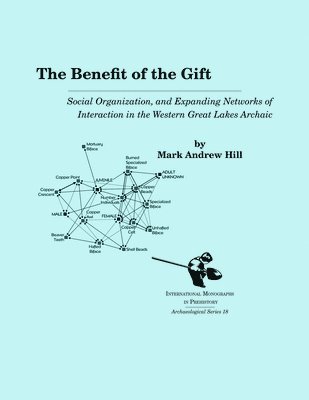
Archaeological data from the Late Archaic (4000-2000 years ago) in the Western Great Lakes are analyzed to understand the production and movement of copper and lithic exchange materials. Also considered in this volume are access to and benefits from exchange networks, as well as social changes accompanying the development of extensive, continental scale, exchange systems of interaction in this period.
Mark Andrew Hill is an Associate Professor of Anthropology at Ball State University. He was formerly J Clayton Stephenson Professor of Anthropology at Yale University, and former Curator and Head of the division of Anthropology in the Yale Peabody Museum of Natural History.
Innehållsförteckning
List of FiguresList of TablesPrefaceOrganization of this VolumeAcknowledgementsChapter 1. An Evolutionary Perspective on the Development of Intercommunity Interaction and Exchange NetworksChapter 2. The Western Great Lakes: Landscapes and People of the ArchaicChapter 3. Distribution of Resources and Populations: Understanding the Geography of the Late Archaic Lithic ResourcesChapter 4. The Development of Late Archaic Regional SystemsChapter 5. Material Symbols and Social Effects of ExchangeChapter 6. Copper Acquisition and Production at the Duck Lake Site and its Implications for Systems of Regional ExchangeChapter 7. Tracing Exchange and Interaction: Using Lithic Sourcing and Chemical Composition of Copper to Identify Communities of InteractionChapter 8. Summary and ConclusionsAppendix IAppendix IIAppendix IIIAppendix IVAppendix VAppendix VIAppendix VIIReferences Cited
Archaeological data from the Late Archaic (4000-2000 years ago) in the Western Great Lakes are analyzed to understand the production and movement of copper and lithic exchange materials. Also considered in this volume are access to and benefits from exchange networks, as well as social changes accompanying the development of extensive, continental scale, exchange systems of interaction in this period.
Mark Andrew Hill is an Associate Professor of Anthropology at Ball State University. He was formerly J Clayton Stephenson Professor of Anthropology at Yale University, and former Curator and Head of the division of Anthropology in the Yale Peabody Museum of Natural History.
Innehållsförteckning
List of FiguresList of TablesPrefaceOrganization of this VolumeAcknowledgementsChapter 1. An Evolutionary Perspective on the Development of Intercommunity Interaction and Exchange NetworksChapter 2. The Western Great Lakes: Landscapes and People of the ArchaicChapter 3. Distribution of Resources and Populations: Understanding the Geography of the Late Archaic Lithic ResourcesChapter 4. The Development of Late Archaic Regional SystemsChapter 5. Material Symbols and Social Effects of ExchangeChapter 6. Copper Acquisition and Production at the Duck Lake Site and its Implications for Systems of Regional ExchangeChapter 7. Tracing Exchange and Interaction: Using Lithic Sourcing and Chemical Composition of Copper to Identify Communities of InteractionChapter 8. Summary and ConclusionsAppendix IAppendix IIAppendix IIIAppendix IVAppendix VAppendix VIAppendix VIIReferences Cited
Archaeological data from the Late Archaic (4000-2000 years ago) in the Western Great Lakes are analyzed to understand the production and movement of copper and lithic exchange materials. Also considered in this volume are access to and benefits from exchange networks, as well as social changes accompanying the development of extensive, continental scale, exchange systems of interaction in this period.
Mark Andrew Hill is an Associate Professor of Anthropology at Ball State University. He was formerly J Clayton Stephenson Professor of Anthropology at Yale University, and former Curator and Head of the division of Anthropology in the Yale Peabody Museum of Natural History.
Innehållsförteckning
List of FiguresList of TablesPrefaceOrganization of this VolumeAcknowledgementsChapter 1. An Evolutionary Perspective on the Development of Intercommunity Interaction and Exchange NetworksChapter 2. The Western Great Lakes: Landscapes and People of the ArchaicChapter 3. Distribution of Resources and Populations: Understanding the Geography of the Late Archaic Lithic ResourcesChapter 4. The Development of Late Archaic Regional SystemsChapter 5. Material Symbols and Social Effects of ExchangeChapter 6. Copper Acquisition and Production at the Duck Lake Site and its Implications for Systems of Regional ExchangeChapter 7. Tracing Exchange and Interaction: Using Lithic Sourcing and Chemical Composition of Copper to Identify Communities of InteractionChapter 8. Summary and ConclusionsAppendix IAppendix IIAppendix IIIAppendix IVAppendix VAppendix VIAppendix VIIReferences Cited