• Fri frakt över 249 kr
  • •
  • Snabba leveranser
  • •
  • Billiga böcker
Kundservice

Du är på sajten för privatpersoner.

Företag, bibliotek eller offentlig verksamhet?

Du handlar på classic.bokus.com, där alla dina funktioner finns intakta.
Till classic.bokus.com
Bokus logotyp. Gå till startsidan.
  • Erbjudanden
  • Student
  • Topplistor
  • Barn & ungdom
  • Bokus Play
  • E-böcker
  • Ljudböcker
  • Pocketböcker
  • Spel & pussel

Upp till 25% på utvalda nyheter →

Sidfot

Mina sidor

    Hjälp

    • Kundservice
    • Vanliga frågor och svar
    • Frakt och leverans
    • Retur vid ångerrätt
    • Reklamera vara
    • Betalning
    • Köpvillkor
    • Allmänna villkor
    • Information om webbplatsens tillgänglighet

    Om Bokus

    • Om oss
    • Pressrum
    • För studenter
    • För företag
    • För bibliotek och offentlig verksamhet
    • För leverantörer
    • Hållbarhet

    Populärt

    • Aktuella erbjudanden
    • Presentkort
    • Studentlitteratur
    • Nya böcker
    • Topplistor
    • Signerade böcker
    • Engelska böcker

    Inspiration

    • Boktips
    • BookTok
    • Populära bokserier
    • Barnbokskaraktärer
    • Populära författare
    Logotyp för Bokus
    Följ oss på Facebook (extern länk)Följ oss på Instagram (extern länk)Följ oss på YouTube (extern länk)Följ oss på TikTok (extern länk)
    bokus @ CookiesAnpassa cookiesIntegritetspolicyKöpvillkor
    Till Citymail hemsida (extern länk)Till Budbee hemsida (extern länk)Till Postnord hemsida (extern länk)Till Schenker hemsida (extern länk)Till Early Bird hemsida (extern länk)Till Walleys hemsida (extern länk)
    1. Naturvetenskap och teknik
    2. Teknik och industri
    3. Elektronik och kommunikationer

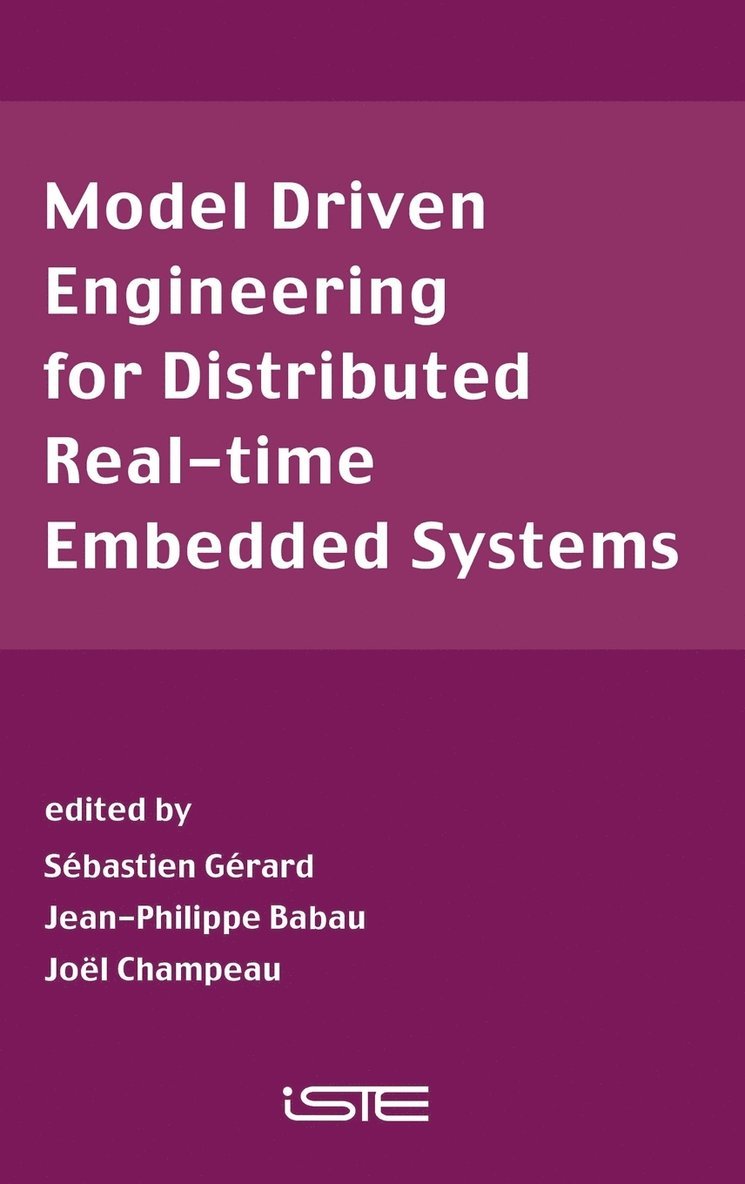
    Model Driven Engineering for Distributed Real-Time Embedded Systems

    AvGerard,Babau J-P

    Inbunden, Engelska, 2005

    1 871 kr

    Beställningsvara. Skickas inom 5-8 vardagar. Fri frakt över 249 kr.

    Beskrivning

    Model-based development methods, and supporting technologies, can provide the techniques and tools needed to address the dilemma between reducing system development costs and time, and developing increasingly complex systems. The Model Driven Architecture (MDA) initiative of the Object Management Group (OMG) is concerned with the development of standards and technologies that enable and support model-based system development. The aim of this book is to provide the information needed to understand and apply MDE (including MDA) approaches to the development of embedded systems. Chapters, written by experts from academia and industry, cover topics relating to MDE practices and methods, as well as emerging MDE technologies. Much of the writing is based on the presentations given at the Summer School 'MDE for Embedded Systems' held at Brest, France, in September 2004.

    Produktinformation

    • Utgivningsdatum:2005-09-14
    • Mått:163 x 238 x 25 mm
    • Vikt:573 g
    • Format:Inbunden
    • Språk:Engelska
    • Antal sidor:288
    • Förlag:ISTE Ltd and John Wiley & Sons Inc
    • ISBN:9781905209323

    Utforska kategorier

    • Elektronik och kommunikationer inom Naturvetenskap och teknik
    • Systemvetenskap och AI inom Data och IT

    Mer om författaren

    Sébastien Gérard is a researcher at CEA LIST ("Comissariat à l'Energie Atomique, Laboratoire d'intégration des Systèmes et des Technologies"). Here he leads the group research on model-based software engineering for RTE systems. He is also strongly involved at OMG with the standardization of the UML2 and all its related extensions for real-time and embedded domains, specially the UML profile called MARTE (Modeling and Analysis of Real-Time and Embedded Systems).Jean-Philippe Babau is Associate Professor at the INSA of Lyon, France, where he teaches industrial computing, real-time operating systems and real-time and embedded systems development.Joël Champeau is a researcher at ENSIETA, France, where he is involved in the modeling domain for embedded systems.

    Innehållsförteckning

    • INTRODUCTION Chapter 1: Model Engineering: From Principles to PlatformsIntroductionDefinitions and concernsAMMA: a model engineering platformConclusionAcknowledgmentsBibliographyChapter 2: Model-Driven Development of Distributed Real-time and Embedded Systems2.1. Introduction2.2. Overview of Video Distribution Case Study2.3. Applying CoSMIC to Address Video Distribution Needs2.4. Related Work2.5. Concluding Remarks2.6. ReferencesChapter 3: Model Transformation3.1. Why should we transform models?3.2. Role of model transformation in the software lifecycle3.3. Basics of model transformation3.4. Classification of model transformations3.5. Conclusion3.6. ReferencesChapter 4: Modeling Dependability Features4.1. Introduction4.2. Separating Crosscutting Features4.3. Aspect Models4.4. Composing Models4.5. Using the AOM Approach to Separate Middleware-Specific Features4.6. Related Work4.7. Conclusion4.8. ReferencesChapter 5: Model-Driven Systems Engineering: SysML & the MDSysE Approach at THALES5.1. Introduction5.2. The SysML Profile for Systems Engineering5.3. Building a Model-Driven Systems Engineering methodology: the MDSysE approach5.4. Tooling model-driven systems engineering: the MDSysE Tools5.5. Perspectives5.6. ReferencesChapter 6: Maturity of Model Driven Engineering for Embedded Control Systems from a Mechatronic PerspectiveIntroductionEvolution of model-driven engineering practice for ECSA contextual perspective to MDEA definition of Model-Driven Engineering for ECSA model of MDE maturityMDE maturity in practiceDiscussionConclusionAcknowledgmentsDictionaryIndex / KeywordsReferencesChapter 7: Real-Time Components & Contracts7.1. Introduction7.2. Contract Aware Components: The four levels of Contracts7.3. Implementing contract-aware components7.4. Predicting extra-functional properties of an assembly7.5. Conclusion7.6. ReferencesChapter 8: The Think Component-Based Operating System8.1. Introduction8.2. The Fractal Component Model8.3. The Think Framework8.4. Think experiments8.5. Analysis8.6. Conclusion8.7. Acknowledgments and availability8.8. Bibliography / ReferencesChapter 9: Model-Driven Schedulability Analysis9.1. Introduction9.2. Real-time scheduling9.3. The MDD process9.4. Conclusions9.5. ReferencesChapter 10: Performance Analysis based on the UML SPT Profile10.1. Introduction10.2. Performance Models10.3. UML models with performance annotations10.4. UML to LQN Transformation10.5. Performance Model Validation10.6. Conclusions10.7. Acknowledgments10.8. ReferencesChapter 11: Code Generation for Embedded Systems11.1. Introduction11.2. Code Generation11.3. Rialto as an Intermediate Language for Code Generation11.4. Rialto in Code Generation11.5. Conclusions11.6. ReferencesChapter 12: Model Driven Architecture for Intensive Embedded Systems12.1. Introduction12.2. MDA and co-design12.3. The Transformation Engine: ModTransf12.4. Models and Metamodels12.5. Application of MDA transformations12.6. Conclusion12.7. ReferencesChapter 13: Spidergon: A NoC Modeling Paradigm13.1. Introduction13.2. The Spidergon NoC Architecture13.3. Spidergon NoC Modeling13.4. Design Space Exploration Using NoC Metamodels13.5. Conclusion and Extensions13.6. ReferencesAcknowledgments