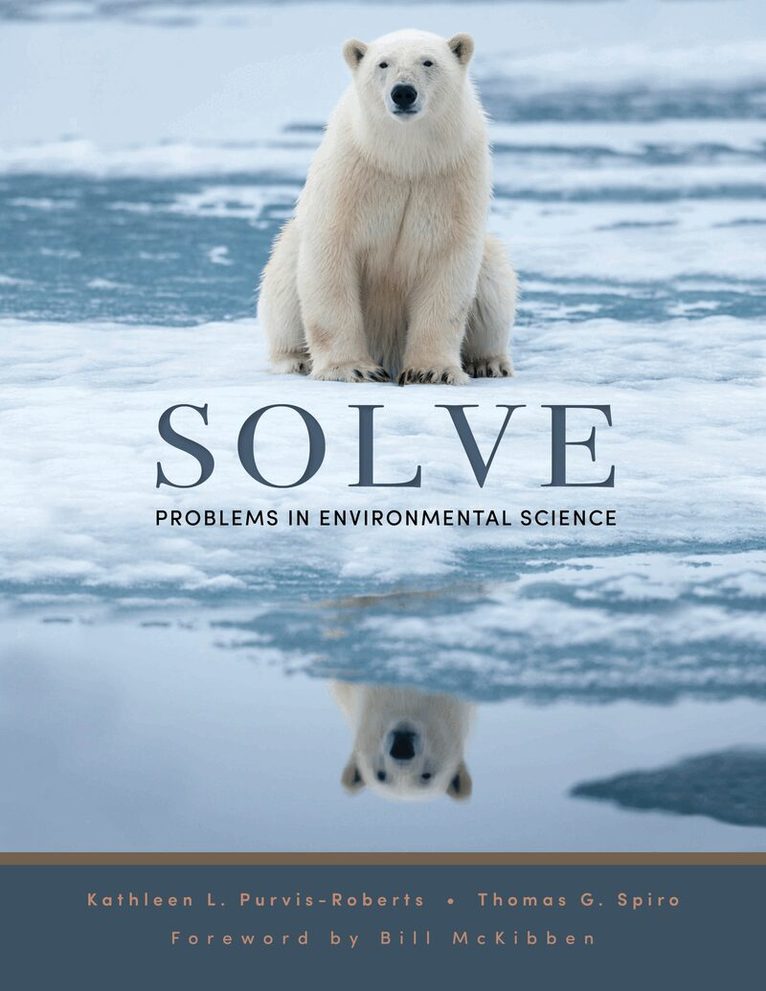
This stand-alone book offers students of environmental science an array of quantitative problems addressing real-world issues, from climate change to GMOs.
Kathleen L. Purvis-Roberts (Author) Kathleen Purvis-Roberts is a Professor of Chemistry at the W.M. Keck Science Department of Claremont McKenna, Pitzer, and Scripps Colleges. She earned her B.S. from Westmont College and her Ph.D. from Princeton University, where she worked with Steven Bernasek. From there, she did her postdoctoral work at the National Center for Atmospheric Research in Boulder, Colorado. She joined the faculty of Claremont McKenna, Pitzer, and Scripps Colleges in 2001. She is the recipient of the Henry Dreyfus Teacher-Scholar award (2013) and the Jefferson Science Fellowship (2016–2017).Thomas G. Spiro (Author) Thomas G. Spiro is Professor of Chemistry at the University of Washington. He received the B. S. from UCLA and the Ph.D. from MIT, and did postdoctoral work in Copenhagen. He joined the faculty of Princeton University in 1963, and served as chair of the chemistry department from 1980 to 1989, relocating to the University of Washington in 2007. He is the recipient of the ICPP Eraldo Antonini Lifetime Achievment Award (2010), the ACS Award for Distinguished Service in the Advancement of Inorganic Chemistry (2004), Biophysical Society Founders Award (2004), the Wellcome Visiting Professorship in the Basic Medical Sciences, at the University of British Columbia (1999) in1999, and the Bomem-Michelson Award in Molecular Spectroscopy (1986).
Recensioner i media
"Numbers matter. Incorrect ones cause damage, while realistic ones open doorways to finding solutions to many of the problems that afflict humanity. This environmental problem-solving text will help your students be better equipped to recognize and shun misleading numbers and to calculate better ones." --John Harte, UC Berkeley
Innehållsförteckning
Part I. Introduction: Chapter 1. IntroductionPart II. Energy and Materials: Chapter 2. Energy Flows and Supplies; Chapter 3. Energy Utilization; Chapter 4. Renewable Energy; Chapter 5. Fossil Fuels; Chapter 6. Nuclear EnergyPart III. Atmosphere: Chapter 7. Climate Change; Chapter 8. Free Radical Chemistry – Nitrogen Oxide, Ozone, and Combustion; Chapter 9. Air Pollution; Chapter 10. Stratospheric Ozone ShieldPart IV. Hydrosphere and Lithosphere: Chapter 11. Water Resources; Chapter 12. Water as Solvents: Acids and Bases; Chapter 13. Water and the Lithosphere; Chapter 14. Oxygen and Life; Chapter 15. Water Pollution and Water TreatmentPart V. Biosphere: Chapter 16. Nitrogen and Food Production; Chapter 17. Pest Control; Chapter 18. Toxicity of ChemicalsAppendixes:Appendix A. Organic StructuresAppendix B. Mathematical FundamentalsAppendix C. Answers to the Starred Questions