E-bok, Engelska, 2023
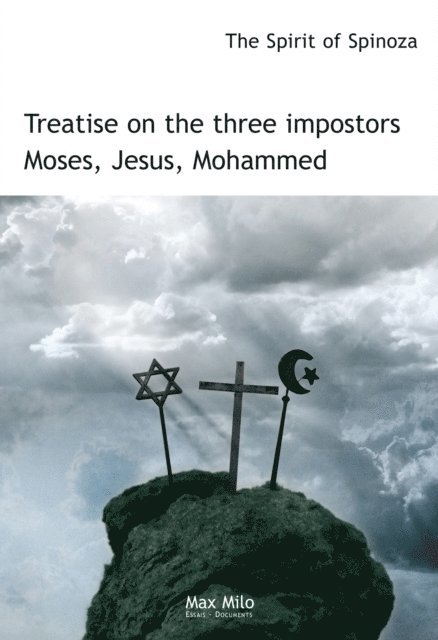
Treatise on the Three Impostors
Av Spinoza
201 kr
Läs direkt i Bokus Reader – eller ladda ned till din enhet
Beskrivning
The Treatise on the Three Impostors was first published in 1712 under the title L''esprit de M. Benoît de Spinosa, preceded by a biography entitled La Vie de M. Benoît de Spinosa. These two works, of very dissimilar contents, have been brought together only by their common reference to Spinoza. Who is the author? This question has lost none of its relevance in three centuries. First of all, let us rule out the participation of Spinoza himself for chronological reasons, La vie de M. Benoît de Spinosa refers to events after the philosopher''s death in 1677, such as the presence of the Prince of Condé in Utrecht, "at the beginning of the last wars" in 1678. In his Dictionnaire Historique, published in The Hague in 1758, Prosper Marchand concluded that the author of L''esprit de M. Benoît de Spinosa was a certain Jan Vroesen. Marchand was a scholar, editor, bibliographer, bookseller and writer, and one of the most knowledgeable figures on the movement of ideas and authors in Northern Europe. If we confine ourselves to this information, however, we might be embarrassed. Indeed, if he is indeed the complete and only author of L''esprit de M. Benoît de Spinosa, Vroesen must have been a very precocious man, since around 1687, Vroesen was only fifteen or sixteen years old.Until the French Revolution, literate Europe was full of memoirs, hypotheses and questions about the real author of the Treatise of the Three Impostors. People even came to suspect Frederick II of Prussia, a notorious anticleric, of being its author. The only problem is that Frederick was born the same year that the Rotterdam edition was published. And Spinoza? This bibliographical and philosophical enigma of a book does not allow us to forget that it is a tribute to the great philosopher. His spirit floats, indeed, through these vigorous pages. Some authors even tend to believe today that the author of the Ethics is also the one who wrote this mysterious book. Certainly, several passages testify to a careful reading of Spinoza, such as the sixth chapter “On the Spirits called Demons,” which comes straight out of the Short Treatise, or the first two chapters on the popular conception of God, which are borrowed from the same work. Specialists will be happy to find other borrowings. But the virulent disdain for the Old and New Testaments, for example, which is evident in many passages of the Treatise, does not fit Spinoza''s ideas or tone at all, nor does the irreverent atheism. Could it be that Levier, the first editor of the Treatise, and the mysterious Vroesen extracted from the Spinozian archives in Holland, "probably from the Rieuwerts collection," notes the critical edition of the Bibliothèque de la Pléïade, a selection of texts that they transformed to their liking? This is, in the end, the hypothesis that seems most plausible. For despite the mysteries and manipulations, if not the forgeries, the shadow of Spinoza hangs over the enterprise and the text clearly comes from Holland. The hypothesis is reinforced by the publisher''s brilliant desire to pay homage to Spinoza by publishing in the same volume The Life and Mind of M. Benoît de Spinosa. It is undoubtedly an exaggerated homage to the philosopher, awkwardly reinforced by the borrowings from Pierre Charron and Gabriel Naudé. It evokes those Rubens whose studio notebooks we know that the great painter only added a few touches here and there, but which he nevertheless signed.The result is that the Treatise of the Three Impostors appears as a collective anthology of the resistance to religion in the Europe of the Enlightenment. Spinoza is only the emblem, but he is nevertheless omnipresent.
Produktinformation
- Utgivningsdatum: 2023-07-04
- Språk: Engelska
- Filformat: EPUB
- Kopieringsskydd: LCP
- ISBN: 9782315010998
- Förlag: Max Milo Editions
Utforska kategorier
Betyg & recensioner
0 recensioner
Inga recensioner tillgängliga.