• Fri frakt över 249 kr
  • •
  • Snabba leveranser
  • •
  • Billiga böcker
Kundservice

Du är på sajten för privatpersoner.

Företag, bibliotek eller offentlig verksamhet?

Du handlar på classic.bokus.com, där alla dina funktioner finns intakta.
Till classic.bokus.com
Bokus logotyp. Gå till startsidan.
  • Erbjudanden
  • Student
  • Topplistor
  • Barn & ungdom
  • Bokus Play
  • E-böcker
  • Ljudböcker
  • Pocketböcker
  • Spel och pussel

Pocketfynda! Hundratals böcker för 49 kr/st →

Sidfot

Mina sidor

    Hjälp

    • Kundservice
    • Vanliga frågor och svar
    • Frakt och leverans
    • Retur vid ångerrätt
    • Reklamera vara
    • Betalning
    • Köpvillkor
    • Allmänna villkor
    • Information om webbplatsens tillgänglighet

    Om Bokus

    • Om oss
    • Pressrum
    • För studenter
    • För företag
    • För bibliotek och offentlig verksamhet
    • För leverantörer
    • Hållbarhet

    Populärt

    • Aktuella erbjudanden
    • Presentkort
    • Studentlitteratur
    • Nya böcker
    • Topplistor
    • Signerade böcker
    • Engelska böcker

    Inspiration

    • Boktips
    • BookTok
    • Barnbokskaraktärer
    • Populära författare
    Logotyp för Bokus
    Följ oss på Facebook (extern länk)Följ oss på Instagram (extern länk)Följ oss på YouTube (extern länk)Följ oss på TikTok (extern länk)
    bokus @ CookiesAnpassa cookiesIntegritetspolicyKöpvillkor
    Till Citymail hemsida (extern länk)Till Budbee hemsida (extern länk)Till Postnord hemsida (extern länk)Till Schenker hemsida (extern länk)Till Early Bird hemsida (extern länk)Till Walleys hemsida (extern länk)
    1. Naturvetenskap och teknik
    2. Geovetenskap
    3. Miljövetenskap och miljöpolitik

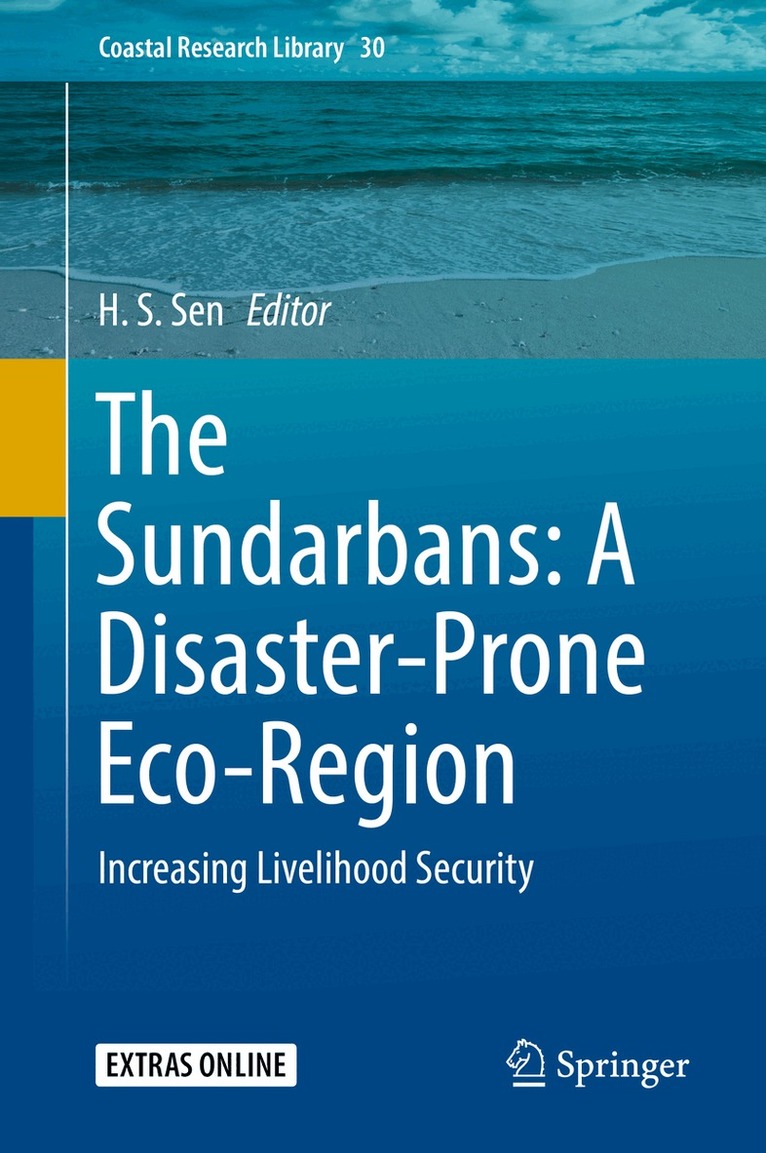
    Sundarbans: A Disaster-Prone Eco-Region

    Increasing Livelihood Security

    AvH.S. Sen

    Inbunden, Engelska, 2019

    Del i serien Coastal Research Library

    1 078 kr

    Beställningsvara. Skickas inom 10-15 vardagar. Fri frakt över 249 kr.

    Beskrivning

    This book explores the Sundarbans eco-region from a trans-boundary perspective, examining the cross-country interaction that helps planners to develop more efficient coastal zone planning for the delta. The dynamic ecosystem of the Sundarbans is considered the largest coastal delta in the world. It is located in the Bay of Bengal and spans across Bangladesh and West Bengal (India).Featuring chapters by experts from a range of fields, it addresses (i) risk factor analyses, and the geohydrological, climatic, natural, socio-economic, and anthropological factors related to the Sundarbans; (ii) strategies for sustainability in natural resource management in trans-boundary Sundarbans, cutting across political boundaries; (iii) improved agriculture, fisheries, and forestry practices and their impacts on the socio-economy for livelihood security; and (iv) a future road map for improvements.This book will be of value to those working in academia, as well as to experts and professionals in coastal zone planning and management.

    Produktinformation

    • Utgivningsdatum:2019-02-28
    • Mått:155 x 235 x undefined mm
    • Format:Inbunden
    • Språk:Engelska
    • Serie:Coastal Research Library
    • Antal sidor:654
    • Förlag:Springer Nature Switzerland AG
    • ISBN:9783030006792

    Utforska kategorier

    • Miljövetenskap och miljöpolitik inom Naturvetenskap och teknik
    • Geografi inom Naturvetenskap och teknik

    Mer om författaren

    Dr. H.S. Sen is the former Director of the Central Research Institute for Jute & Allied Fibres (CRIJAF – an Indian Council of Agricultural Research unit under the Ministry of Agriculture, Gol), located at Barrackpore, West Bengal. He started his research career after completing his MSc and PhD at Indian Agricultural Research Institute, New Delhi, in 1971, and retired from regular service in January 2008. During his career, Dr. Sen was exclusively devoted to research, especially in the fields of water management and soil salinity related to coastal ecosystems from 1971-1976 and from 1982-2002 at the Central Soil Salinity Research Institute, Regional Station Canning Town, which is located in the heart of the Sundarbans. His research on water management and soil salinity aspects on coastal Sundarbans covered a large number of areas such as salt and water dynamics in soils, irrigation and drainage methods and applications, nutrient use efficiency under nitrogenous fertilizer employment, and crop management in stressed environments. Between 1976 and 1982, he was involved in research in the field of water management in rice-oriented cropping systems at the Central Rice Research Institute, Cuttack, Orissa. At CRIJAF, he was exclusively involved in research management and administration under the mandate “Productivity and Quality Improvement of Jute & Allied Fibers” with emphasis on ecology and the environment.Since retiring, Dr. Sen has devoted his time to planning for future research strategies and livelihood securities in the tidal-dominated lower Ganges delta covering India and Bangladesh. He has also authored a book on this topic and a book chapter on a similar topic. Recently, he has also authored several papers on the drying up of the Ganga and its consequences for the deteriorating ecology in the lower delta in India and Bangladesh. In addition, he has turned his attention to climate change and its impact on water management, along with suggestionsfor possible remedies to provide for sustained productivity, as well as the role of climate change on oceanic hazards damaging coastal ecosystems at a global scale. He has published over 165 research papers, and has been a post-graduate teacher at the University of Calcutta for 26 years. He also serves as a regular reviewer for leading journals. In 1999, Dr. Sen received a National Award on rainfed management in the Sundarbans.

    Innehållsförteckning

    • Part I: Sundarbans - A Dynamic Ecosystem Meddling with Environment.- Chapter 1. Sundarbans - A Dynamic Ecosystem Meddling with Environment (H.S.Sen and Dipankar Ghorai).- Chapter 2. Sundarbans a Dynamic Ecosystem: An Overview of Opportunities, Threats and Tasks (Shafi Noor Islam).- Part II: Societal Transformation and Livelihood Options.- Chapter 3. Transformation of the Sundarbans Eco-region: Lessons from Past Approaches and Suggested Development Options (Anamitra Anurag Danda, and Mowdudur Rahman).- Part III: Forestry, Mangroves and Biodiversity.- Chapter 4. Current Status of Mangrove Forests in the Trans-boundary Sundarbans (R. N. Mandal, Peter Saenger, Chandan Surabhi Das, and Abdul Aziz).- Chapter 5. Dynamics of algae in Sundarbans and their implications as climate change proxies (Neera Sen Sarkar, and Sanoyaz Sekh).- Part IV: Production and Productivity of Major Enterprises under Stressed Environment.- Chapter 6. Soil and Water Resources of Sundarbans (D.Burman, Manoranjan K.Mondal, Zahirul H.Khan, Asish K. Sutradhar, and Farhana A. Kamal).- Chapter 7. Managing Land and Water Resources in Sundarbans Delta for Enhancing Agricultural Productivity in India (S.K. Ambast).- Chapter 8. Advances in Agronomic and Related Management Options for Sundarbans (Sukanta K. Sarangi, and Mohammad Rafiqul Islam).- Chapter 9. Aquaculture and Fisheries in the Sundarbans and Adjacent Areas in Bangladesh: Resources, Productivity, Challenges and Opportunities (Kazi Ahmed Kabir, S.B. Saha, and Michael Phillips).- Chapter 10. Freshwater Aquaculture in Sundarbans India (Jitendra Kumar Sundaray, Partha Pratim Chakrbarti, Bikash Chandra Mohapatra, Arabinda Das, Ajmal Hussan, Arnab Ghosh, and Farhana Hoque).- Chapter 11. Brackishwater Aquaculture: Opportunities and Challenges for Meeting Livelihood Demand in Indian Sundarbans (T.K. Ghoshal, Debasis De, G. Biswas, Prem Kumar, and K.K. Vijayan).- Chapter 12. Risks and Profitability Challenges of Agriculture in Sundarbans India (SubhasisMandal).- Part V: Flood and Drainage Impacts, and Engineering Interventions for Integrated Water  Management.- Chapter 13. Development of Sundarbans through Estuary Management for Augmenting Freshwater Supply, Improved Drainage and Reduced Bank Erosion (N. K. Tyagi, and H. S. Sen).- Part VI: Risk Factor Analyses on Climate Change and its Impact on Livelihood, Biodiversity, Disaster Mitigation and Forecast.- Chapter 14. Global Climate Change and Human Interferences as Risk Factors, and their Impacts on Geomorphological Features as well as on Farming Practices in Sundarbans Eco-region (Uttam Kumar Mandal, B. Maji, Sourav Mullick, Dibyendu Bikas Nayak, K.K. Mahanta, and S. Raut).- Chapter 15. Influence of Climate Change on Biodiversity and Ecosystems in the Bangladesh Sundarbans (Ainun Nishat).- Chapter 16. Climate Change-induced Environmental Hazards and Aila Relief Measures Undertaken to Sundarbans in Bangladesh and India (Bimal Kanti Paul and Subarna Chatterjee).- Chapter 17. Dynamics of the Sundarbans Forested Islands in the Context of Erosion-Accretion and Sea Level Rise (Anirban Mukhopadhyay, and Tuhin Ghosh).- Chapter 18. Space Technology and its Application in Disaster Management – Case Studies on Ecological Disturbance and Landmass Changes in Sundarbans (Dibyendu Dutta, Tanumi Kumar, Libeesh Lukose, and Sourav Samanta).- Part VII: Mainstreaming Engineering Interventions to Climate Change.- Chapter 19. Mainstreaming Climate Change Adaptation into Policies in the Sundarbans Region (M. Monirul Qader Mirza, Mir Ahsan A. Talpur, and Ainun Nishat).- Part VIII: Regional Integration of Climate Change Policies for Disaster Risk Reduction.- Chapter 20. Integration of National Policies towards Addressing the Challenges of Impacts of Climate Change in the GBM Region (M. Monirul Qader Mirza, Uttam Kumar Mandal, Golam Rabbani, and Ainun Nishat).- Part IX.- Chapter 21. Summary and Concluding Remarks (H.S.Sen).