• Fri frakt över 249 kr
  • •
  • Snabba leveranser
  • •
  • Billiga böcker
Kundservice

Du är på sajten för privatpersoner.

Företag, bibliotek eller offentlig verksamhet?

Du handlar på classic.bokus.com, där alla dina funktioner finns intakta.
Till classic.bokus.com
Bokus logotyp. Gå till startsidan.
  • Erbjudanden
  • Nyheter
  • Student
  • Topplistor
  • Barn & ungdom
  • Bokus Play
  • E-böcker
  • Pocketböcker
  • Spel & pussel

10% rabatt på allt med kod NYSTART10 →

Sidfot

Mina sidor

    Hjälp

    • Kundservice
    • Vanliga frågor och svar
    • Frakt och leverans
    • Retur vid ångerrätt
    • Reklamera vara
    • Betalning
    • Köpvillkor
    • Allmänna villkor
    • Information om webbplatsens tillgänglighet

    Om Bokus

    • Om oss
    • Pressrum
    • För studenter
    • För företag
    • För bibliotek och offentlig verksamhet
    • För leverantörer
    • Hållbarhet

    Populärt

    • Aktuella erbjudanden
    • Presentkort
    • Studentlitteratur
    • Nya böcker
    • Topplistor
    • Signerade böcker
    • Engelska böcker

    Inspiration

    • Boktips
    • BookTok
    • Populära bokserier
    • Barnbokskaraktärer
    • Populära författare
    Logotyp för Bokus
    Följ oss på Facebook (extern länk)Följ oss på Instagram (extern länk)Följ oss på YouTube (extern länk)Följ oss på TikTok (extern länk)
    bokus @ CookiesAnpassa cookiesIntegritetspolicyKöpvillkor
    Till Citymail hemsida (extern länk)Till Budbee hemsida (extern länk)Till Postnord hemsida (extern länk)Till Schenker hemsida (extern länk)Till Early Bird hemsida (extern länk)Till Walleys hemsida (extern länk)
    1. Data och IT
    2. Systemvetenskap och AI

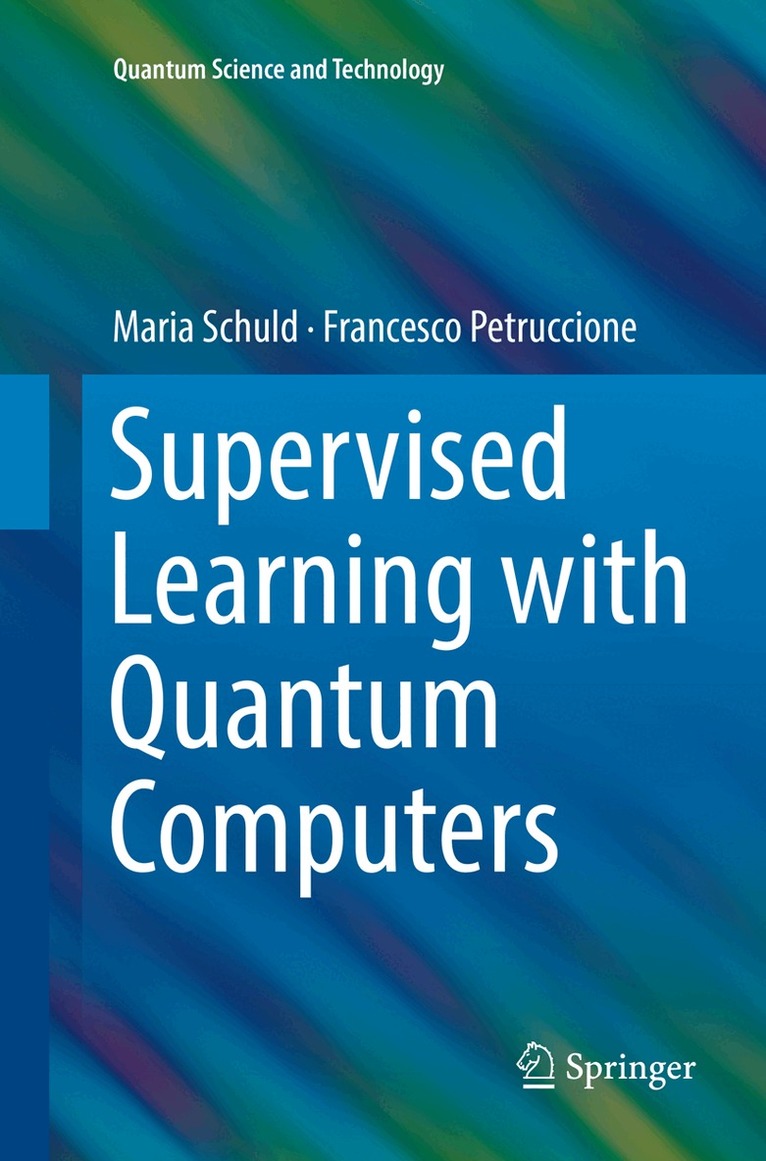
    Supervised Learning with Quantum Computers

    AvMaria Schuld,Francesco Petruccione

    Häftad, Engelska, 2019

    Del i serien Quantum Science and Technology

    1 947 kr

    Beställningsvara. Skickas inom 10-15 vardagar. Fri frakt över 249 kr.

    Fler format och utgåvor

    Inbunden

    1 947 kr

    Beskrivning

    Quantum machine learning investigates how quantum computers can be used for data-driven prediction and decision making. The books summarises and conceptualises ideas of this relatively young discipline for an audience of computer scientists and physicists from a graduate level upwards. It aims at providing a starting point for those new to the field, showcasing a toy example of a quantum machine learning algorithm and providing a detailed introduction of the two parent disciplines. For more advanced readers, the book discusses topics such as data encoding into quantum states, quantum algorithms and routines for inference and optimisation, as well as the construction and analysis of genuine ``quantum learning models''. A special focus lies on supervised learning, and applications for near-term quantum devices.

    Produktinformation

    • Utgivningsdatum:2019-01-03
    • Mått:155 x 235 x 17 mm
    • Vikt:464 g
    • Format:Häftad
    • Språk:Engelska
    • Serie:Quantum Science and Technology
    • Antal sidor:287
    • Förlag:Springer Nature Switzerland AG
    • ISBN:9783030071882

    Utforska kategorier

    • Systemvetenskap och AI inom Data och IT
    • Kvantfysik inom Naturvetenskap och teknik
    • Maskinteknik och material inom Naturvetenskap och teknik

    Mer om författaren

    Francesco Petruccione received his PhD (1988) and ”Habilitation” (1994) from the University of Freiburg, Germany. Since 2004 he is Professor of Theoretical Physics at the University of KwaZulu-Natal in Durban, Africa, where in 2007 he was granted a South African Research Chair for Quantum Information Processing and Communication from the National Research Foundation. He is the co-author of “The theory of open quantum systems” (Oxford University Press, 2002) and has published more than 100 papers in refereed journals, adding up to more than 7000 citations. Francesco Petruccione’s research focusses on quantum information and open quantum systems.Maria Schuld received her PhD degree from the University of KwaZulu-Natal in South Africa in 2017 as a fellow of the German Academic Foundation. Her Master’s degree was awarded by the Technical University of Berlin and supported through a scholarship of the German Academic Exchange Service (DAAD). Since 2013 she dedicates her research to the design of quantum machine learning algorithms, which she presented at numerous international conferences and in a range of research articles. Maria Schuld is a Post-Doc at the University of KwaZulu-Natal and works as a researcher for the Canadian-based quantum computing startup Xanadu.

    Recensioner i media

    “The book is very well written and contains sufficiently many examples and illustrations. The authors make a concerted effort to make the material accessible to both computer science graduates as well as scientists with a quantum physics background. … The intended audience are thus machine learning scientists that want to explore the quantum approach to their discipline or quantum information scientists that want to enter the field of machine learning.” (Andreas Maletti, zbMATH 1411.81008, 2019)

    Innehållsförteckning

    • Introduction.- Background.- How quantum computers can classify data.- Organisation of the book.-  Machine Learning.- Prediction.- Models.- Training.- Methods in machine learning.- Quantum Information.- Introduction to quantum theory.- Introduction to quantum computing.- An example: The Deutsch-Josza algorithm.- Strategies of information encoding.- Important quantum routines.- Quantum advantages.- Computational complexity of learning.- Sample complexity.- Model complexity.- Information encoding.-  Basis encoding.- Amplitude encoding.- Qsample encoding.- Hamiltonian encoding.- Quantum computing for inference.- Linear models.- Kernel methods.- Probabilistic models.- Quantum computing for training.-  Quantum blas.- Search and amplitude amplification.- Hybrid training for variational algorithms.- Quantum adiabatic machine learning.- Learning with quantum models.- Quantum extensions of Ising-type models.- Variational classifiers and neural networks.- Other approaches to buildquantum models.- Prospects for near-term quantum machine learning.- Small versus big data.- Hybrid versus fully coherent approaches.- Qualitative versus quantitative advantages.- What machine learning can do for quantum computing.- References.