• Fri frakt över 249 kr
  • •
  • Snabba leveranser
  • •
  • Billiga böcker
Kundservice

Du är på sajten för privatpersoner.

Företag, bibliotek eller offentlig verksamhet?

Du handlar på classic.bokus.com, där alla dina funktioner finns intakta.
Till classic.bokus.com
Bokus logotyp. Gå till startsidan.
  • Erbjudanden
  • Student
  • Topplistor
  • Barn & ungdom
  • Bokus Play
  • E-böcker
  • Ljudböcker
  • Pocketböcker
  • Spel och pussel

5% studentrabatt – använd koden KURSBOK27 →

Sidfot

Mina sidor

    Hjälp

    • Kundservice
    • Vanliga frågor och svar
    • Frakt och leverans
    • Retur vid ångerrätt
    • Reklamera vara
    • Betalning
    • Köpvillkor
    • Allmänna villkor
    • Information om webbplatsens tillgänglighet

    Om Bokus

    • Om oss
    • Pressrum
    • För studenter
    • För företag
    • För bibliotek och offentlig verksamhet
    • För leverantörer
    • Hållbarhet

    Populärt

    • Aktuella erbjudanden
    • Presentkort
    • Studentlitteratur
    • Nya böcker
    • Topplistor
    • Signerade böcker
    • Engelska böcker

    Inspiration

    • Boktips
    • BookTok
    • Barnbokskaraktärer
    • Populära författare
    Logotyp för Bokus
    Följ oss på Facebook (extern länk)Följ oss på Instagram (extern länk)Följ oss på YouTube (extern länk)Följ oss på TikTok (extern länk)
    bokus @ CookiesAnpassa cookiesIntegritetspolicyKöpvillkor
    Till Citymail hemsida (extern länk)Till Budbee hemsida (extern länk)Till Postnord hemsida (extern länk)Till Schenker hemsida (extern länk)Till Early Bird hemsida (extern länk)Till Walleys hemsida (extern länk)
    1. Ekonomi och Ledarskap
    2. Nationalekonomi

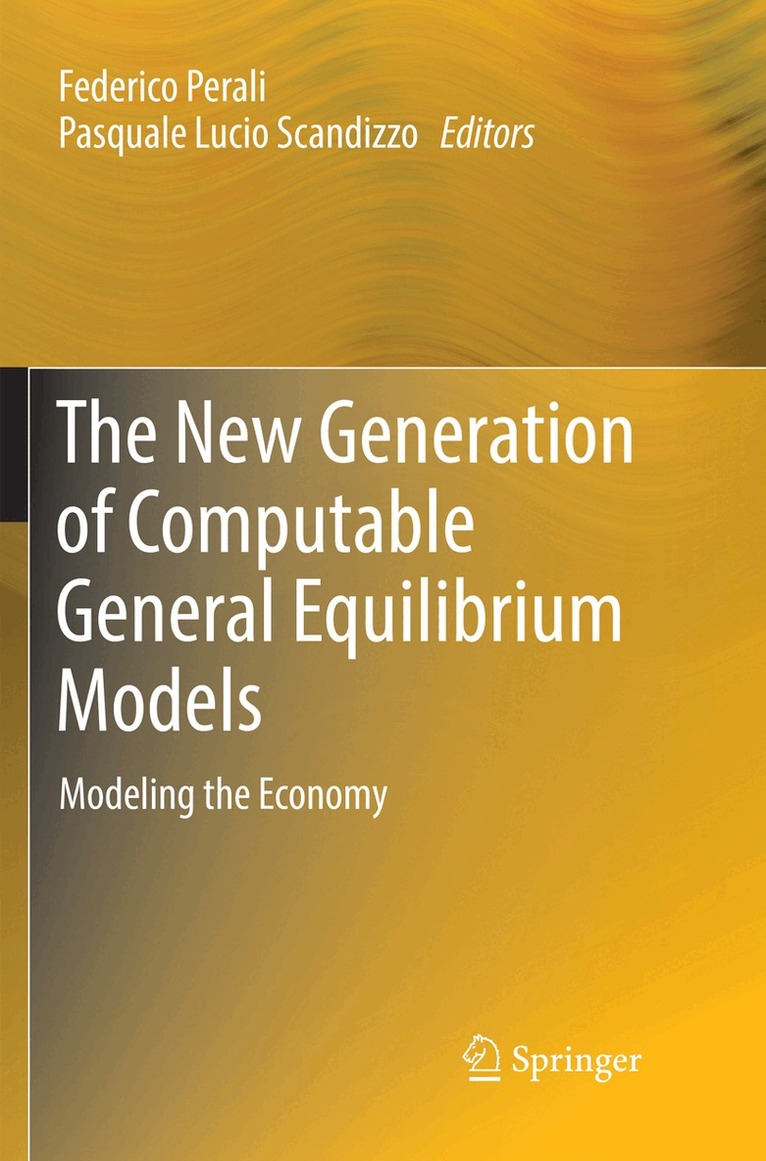
    New Generation of Computable General Equilibrium Models

    Modeling the Economy

    AvFederico Perali,Pasquale Lucio Scandizzo

    Häftad, Engelska, 2018

    1 935 kr

    Beställningsvara. Skickas inom 10-15 vardagar. Fri frakt över 249 kr.

    Beskrivning

    This book covers some important topics in the construction of computable general equilibrium (CGE) models and examines use of these models for the analysis of economic policies, their properties, and their implications. Readers will find explanation and discussion of the theoretical structure and practical application of several model typologies, including dynamic, stochastic, micro-macro, and simulation models, as well as different closure rules and policy experiments. The presentation of applications to various country and problem-specific case studies serves to provide an informed and clearly articulated summary of the state of the art and the most important methodological advancements in the field of policy modeling within the framework of general equilibrium analysis. The book is an outcome of a recent workshop of the Italian Development Economists Association attended by a group of leading practitioners involved in the generation of CGE models and research on modeling the economy and policy making. It will be of interest to researchers, professional economists, graduate students, and knowledgeable policy makers.

    Produktinformation

    • Utgivningsdatum:2018-12-25
    • Mått:155 x 235 x 20 mm
    • Vikt:534 g
    • Format:Häftad
    • Språk:Engelska
    • Antal sidor:342
    • Förlag:Springer Nature Switzerland AG
    • ISBN:9783030096335

    Utforska kategorier

    • Nationalekonomi inom Ekonomi och Ledarskap
    • Optimering inom Naturvetenskap och teknik
    • Systemvetenskap och AI inom Data och IT

    Mer om författaren

    Federico Perali is Full Professor in Political Economy in the Department of Economics at Verona University, Italy. He served as head of the Department of Economics at the university from 2006 to 2013 and as Director of the Doctoral School in Law and Economics in 2014–5. He is a co-founder and scientific committee member of the Italian Association of Development Economists and also a member of the scientific committee of the Italian Center for International Development. He has worked as a consultant for organizations including the OECD and as coordinator for various projects within Italy. He is the author of more than 70 publications.Pasquale L. Scandizzo holds a Ph.D. from the University of California, Berkeley and is presently Professor of Political Economy, Fellow of the Center for Economic and International Studies, Senior Fellow and Board Member of the Economics Foundation at the University of Rome “Tor Vergata”. He is also President ofthe Italian Association of Development Economists and President of Openeconomics, a university spin off focusing on project evaluation and economic development. Among many topics, his research, whose results have been widely published, concerns the relationship between institutions and economic development, with focus on risk aversion, the distribution of rights and the demand supply nexus in a general equilibrium framework. He has developed methodologies for the economic evaluation of public projects under uncertainty using real option theory and general equilibrium techniques and has been leading their application in both developed and developing countries.

    Innehållsförteckning

    • Part I Introduction.- 1 General Equilibrium Modelling: The Integration of Policy and Project Analysis.- Part II Methodology and Estimation Issues.- 2 Demand-Driven Structural Change in Applied General Equilibrium Models.- 3 Micro-Macro Simulation of Corporate Tax Reforms.- 4 Estimating an Energy-Social Accounting Matrix for Italy.- 5 Analysis of local economic impacts using a Village Social Accounting Matrix: the case of Oaxaca.- Part III  Static and Dynamic CGEs and Policy Applications.- 6 A CGE Model for Productivity and Investment in Kenya.- 7 The Political Economy of the CAP Reform in Italy.- 8 A CGE Model for Mauritius  Ocean Economy.- 9 A Micro-Macro simulation model applied to the French economy: The case of a Euro’s Real Depreciation.- 10 Green and Blue Dividends and Environmental Tax reform: Dynamic CGE Model.- 11 A Sub-National CGE Model for the European Mediterranean Countries.- 12 A regional dynamic general equilibrium model with historical calibration: a counterfactual exercise.