• Fri frakt över 249 kr
  • •
  • Snabba leveranser
  • •
  • Billiga böcker
Kundservice

Du är på sajten för privatpersoner.

Företag, bibliotek eller offentlig verksamhet?

Du handlar på classic.bokus.com, där alla dina funktioner finns intakta.
Till classic.bokus.com
Bokus logotyp. Gå till startsidan.
  • Erbjudanden
  • Nyheter
  • Student
  • Topplistor
  • Barn & ungdom
  • Bokus Play
  • E-böcker
  • Pocketböcker
  • Spel & pussel

10% rabatt på allt med kod NYSTART10 →

Sidfot

Mina sidor

    Hjälp

    • Kundservice
    • Vanliga frågor och svar
    • Frakt och leverans
    • Retur vid ångerrätt
    • Reklamera vara
    • Betalning
    • Köpvillkor
    • Allmänna villkor
    • Information om webbplatsens tillgänglighet

    Om Bokus

    • Om oss
    • Pressrum
    • För studenter
    • För företag
    • För bibliotek och offentlig verksamhet
    • För leverantörer
    • Hållbarhet

    Populärt

    • Aktuella erbjudanden
    • Presentkort
    • Studentlitteratur
    • Nya böcker
    • Topplistor
    • Signerade böcker
    • Engelska böcker

    Inspiration

    • Boktips
    • BookTok
    • Populära bokserier
    • Barnbokskaraktärer
    • Populära författare
    Logotyp för Bokus
    Följ oss på Facebook (extern länk)Följ oss på Instagram (extern länk)Följ oss på YouTube (extern länk)Följ oss på TikTok (extern länk)
    bokus @ CookiesAnpassa cookiesIntegritetspolicyKöpvillkor
    Till Citymail hemsida (extern länk)Till Budbee hemsida (extern länk)Till Postnord hemsida (extern länk)Till Schenker hemsida (extern länk)Till Early Bird hemsida (extern länk)Till Walleys hemsida (extern länk)
    1. Naturvetenskap och teknik
    2. Matematik och naturvetenskap
    3. Kemi
    4. Fysikalisk kemi

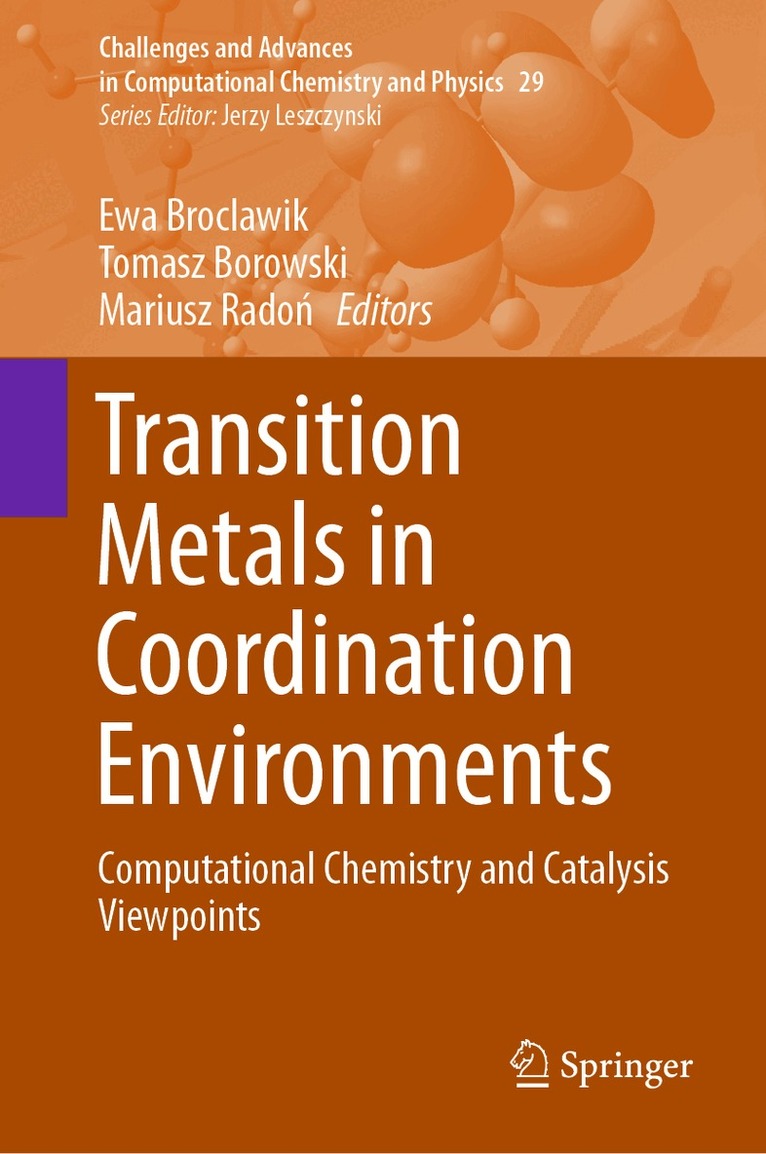
    Transition Metals in Coordination Environments

    Computational Chemistry and Catalysis Viewpoints

    AvEwa Broclawik,Tomasz Borowski

    Inbunden, Engelska, 2019

    Del 29 i serien Challenges and Advances in Computational Chemistry and Physics

    1 625 kr

    Beställningsvara. Skickas inom 10-15 vardagar. Fri frakt över 249 kr.

    Beskrivning

    This book focuses on the electronic properties of transition metals in coordination environments. These properties are responsible for the unique and intricate activity of transition metal sites in bio- and inorganic catalysis, but also pose challenges for both theoretical and experimental studies. Written by an international group of recognized experts, the book reviews recent advances in computational modeling and discusses their interplay using experiments. It covers a broad range of topics, including advanced computational methods for transition metal systems; spectroscopic, electrochemical and catalytic properties of transition metals in coordination environments; metalloenzymes and biomimetic compounds; and spin-related phenomena. As such, the book offers an invaluable resource for all researchers and postgraduate students interested in both fundamental and application-oriented research in the field of transition metal systems.

    Produktinformation

    • Utgivningsdatum:2019-03-27
    • Mått:155 x 235 x 35 mm
    • Vikt:980 g
    • Format:Inbunden
    • Språk:Engelska
    • Serie:Challenges and Advances in Computational Chemistry and Physics
    • Antal sidor:532
    • Förlag:Springer Nature Switzerland AG
    • ISBN:9783030117139

    Utforska kategorier

    • Fysikalisk kemi inom Naturvetenskap och teknik
    • Oorganisk kemi inom Naturvetenskap och teknik
    • Biokemi inom Naturvetenskap och teknik

    Mer om författaren

    Ewa Broclawik is a Professor Emeritus and former Full Professor at the Jerzy Haber Institute of Catalysis and Surface Chemistry, Polish Academy of Sciences in Krakow, Poland. Her research interests focus on theoretical and applied quantum chemistry, in particular on the modeling of active sites in heterogeneous and enzymatic catalysis and on catalytic reaction mechanisms. Dr. Broclawik is the author of more than 180 publications, including 9 book chapters.   Tomasz Borowski is a Full Professor at the Jerzy Haber Institute of Catalysis and Surface Chemistry, Polish Academy of Sciences. His research interests encompass computational chemistry, biochemistry, reaction mechanisms, metalloenzymes, and protein structure and dynamics. Dr. Borowski has published more than 60 research papers in refereed journals as well as 3 book chapters. Mariusz Radoń is an Assistant Professor at Jagiellonian University,Krakow, Poland. His primary research interest is in quantum chemistry, especially its applications to transition metal complexes and active sites of metalloproteins, with a focus on electronic structure, spin-state energetics, metal–ligand interactions and connections to catalytic activity. Dr. Radoń is the author of 30 publications, including 1 book chapter.

    Innehållsförteckning

    • From the content: Review of the current status of knowledge in the field of recent achievements in computational modeling and their interplay with experiment.- Density matrix renormalization group (DMRG): An emerging method in bioinorganic chemistry.- Approaching magnetic interactions in oligonuclear transition metal clusters with density matrix renormalization group.- New strategies in modelling electronic structures and properties in actinides.- X-ray probes of electronic structure in transition metal complexes.- Electronic spectroscopy of cobalamins studied with density functional theory.- Spin magnetic properties of transition metal complexes.- Computational studies of transition-metal catalysis in biological and non-biological settings.- The role of non-covalent interactions in metal complexes.- Molecular electrochemistry of coordination compounds - a correlation between quantum-chemical calculations and experiment.- Computational modelling of structure and catalytic properties of supported group VI transition metal oxide species.- Catalytic properties of TM in inorganic coordination environments.- Challenges in modeling metalloenzymes and their troubleshooting.- The quest for accurate theoretical models of metalloenzymes: an aid to experiment.- Metal coordination in the active sites of selected metalloenzymes: a theoretical point of view.- Metal – redox-active ligand cooperation in biomimetic transition metal compounds to exhibit metal-centered multi-electron reactivity.- Computational vs. experimental spectroscopy for transition-metals.- The electronic determinants of spin crossover described by density functional theory.- Photodeactivation channels of transition metal complexes: a computational chemistry perspective.