• Fri frakt över 249 kr
  • •
  • Snabba leveranser
  • •
  • Billiga böcker
Kundservice

Du är på sajten för privatpersoner.

Företag, bibliotek eller offentlig verksamhet?

Du handlar på classic.bokus.com, där alla dina funktioner finns intakta.
Till classic.bokus.com
Bokus logotyp. Gå till startsidan.
  • Erbjudanden
  • Nyheter
  • Student
  • Topplistor
  • Barn & ungdom
  • Bokus Play
  • E-böcker
  • Pocketböcker
  • Spel & pussel

10% rabatt på allt med kod: NYSTART10 →

Sidfot

Mina sidor

    Hjälp

    • Kundservice
    • Vanliga frågor och svar
    • Frakt och leverans
    • Retur vid ångerrätt
    • Reklamera vara
    • Betalning
    • Köpvillkor
    • Allmänna villkor
    • Information om webbplatsens tillgänglighet

    Om Bokus

    • Om oss
    • Pressrum
    • För studenter
    • För företag
    • För bibliotek och offentlig verksamhet
    • För leverantörer
    • Hållbarhet

    Populärt

    • Aktuella erbjudanden
    • Presentkort
    • Studentlitteratur
    • Nya böcker
    • Topplistor
    • Signerade böcker
    • Engelska böcker

    Inspiration

    • Boktips
    • BookTok
    • Populära bokserier
    • Barnbokskaraktärer
    • Populära författare
    Logotyp för Bokus
    Följ oss på Facebook (extern länk)Följ oss på Instagram (extern länk)Följ oss på YouTube (extern länk)Följ oss på TikTok (extern länk)
    bokus @ CookiesAnpassa cookiesIntegritetspolicyKöpvillkor
    Till Citymail hemsida (extern länk)Till Budbee hemsida (extern länk)Till Postnord hemsida (extern länk)Till Schenker hemsida (extern länk)Till Early Bird hemsida (extern länk)Till Walleys hemsida (extern länk)
    1. Samhälle och politik
    2. Samhälle och kultur
    3. Kultur och medier
    4. Referensverk och tvärvetenskap

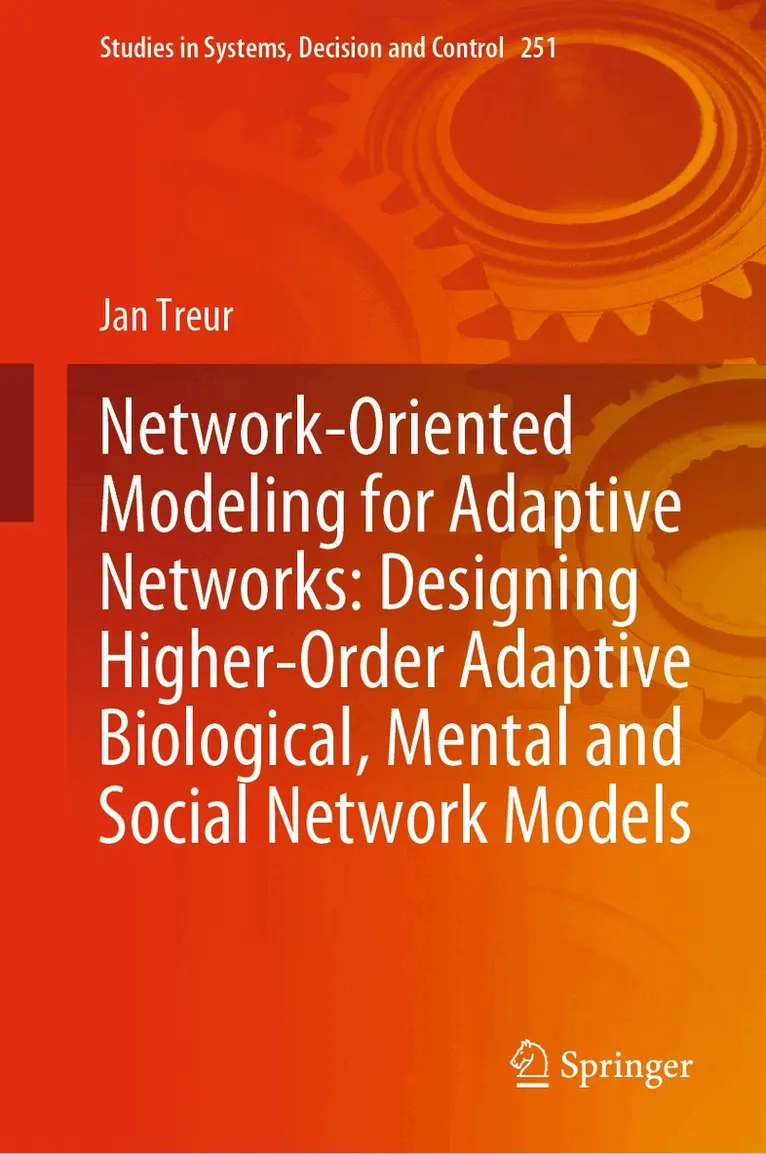
    Network-Oriented Modeling for Adaptive Networks: Designing Higher-Order Adaptive Biological, Mental and Social Network Models

    AvJan Treur

    Inbunden, Engelska, 2019

    Del 251 i serien Studies in Systems, Decision and Control

    1 086 kr

    Beställningsvara. Skickas inom 10-15 vardagar. Fri frakt över 249 kr.

    Fler format och utgåvor

    E-bok

    1 413 kr

    Häftad

    1 086 kr

    Beskrivning

    This book addresses the challenging topic of modeling adaptive networks, which often manifest inherently complex behavior. Networks by themselves can usually be modeled using a neat, declarative, and conceptually transparent Network-Oriented Modeling approach. In contrast, adaptive networks are networks that change their structure; for example, connections in Mental Networks usually change due to learning, while connections in Social Networks change due to various social dynamics. For adaptive networks, separate procedural specifications are often added for the adaptation process. Accordingly, modelers have to deal with a less transparent, hybrid specification, part of which is often more at a programming level than at a modeling level. This book presents an overall Network-Oriented Modeling approach that makes designing adaptive network models much easier, because the adaptation process, too, is modeled in a neat, declarative, and conceptually transparent Network-OrientedModeling manner, like the network itself. Thanks to this approach, no procedural, algorithmic, or programming skills are needed to design complex adaptive network models. A dedicated software environment is available to run these adaptive network models from their high-level specifications. Moreover, because adaptive networks are described in a network format as well, the approach can simply be applied iteratively, so that higher-order adaptive networks in which network adaptation itself is adaptive (second-order adaptation), too  can be modeled just as easily. For example, this can be applied to model metaplasticity in cognitive neuroscience, or second-order adaptation in biological and social contexts. The book illustrates the usefulness of this approach via numerous examples of complex (higher-order) adaptive network models for a wide variety of biological, mental, and social processes.The book is suitable for multidisciplinary Master’s and Ph.D. students withoutassuming much prior knowledge, although also some elementary mathematical analysis is involved. Given the detailed information provided, it can be used as an introduction to Network-Oriented Modeling for adaptive networks. The material is ideally suited for teaching undergraduate and graduate students with multidisciplinary backgrounds or interests. Lecturers will find additional material such as slides, assignments, and software.

    Produktinformation

    • Utgivningsdatum:2019-11-13
    • Mått:155 x 235 x 29 mm
    • Vikt:811 g
    • Format:Inbunden
    • Språk:Engelska
    • Serie:Studies in Systems, Decision and Control
    • Antal sidor:412
    • Förlag:Springer Nature Switzerland AG
    • ISBN:9783030314446

    Utforska kategorier

    • Referensverk och tvärvetenskap inom Samhälle och politik
    • Artificiell intelligens inom Data och IT
    • Matematisk fysik inom Naturvetenskap och teknik

    Innehållsförteckning

    • On Adaptive Networks and Network Reification.- Ins and Outs of Network-Oriented Modeling.- A Unified Approach to Represent Network Adaptation Principles by Network Reification.- Modeling Higher-Order Network Adaptation by Multilevel Network Reification.- A Reified Network Model for Adaptive Decision Making Based on the Disconnect-Reconnect Adaptation Principle.- Using Multilevel Network Reification to Model Second-Order Adaptive Bonding by Homophily.- Reified Adaptive Network Models of Higher-Order Modeling a Strange Loop.- A Modeling Environment for Reified Temporal-Causal Network Models.- On the Universal Combination Function and the Universal  Difference Equation for Reified Temporal-Causal Network Models.- Relating Network Emerging Behaviour to Network Structure.- Analysis of a Network’s Emerging Behaviour via its Structure Involving its Strongly Connected Components.- Relating a Reified Adaptive Network’s Structure to its Emerging Behaviour for Bonding by Homophily.- Relatinga Reified Adaptive Network’s Structure to its Emerging Behaviour for Hebbian learning.- Mathematical Details of Specific Difference and Differential Equations and Mathematical Analysis of Emerging Network Behaviour.- Using Network Reification for Adaptive Networks: Discussion