• Fri frakt över 249 kr
  • •
  • Snabba leveranser
  • •
  • Billiga böcker
Kundservice

Du är på sajten för privatpersoner.

Företag, bibliotek eller offentlig verksamhet?

Du handlar på classic.bokus.com, där alla dina funktioner finns intakta.
Till classic.bokus.com
Bokus logotyp. Gå till startsidan.
  • Erbjudanden
  • Nyheter
  • Student
  • Topplistor
  • Barn & ungdom
  • Bokus Play
  • E-böcker
  • Pocketböcker
  • Spel & pussel

10% rabatt på allt med kod: NYSTART10 →

Sidfot

Mina sidor

    Hjälp

    • Kundservice
    • Vanliga frågor och svar
    • Frakt och leverans
    • Retur vid ångerrätt
    • Reklamera vara
    • Betalning
    • Köpvillkor
    • Allmänna villkor
    • Information om webbplatsens tillgänglighet

    Om Bokus

    • Om oss
    • Pressrum
    • För studenter
    • För företag
    • För bibliotek och offentlig verksamhet
    • För leverantörer
    • Hållbarhet

    Populärt

    • Aktuella erbjudanden
    • Presentkort
    • Studentlitteratur
    • Nya böcker
    • Topplistor
    • Signerade böcker
    • Engelska böcker

    Inspiration

    • Boktips
    • BookTok
    • Populära bokserier
    • Barnbokskaraktärer
    • Populära författare
    Logotyp för Bokus
    Följ oss på Facebook (extern länk)Följ oss på Instagram (extern länk)Följ oss på YouTube (extern länk)Följ oss på TikTok (extern länk)
    bokus @ CookiesAnpassa cookiesIntegritetspolicyKöpvillkor
    Till Citymail hemsida (extern länk)Till Budbee hemsida (extern länk)Till Postnord hemsida (extern länk)Till Schenker hemsida (extern länk)Till Early Bird hemsida (extern länk)Till Walleys hemsida (extern länk)
    1. Ekonomi och Ledarskap
    2. Nationalekonomi

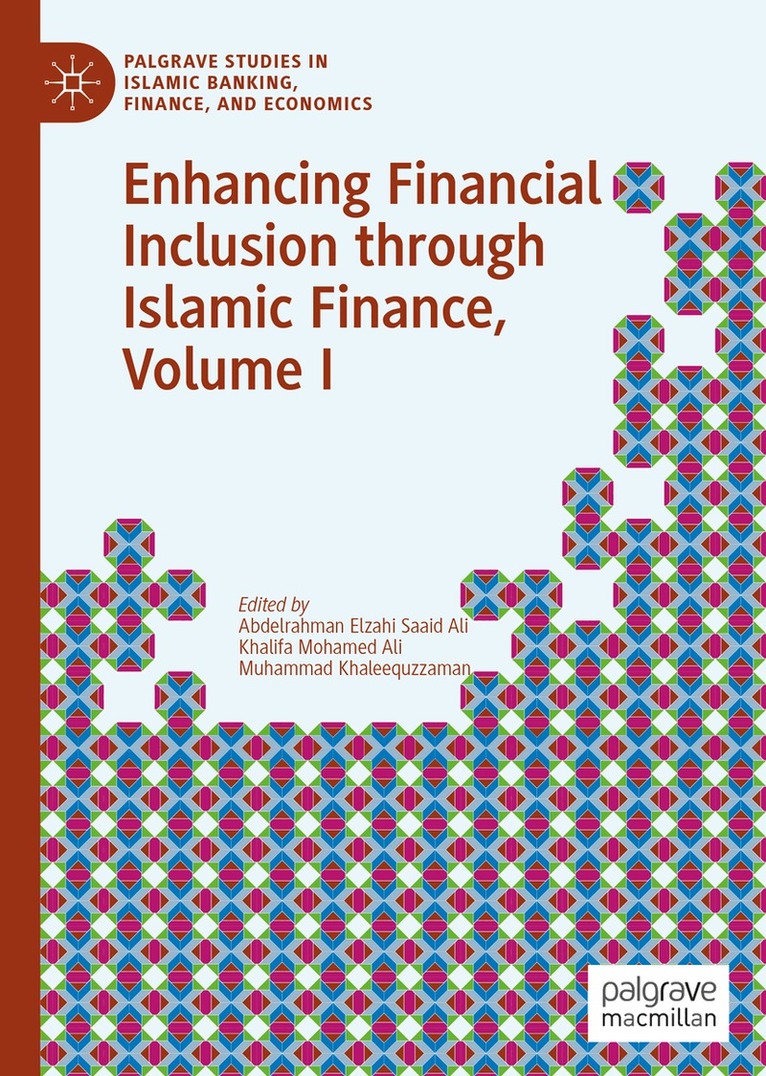
    Enhancing Financial Inclusion through Islamic Finance, Volume I

    AvAbdelrahman Elzahi Saaid Ali,Khalifa Mohamed Ali

    Inbunden, Engelska, 2020

    Del i serien Palgrave Studies in Islamic Banking, Finance, and Economics

    1 086 kr

    Beställningsvara. Skickas inom 10-15 vardagar. Fri frakt över 249 kr.

    Beskrivning

    This book, the first of two volumes, highlights the concept of financial inclusion from the Islamic perspective. An important element of the Sustainable Development Goals (SDGs), financial inclusion has been given significant prominence in reform and development agendas proposed by the United Nations and G-20. The significance of Islamic financial inclusion goes beyond improved access to finance to encompass enhanced access to savings and risk mitigation products, as well as social inclusion that allows individuals and companies to engage more actively in the real economy. It represents one of the important drivers of economic growth. Gender disparity exists within financial access and its extent varies widely across world economies. South Asia, the Middle East and North Africa have the largest gender gaps, with women in these regions being forty per cent less likely than men to have a formal account at a financial institution. Analysing how Islamic financial inclusion can empower individuals, this volume explores the contribution of Islamic microfinance in achieving SDGs and solving income and wealth inequality. Comprising a combination of empirical evidence, theory and modelling, this edited collection illustrates how to improve access to finance, making it essential reading for those researching both Islamic finance and development finance.

    Produktinformation

    • Utgivningsdatum:2020-07-02
    • Mått:148 x 210 x 20 mm
    • Vikt:463 g
    • Format:Inbunden
    • Språk:Engelska
    • Serie:Palgrave Studies in Islamic Banking, Finance, and Economics
    • Antal sidor:245
    • Förlag:Springer Nature Switzerland AG
    • ISBN:9783030399344

    Utforska kategorier

    • Nationalekonomi inom Ekonomi och Ledarskap
    • Internationell ekonomi inom Ekonomi och Ledarskap
    • Finansiering inom Ekonomi och Ledarskap

    Mer om författaren

    Abdelrahman Elzahi Saaid Ali is a Senior Economist at the Islamic Research and Training Institute (IRTI) of the Islamic Development Bank (IsDB). Before joining IRTI, he was Associate Professor of Economics at Sudan University of Science and Technology. Abdelrahman has written and edited a number of academic publications including Revitalization of Waqf for Socio-Economic Development (Palgrave, 2019).Khalifa Mohamed Ali is a Senior Economist at IRTI. Before this, he was Associate Professor of Economics at the United Arab Emirates University and taught economics at Iowa State University, USA. Khalifa is the Editor of the Arabic edition of Islamic Economic Studies, one of IRTI's flagship publications, and has published extensively in the area of Islamic finance.Muhammad Khaleequzzaman studied Economics at the University of Illinois at Urbana‐Champaign, USA, and Islamic Banking and Finance at the International Islamic University Islamabad, Pakistan. Muhammad is a certified Islamic banker from the State Bank of Pakistan.

    Innehållsförteckning

    • Part I. Enhancing Financial Inclusion through Islamic Finance.- 1. Introduction; Abdelrahman Elzahi Saaid Ali, Khalifa Mohamed Ali and Muhammad Khaleequzzaman.- 2. Empowering the Poor and Enhancing Financial Inclusion from a Multi-dimensional Perspective; Hazik Mohamed.- 3. Causes of Income and Wealth Inequalities: Perspectives of Economists from the Fields of Conventional and Islamic Economics; Muhammad Imran Ejaz.- 4. How Islamic Microfinance Can Contribute to Achieving the Sustainable Development Goals; Murniati Mukhlisin, Luqyan Tamanni, Toseef Azid and Rifka Mustafida.- 5. Islamic Finance and its Impact on Financial Inclusion; Wissal Msellek.- 6. A Critical Review of Takāful Companies’ Contributions to Economic Developments in Fulfillment of Maqasid al-Sharīʿah: Evidence from Malaysia; Abu Umar Faruq Ahmad and Rashedul Hasan.- Part II. Islamic Financial Inclusion: Cases and Modeling.- 7. Making Islamic Finance a Vehicle for SocialInclusion: A Case for Revisiting the Liquidity Management Practices by Islamic Banks; Muhammad Ayub.- 8. Improving Access to Financial Services: Theory and Practice around the Globe; Muhammad Azeem Qureshi and Toseef Azid.- 9. Fintech and Financial Inclusion in Pakistan: An Exploratory Study; Hassnian Ali and Rose Abdullah.- 10. Financial Inclusion for Farmers through Appropriate Financing Products: Analytic Network Process Approach; Dika Megantara and Anita Priantina.- 11. A Skill-based and Interest-free Microfinance Model of Entrepreneurship is the Most Sustainable Model; Farhat Mahmood and Adeeba Ishaq.