• Fri frakt över 249 kr
  • •
  • Snabba leveranser
  • •
  • Billiga böcker
Kundservice

Du är på sajten för privatpersoner.

Företag, bibliotek eller offentlig verksamhet?

Du handlar på classic.bokus.com, där alla dina funktioner finns intakta.
Till classic.bokus.com
Bokus logotyp. Gå till startsidan.
  • Erbjudanden
  • Nyheter
  • Student
  • Topplistor
  • Barn & ungdom
  • Bokus Play
  • E-böcker
  • Pocketböcker
  • Spel & pussel

10% rabatt på allt med kod: NYSTART10 →

Sidfot

Mina sidor

    Hjälp

    • Kundservice
    • Vanliga frågor och svar
    • Frakt och leverans
    • Retur vid ångerrätt
    • Reklamera vara
    • Betalning
    • Köpvillkor
    • Allmänna villkor
    • Information om webbplatsens tillgänglighet

    Om Bokus

    • Om oss
    • Pressrum
    • För studenter
    • För företag
    • För bibliotek och offentlig verksamhet
    • För leverantörer
    • Hållbarhet

    Populärt

    • Aktuella erbjudanden
    • Presentkort
    • Studentlitteratur
    • Nya böcker
    • Topplistor
    • Signerade böcker
    • Engelska böcker

    Inspiration

    • Boktips
    • BookTok
    • Populära bokserier
    • Barnbokskaraktärer
    • Populära författare
    Logotyp för Bokus
    Följ oss på Facebook (extern länk)Följ oss på Instagram (extern länk)Följ oss på YouTube (extern länk)Följ oss på TikTok (extern länk)
    bokus @ CookiesAnpassa cookiesIntegritetspolicyKöpvillkor
    Till Citymail hemsida (extern länk)Till Budbee hemsida (extern länk)Till Postnord hemsida (extern länk)Till Schenker hemsida (extern länk)Till Early Bird hemsida (extern länk)Till Walleys hemsida (extern länk)
    1. Medicin
    2. Andra medicinska specialiteter
    3. Patologi

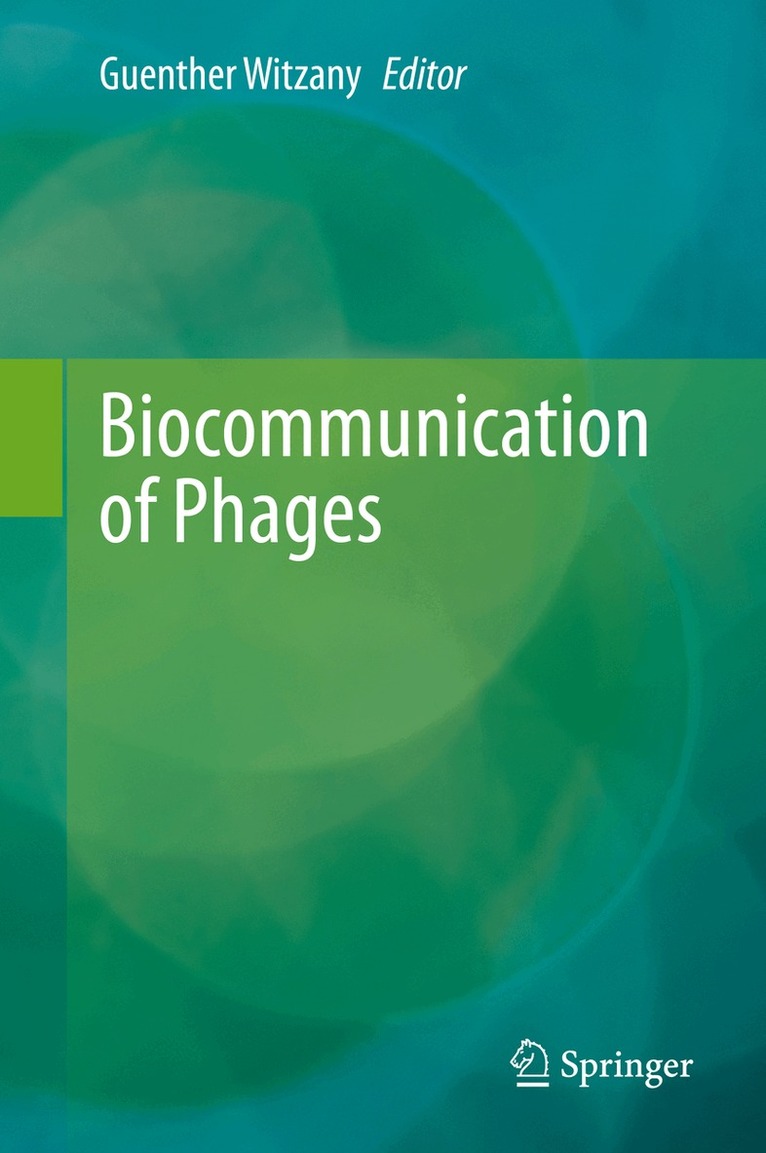
    Biocommunication of Phages

    AvGuenther Witzany

    Inbunden, Engelska, 2020

    2 008 kr

    Beställningsvara. Skickas inom 10-15 vardagar. Fri frakt över 249 kr.

    Beskrivning

    This is the first book to systemize all levels of communicative behavior of phages. Phages represent the most diverse inhabitants on this planet. Until today they are completely underestimated in their number, skills and competences and still remain the dark matter of biology. Phages have serious effects on global energy and nutrient cycles. Phages actively compete for host. They can distinguish between ‘self’ and ‘non-self’ (complement same, preclude others). They process and evaluate available information and then modify their behaviour accordingly. These diverse competences show us that this capacity to evaluate information is possible owing to communication processes within phages (intra-organismic), between the same, related and different phage species (interorganismic), and between phages and non-phage organisms (transorganismic). This is crucial in coordinating infection strategies (lytic vs. lysogenic) and recombination in phage genomes.In 22 chapters, expert contributors review current research into the varying forms of phage biocommunication and Phagetherapy. Biocommunication of Phages aims to assess the current state of research, to orient further investigations on how phages communicate with each other to coordinate their behavioral patterns, and to inspire further investigation of the role of non-phage viruses (non-lytic, non-prokaryotic) in these highly dynamic interactional networks.

    Produktinformation

    • Utgivningsdatum:2020-06-30
    • Mått:155 x 235 x undefined mm
    • Format:Inbunden
    • Språk:Engelska
    • Antal sidor:502
    • Förlag:Springer Nature Switzerland AG
    • ISBN:9783030458843

    Utforska kategorier

    • Patologi inom Medicin
    • Cellbiologi inom Naturvetenskap och teknik
    • Biologi inom Naturvetenskap och teknik

    Mer om författaren

    Guenther Witzany is philosopher and developed a new philosophy of biology based on the current empirical data in all domains of cellular life, virology and RNA-biology. In a series of books he applied his theory of biocommunication to all organismic kingdoms. Theory of biocommunication is the first and only theory that integrates all living agents empiristically in a non-reductionistic and non-mechanistic way and opens a ground breaking understanding of life through analyses of sign-mediated interactions within and between cells, tissues, organs, and organisms.

    Innehållsförteckning

    • Chapter 1. What Does Communication of Phages Mean?.- Chapter 2. Phage-Phage, Phage-Bacteria, and Phage-Environment Communication.- Chapter 3. Phage communication and the ecological implications on microbial interactions, diversity, and function.- Chapter 4. Phage-Phage Interactions.- Chapter 5. Social interactions among bacteriophages.- Chapter 6. Phage protein interactions in the inhibition mechanism of bacterial cell.- Chapter 7. Are phages parasites or symbionts of bacteria?.- Chapter 8. Microbial communication networks: sketching a methodology to analyze communication involving bacteriophages inside environmental communities.- Chapter 9. Information stored in a phage particle: Lactobacillus delbrueckii bacteriophage LL-H as a case.- Chapter 10. Archaeal viruses and their interactions with CRISPR-Cas systems.- Chapter 11. Filamentous phages affect virulence of the phytopathogen Ralstonia solanacearum.- Chapter 12. Intra-population interactions and the evolution of RNA phages.- Chapter 13. ssRNA phages: life cycle, structure and applications.- Chapter 14. Phages as therapy or "dietary supplements"against multiresistant bacteria?.- Chapter 15. Bacteriophage application and biological safety (or how should I train my dog not to bite me).- Chapter 16. Phage therapy: an alternative to antibiotics.- Chapter 17. Bacteriophage as a therapeutic agent to combat bacterial infection: A journey from history to application.- Chapter 18. Phagetherapy: Clinical applications – Critical appraisal of randomized controlled trials.- Chapter 19. Bacteriophage therapies targets multiple diseases caused by protein misfolding.- Chapter 20.- Phage Therapy in Cystic Fibrosis. Challenges and Perspectives.- Chapter 21. Bacteriophage Applications for Food Safety.- Chapter 22. Bacteriophages for environmental applications: Effect of trans-organismic communication on wastewater treatments