• Fri frakt över 249 kr
  • •
  • Snabba leveranser
  • •
  • Billiga böcker
Kundservice

Du är på sajten för privatpersoner.

Företag, bibliotek eller offentlig verksamhet?

Du handlar på classic.bokus.com, där alla dina funktioner finns intakta.
Till classic.bokus.com
Bokus logotyp. Gå till startsidan.
  • Erbjudanden
  • Student
  • Topplistor
  • Barn & ungdom
  • Bokus Play
  • E-böcker
  • Ljudböcker
  • Pocketböcker
  • Spel och pussel

5% studentrabatt – använd koden KURSBOK27 →

Sidfot

Mina sidor

    Hjälp

    • Kundservice
    • Vanliga frågor och svar
    • Frakt och leverans
    • Retur vid ångerrätt
    • Reklamera vara
    • Betalning
    • Köpvillkor
    • Allmänna villkor
    • Information om webbplatsens tillgänglighet

    Om Bokus

    • Om oss
    • Pressrum
    • För studenter
    • För företag
    • För bibliotek och offentlig verksamhet
    • För leverantörer
    • Hållbarhet

    Populärt

    • Aktuella erbjudanden
    • Presentkort
    • Studentlitteratur
    • Nya böcker
    • Topplistor
    • Signerade böcker
    • Engelska böcker

    Inspiration

    • Boktips
    • BookTok
    • Barnbokskaraktärer
    • Populära författare
    Logotyp för Bokus
    Följ oss på Facebook (extern länk)Följ oss på Instagram (extern länk)Följ oss på YouTube (extern länk)Följ oss på TikTok (extern länk)
    bokus @ CookiesAnpassa cookiesIntegritetspolicyKöpvillkor
    Till Citymail hemsida (extern länk)Till Budbee hemsida (extern länk)Till Postnord hemsida (extern länk)Till Schenker hemsida (extern länk)Till Early Bird hemsida (extern länk)Till Walleys hemsida (extern länk)
    1. Samhälle och politik
    2. Politik och statsskick
    3. Statsvetenskap och politisk teori

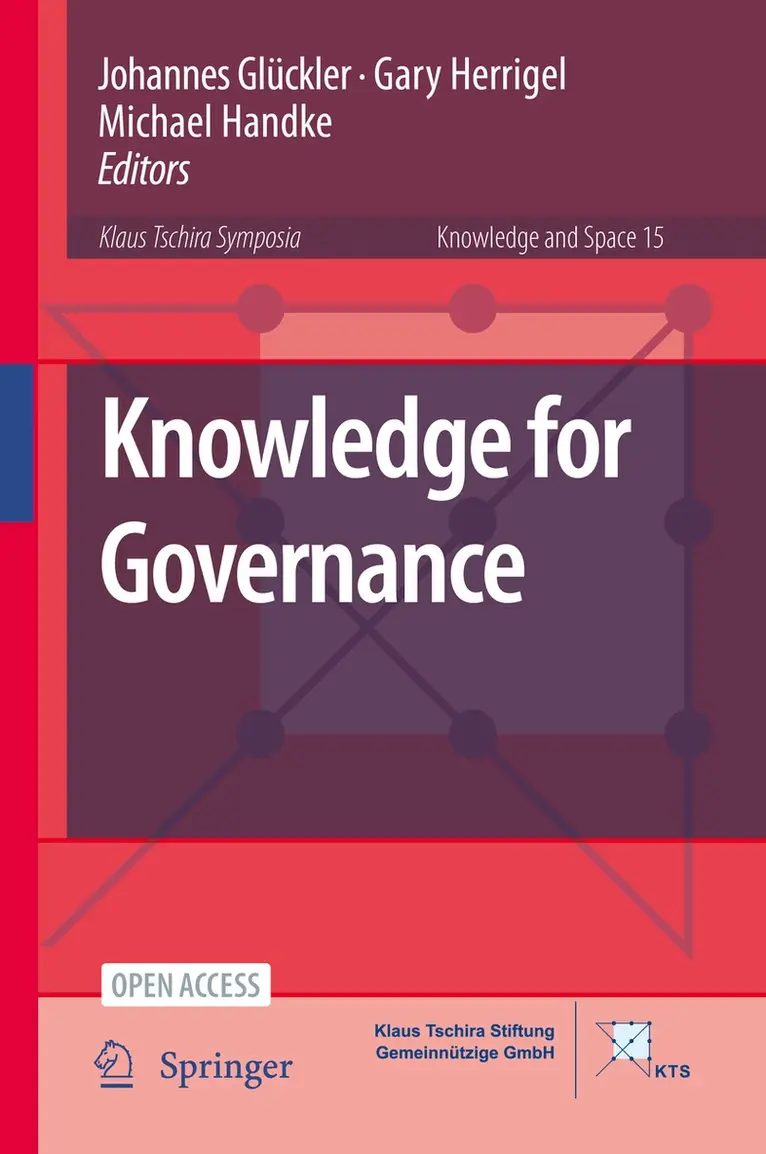
    Knowledge for Governance

    AvJohannes Glückler,Gary Herrigel

    Inbunden, Engelska, 2021

    Del i serien Knowledge and Space

    543 kr

    Beställningsvara. Skickas inom 10-15 vardagar. Fri frakt över 249 kr.

    Beskrivning

    This open access book focuses on theoretical and empirical intersections between governance, knowledge and space from an interdisciplinary perspective. The contributions elucidate how knowledge is a prerequisite as well as a driver of governance efficacy, and conversely, how governance affects the creation and use of knowledge and innovation in geographical context. Scholars from the fields of anthropology, economics, geography, public administration, political science, sociology, and organization studies provide original theoretical discussions along these interdependencies. Moreover, a variety of empirical chapters on governance issues, ranging from regional and national to global scales and covering case studies in Australia, Europe, Latina America, North America and South Africa demonstrate that geography and space are not only important contexts for governance that affect the contingent outcomes of governance blueprints. Governance also creates spaces. It affects the geographicalconfines as well as the quality of opportunities and constraints that actors enjoy to establish legitimate and sustainable ways of social and environmental co-existence.

    Produktinformation

    • Utgivningsdatum:2021-01-15
    • Mått:155 x 235 x 31 mm
    • Vikt:918 g
    • Format:Inbunden
    • Språk:Engelska
    • Serie:Knowledge and Space
    • Antal sidor:469
    • Förlag:Springer Nature Switzerland AG
    • ISBN:9783030471491

    Utforska kategorier

    • Statsvetenskap och politisk teori inom Samhälle och politik
    • Geografi inom Naturvetenskap och teknik

    Mer om författaren

    Johannes Glückler is Professor of Economic and Social Geography and Fellow of the Marsilius Center for Advanced Studies at Heidelberg University, Germany. His research follows a relational perspective and builds on theories of organization, networks, and institutions in the study of the geography of knowledge and regional development. He is founding board member of the German Society for Social Network Research DGNet and co-founder of the M.Sc. Governance of Risks and Resources at the Heidelberg Center for Latin America in Santiago de Chile.Gary Herrigel is the Paul Klapper Professor in the College and the Division of Social Sciences at the University of Chicago, USA. He is the author of three books, many articles and a number of edited collections and journal special issues on corporate governance, manufacturing competitiveness, industrial relations, business history, economic geography and comparative political economy.Michael Handke is a research fellow at Heidelberg University, Germany and head of the M.Sc. Governance of Risk and Resources at the Heidelberg Center for Latin America in Santiago de Chile. His research interests include economic geography, risk research, financial geography, and development research. His empirical work focuses on the management of risks in economic relationships, with a particular interest in the dealing with risks under conditions of limited risk knowledge from a spatial perspective.

    Innehållsförteckning

    • Chapter 1. On the Reflexive Relations Between Knowledge, Governance, and Space.- Part I: How Knowledge Enables Governance.- Chapter 2. Lessons from Rapa Nui (Easter Island, Chile) for Governance in Conditions of Environmental Uncertainty.- Chapter 3. Knowledge of Governance as Knowledge for Governance: Spatialized Techniques of Neutralization.- Chapter 4. The Atmosphere of Democracy: Knowledge and Political Action.- Chapter 5. Risk Governance: From Knowledge to Regulatory Action.- Chapter 6. Knowledge and Governance: Can Systemic Risk in Financial Markets be Managed? The Case of the Euro Crisis.- Part II: How Knowledge Drives the Effectiveness of Governance.- Chapter 7. Explaining Subnational Governance: The Role of Governors’ Codified and Uncodified Knowledge.- Chapter 8. The (De-)Contextualization of Geographical Knowledge in Forest-Fire Risk Management in Chile as a Challenge for Governance.- Chapter 9. Carbon Markets, Values, and Modes of Governance.- Chapter 10. The Fight Against Corruption in Brazil: A Case of Good Governance?.- Chapter 11. Lateral Network Governance.- Part III: How Governance Affects Learning and Innovation.- Chapter 12. Knowledge and the Deliberative Stance in Democratic Systems: Harnessing Scepticism of the Self in Governing Global Environmental Change.- Chapter 13. Nurturing Adaptive Governance Through Environmental Monitoring: People, Practices, Politics in the Kruger to Canyons Biosphere Region, South Africa.- Chapter 14. Ex Ante Knowledge for Infectious Disease Outbreaks: Introducing the Organizational Network Governance Approach.- Chapter 15. Collective Learning and Institutional Collective Action in Fragmented Governance.- Chapter 16. The Remapping of Forest Governance: From Shareholder to Stakeholder.- Chapter 17. The Governance of Global Innovation Systems: Putting Knowledge in Context.- Chapter 18. Experimentalist Systems in Manufacturing Multinationals: Recursivity and Continuous Learning Through Destabilization.- Chapterv19. Networks as Facilitators of Innovation in Technology-Based Industries: The Case of Flat Glass.