• Fri frakt över 249 kr
  • •
  • Snabba leveranser
  • •
  • Billiga böcker
Kundservice

Du är på sajten för privatpersoner.

Företag, bibliotek eller offentlig verksamhet?

Du handlar på classic.bokus.com, där alla dina funktioner finns intakta.
Till classic.bokus.com
Bokus logotyp. Gå till startsidan.
  • Erbjudanden
  • Nyheter
  • Student
  • Topplistor
  • Barn & ungdom
  • Bokus Play
  • E-böcker
  • Pocketböcker
  • Spel & pussel

10% rabatt på allt med kod: NYSTART10 →

Sidfot

Mina sidor

    Hjälp

    • Kundservice
    • Vanliga frågor och svar
    • Frakt och leverans
    • Retur vid ångerrätt
    • Reklamera vara
    • Betalning
    • Köpvillkor
    • Allmänna villkor
    • Information om webbplatsens tillgänglighet

    Om Bokus

    • Om oss
    • Pressrum
    • För studenter
    • För företag
    • För bibliotek och offentlig verksamhet
    • För leverantörer
    • Hållbarhet

    Populärt

    • Aktuella erbjudanden
    • Presentkort
    • Studentlitteratur
    • Nya böcker
    • Topplistor
    • Signerade böcker
    • Engelska böcker

    Inspiration

    • Boktips
    • BookTok
    • Populära bokserier
    • Barnbokskaraktärer
    • Populära författare
    Logotyp för Bokus
    Följ oss på Facebook (extern länk)Följ oss på Instagram (extern länk)Följ oss på YouTube (extern länk)Följ oss på TikTok (extern länk)
    bokus @ CookiesAnpassa cookiesIntegritetspolicyKöpvillkor
    Till Citymail hemsida (extern länk)Till Budbee hemsida (extern länk)Till Postnord hemsida (extern länk)Till Schenker hemsida (extern länk)Till Early Bird hemsida (extern länk)Till Walleys hemsida (extern länk)
    1. Ekonomi och Ledarskap
    2. Nationalekonomi

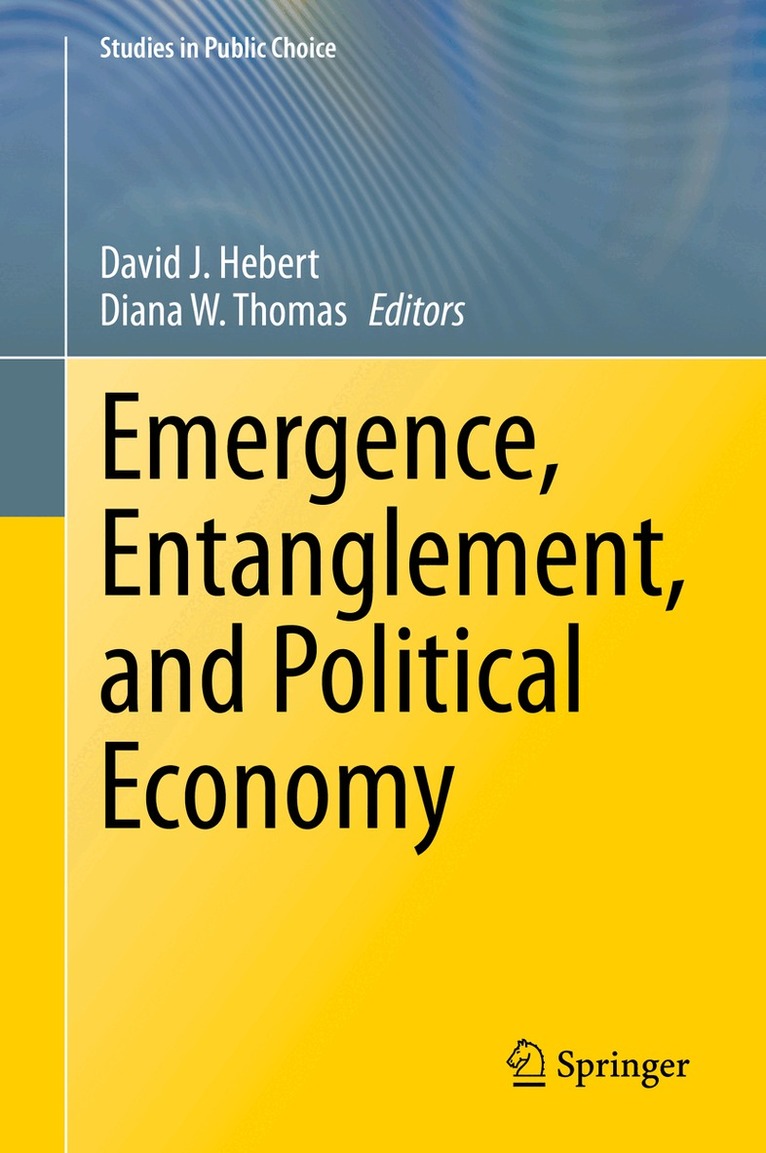
    Emergence, Entanglement, and Political Economy

    AvDavid J. Hebert,Diana W. Thomas

    Inbunden, Engelska, 2020

    Del 38 i serien Studies in Public Choice

    1 302 kr

    Beställningsvara. Skickas inom 10-15 vardagar. Fri frakt över 249 kr.

    Beskrivning

    This volume is intended to serve as a review of the “next generation” of political economy scholars in what can be called the “Wagnerian” tradition, which traces its roots to Buchanan and De Viti De Marco in the 1930s, who argued that any decision that results from a political entity must be the product of individual decision makers operating within some framework of formal and informal rules. To treat these decisions as if they were the product of one single mind, or even simply the additive result of several decisions, is to fundamentally misunderstand and mischaracterize the dynamics of collective action.  Today, Richard Wagner is among the most prominent theorists in analyzing the institutional foundations of the economy and the organization of political decision-making. In this collection of original essays, former students schooled in this tradition offer emerging insights on public choice theory, public finance, and political economy, across a range of topics fromvoting behavior to entrepreneurship.

    Produktinformation

    • Utgivningsdatum:2020-12-05
    • Mått:155 x 235 x 18 mm
    • Vikt:382 g
    • Format:Inbunden
    • Språk:Engelska
    • Serie:Studies in Public Choice
    • Antal sidor:140
    • Förlag:Springer Nature Switzerland AG
    • ISBN:9783030560874

    Utforska kategorier

    • Nationalekonomi inom Ekonomi och Ledarskap
    • Finansiering inom Ekonomi och Ledarskap
    • Miljöekonomi inom Ekonomi och Ledarskap

    Mer om författaren

    David Hebert is an Assistant Professor of Economics and the department chair at Aquinas College. He holds a B.S. in Economics and Mathematics from Hillsdale College and an M.A. and Ph.D. in Economics from George Mason University. During graduate school, he was an F.A. Hayek Fellow with the Mercatus Center and a Fellow with the Department of Health Administration and Policy and also worked with the Joint Economic Committee in the U.S. Congress. Previously, he served as an Assistant Professor at Ferris State University in Big Rapids, MI and Troy University in Troy, AL, and was also a Fellow with the U.S. Senate Budget Committee, where he authored a comprehensive report on Federal budget process reform.His area of expertise lies in public choice and public finance. Specifically, his research aims to address the question of why democracies around the world and throughout history systematically produce tax codes that are long, complicated, and contain numerous loopholes despite universal popular support for tax codes that are short, simple, and contain few (if any) loopholes. His work has appeared in numerous academic publications as well as popular outlets such as The Hill, The Daily Caller, The Ripon Forum, and Investor's Business Daily. Diana Thomas is an Associate Professor of Economics and Director of the Institute for Economic Inquiry at the Heider College of Business at Creighton University.  Previously, she served as an Assistant Professor at Utah State University. A German native, she earned her Diploma in Business Administration from Fachhochschule Aachen and her B.S. in Finance from George Mason University. After gaining some experience as a junior portfolio manager at a mutual fund management company in Frankfurt, Germany, Dr. Thomas returned to George Mason University to complete her M.A. and Ph.D. in Economics. In her research, Dr. Thomas explores the unintended consequences of regulation and the role political entrepreneurs play in changing the rules that govern society. She has published in a number of academic outlets, including Public Choice, Kyklos, Applied Economics, the Southern Economic Journal, and the Journal of Banking and Finance.

    Innehållsförteckning

    • Chapter 1: Introduction.- Chapter 2: Emergence and Entanglement in a Theory of Political Economy.- Chapter 3: Swimming in a Tuxedo: A Systems Theory Approach to Understanding Politics.- Chapter 4: Complex and Entangled Public Policy: Here Be Dragons.- Chapter 5: Taxonomy of Entrepreneurship: A Means-Oriented Approach.- Chapter 6: From Taciturn to Talkative Political Economy.- Chapter 7: Entanglement and Perverse Spontaneous Orders.- Chapter 8: The Tax Code as an Emergent Phenomenon.- Chapter 9: Political Property Rights and Entangled Political Economy.- Chapter 10: The Fiscal Squeeze: Budgets between Fiscal Illusion, Fiscal Commons, and the Tyranny of Experts.- Index.